
One of These Nights (1975): The Eagles’ Turning Point Album
Released in June 1975 on Asylum Records, the eagles one of these nights album arrived at a moment when the band was moving beyond their country-rock roots and defining the polished California sound that would soon make them one of the biggest acts in the world.
Arriving a year before Hotel California, this landmark album one of these nights became their first No.1 on the US Billboard 200 and confirmed a group reaching full confidence in the studio. Produced by Bill Szymczyk, it brought together tighter songwriting, darker subject matter, and a growing sense of ambition.
Listening from England, it felt like another dispatch from a distant America. Stories of Hollywood, the Sunset Strip, and nocturnal Los Angeles seemed far removed from overcast skies at home, yet the record’s success made those places feel strangely familiar.
Artist: Eagles
Album: One of These Nights
Released: June 1975
Producer: Bill Szymczyk
Studios: Criteria Studios (Miami), Record Plant (Los Angeles)
Label: Asylum Records
Key Songs and Cultural Impact
The album opens with its title track, a moody, slow-burn groove built on Don Felder’s distinctive chord progression. Sung by Don Henley and co-written with Glenn Frey, it captures the dark glamour of mid-70s Los Angeles — desire, danger, and a sense of restless nights that might lead anywhere.
Searchers still ask “who sang One of These Nights?” and “what does it mean?” At its heart it’s a song about chasing passion and release in the neon-lit California night. It remains one of their defining singles, still racking up millions of streams.
The Songs That Shaped One of These Nights
One of These Nights
Written by Don Henley and Glenn Frey, the title track of the one of these nights album captures the dark glamour of mid-Seventies Los Angeles—desire, danger, and a restless sense of nocturnal tension. Built on Don Felder’s distinctive chord progression and driven by Henley’s soaring lead vocal, the song explores the pursuit of passion and escape in the neon-lit California night. Henley described it as a song about an elusive object of desire, "part angel, part devil," while Frey often pointed to the simple procrastination of everyday ambition: promising yourself you will finally chase what you want "one of these nights." With its lush harmonies and brooding groove, it remains one of their defining singles and a masterclass in atmospheric songwriting.Lyin’ Eyes
Perhaps the most enduring song on the album, Lyin’ Eyes tells the story of a young woman who trades freedom for security, only to slip back to the Strip at night in search of escape. Don Henley later linked the song to evenings spent observing the quiet dramas unfolding at Dan Tana’s, just along the street from The Troubadour, where the band watched relationships play out across candlelit tables. That sense of lived-in detail gives the song its credibility, with rich harmonies carrying a narrative that feels grounded rather than theatrical.
Lyin’ Eyes As one of the standout tracks on the one of these nights album, "Lyin’ Eyes" is perhaps the most enduring song in the Eagles' catalogue. It tells the story of a young woman who trades freedom for security, only to slip back to the Sunset Strip at night in search of escape. Don Henley later linked the song to evenings spent observing quiet dramas at Dan Tana’s, just along the street from The Troubadour, where the band watched relationships play out across candlelit tables. That lived-in detail grounds this essential album track with a narrative credibility that elevates it far beyond standard pop storytelling.
Take It to the Limit Serving as a major vocal showcase for bassist Randy Meisner on the one of these nights album, this sweeping ballad quickly became a live concert highlight and one of the Eagles' signature songs. Its yearning for “one more night” of love or freedom captures the soaring ambition of the record, standing as one of the group's most polished studio achievements during their mid-Seventies peak.
journey of the Sorcerer As a banjo-led instrumental, Bernie Leadon’s composition stands distinctly apart from the rest of the one of these nights album. While the wider record signalled the Eagles’ shift toward a tougher, more refined rock sound, this track pulls from their earlier country-rock roots, recalling the looser production style of On the Border. In hindsight, it marks the definitive end of an era for the band. Beyond its role on the album, it holds a special place for British listeners as the iconic theme music for Douglas Adams’ The Hitchhiker’s Guide to the Galaxy on BBC Radio, transforming what once felt out of step into an enduring cult favourite.
I Wish You Peace ends out the album. This gentle acoustic ballad was written by Bernie Leadon alongside his then-girlfriend Patti Davis, daughter of Ronald Reagan. Often overlooked in retrospective reviews, its wistful lyrics and stripped-back arrangement reveal a softer side of the Eagles. With Leadon departing shortly after release, the track functions as an intimate parting gift within the broader arc of the album.
One of These Nights Meaning
The meaning of One of These Nights is two fold. On the surface there is an alluring feeling of attraction. Don Henley suggests there is an object of desire, "part angel and part devil," which captures the tension between attraction, danger, and complexity in a relationship. Co-writer Glenn Frey offers another meaning, “one of these nights” as that feeling of putting something off. “One of these nights I’m gonna do that thing ; one of these nights I am gonna get that girl.”
There is a potential third meaning, almost an in-joke with the band. The recording sessions were long and sometimes arduous as the band sought perfection, “one of these nights we’re gonna finish this record!”
Release and Commercial Impact
One of These Nights was both a critical and commercial success. It sold over four million copies in the US and was nominated for Album of the Year at the 1976 Grammys (losing to Paul Simon’s Still Crazy After All These Years). The single Lyin’ Eyes did win a Grammy for Best Pop Vocal Performance by a Duo, Group or Chorus.
The album’s consistency stood out. Where Desperado and On the Border felt patchy, this was a cohesive, confident work — a band finally arriving at their classic sound.
Album Artwork and Visual Identity
After the Western imagery of Desperado and the looser symbolism of On the Border, One of These Nights established the eagle as the defining visual emblem of the band.
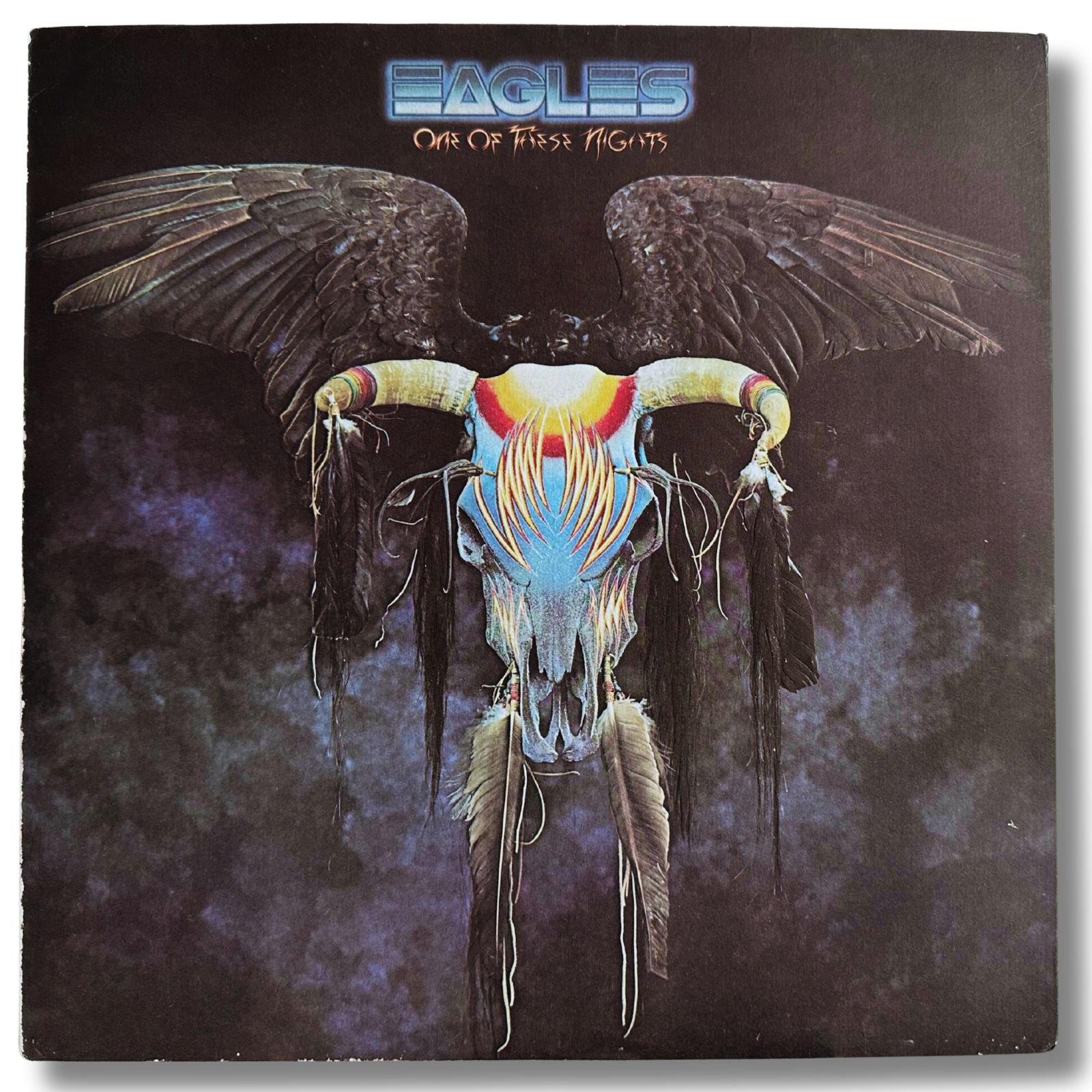
One of These Nights album cover, designed by Boyd Elder, released in 1975
As The Eagles album with the skull on the cover One of These Nights has become one of the Eagles’ most recognisable images. It presents a stylised eagle skull set against a dark, cosmic backdrop, stark and confrontational in tone, and very different from the imagery that had come before.
Designed by Boyd Elder, an artist whose work with painted animal skulls had already begun to attract attention in the American Southwest. His imagery fixed the eagle as a permanent part of the band’s visual identity, one that is still reflected in how the Eagles present themselves today.
One of These Nights marks the point where the Eagles’ direction became clear. Its controlled production, narrative songwriting, and visual identity set the framework for what would follow on Hotel California.
Nearly fifty years later, the album still stands as a precise record of a band arriving at full definition.