
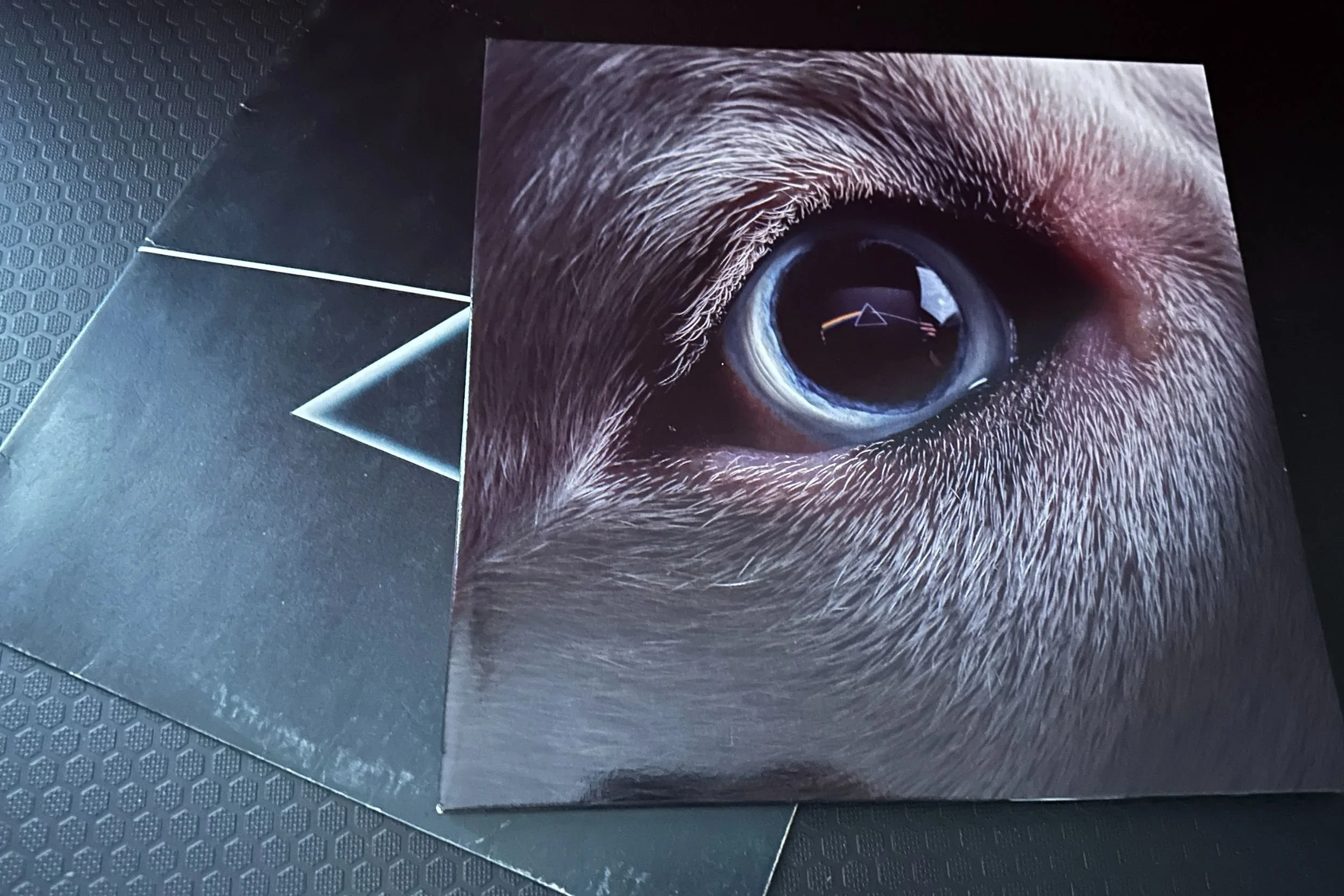
Dark Side of the Moon Redux - Roger Revisits a classic album
Roger Waters returns to the world of Dark Side with a 2023 reimagining that feels closer, quieter and more personal than expected. The familiar themes are still here, but the Redux album shifts the focus towards age, memory and the stories behind the music. It is not a replica of the original. It is a companion piece that rewards a patient listen.
Roger Waters returns to his most famous work with a 2023 reimagining that trades wizardry for intimacy and perspective. Dark Side of the Moon Redux is not an attempt to remake a classic but a, more contemplative companion to an album that has shaped generations.
When Roger Waters announced The Dark Side of the Moon Redux, I was not sure what to expect. The original album has been with me my entire life. It is a landmark that never felt in need of a revival or reworking. Yet within a few minutes of hearing the opening of Speak to Me, I realised this project sits somewhere else entirely. It is still recognisably Dark Side, but reshaped through the eyes of a seventy-nine-year-old man looking back at the twenty-nine-year-old who helped create it.
Waters has spoken clearly about why he chose to revisit this music. During the stripped-back Lockdown Sessions, he noticed the fiftieth anniversary of the original album approaching and wondered if it could be an opportunity to honour the record while revisiting its emotional and political shadows. After discussing the idea with Gus Seyffert and Sean Evans, he decided to take it on. He has described Redux not as a replacement but as a way of paying respect to something irreplaceable while adding the perspective of age, loss and experience.
This is not a recreation of the classic album. There is no attempt to mirror the opening clocks of Time or the groove of Money. There is no attempt to echo David Gilmour’s guitar lines, or Clare Torry’s astonishing performance on The Great Gig in the Sky. Instead, Waters lets the familiar themes drift in and out while he speaks, whispers or half-sings the lyrics. At times he steps aside completely and talks about memory, loss and old friends. At the start of Brain Damage, Waters even jokes, “Why don’t we re-record Dark Side of the Moon,” as if acknowledging the sheer madness of attempting such a project.
It is surprisingly intimate. With On the Run he talks over the track, sharing a story rather than filling the space with synthesisers. Time feels like a letter to his younger self. Money carries more weight when spoken than when sung. And on Brain Damage he gently mocks the idea of re-recording the entire album, joking that he must have gone mad to attempt it.
The question I had going in was simple. How is he going to approach The Great Gig in the Sky without a vocalist trying to emulate Clare Torry. The answer is that he refuses to try. The melody plays on, carried by a Theremin, while Waters talks about his friend, the writer Donald Hall. It becomes a completely different moment, not a showcase of voice but a reflection on friendship, age and the inevitability of time.
As with his recent live shows, the arrangements here are reinterpretations rather than re-enactments. The character and the pulse of the original remain, but the delivery is quieter, more spoken, and more personal.
I keep returning to this version. Not because it replaces the original but because it sits beside it. Unlike the Animals Remix Redux is not an attempt to compete with its younger self, and it does not try to imitate the chemistry of a band that no longer exists. Instead it feels like a companion piece, a long reflection on themes that have only grown sharper with age.
The original album explored fear, madness, conflict and time. The Redux album looks at those same themes from a completely different vantage point. You can enjoy both for different reasons.
DSOM Redux Questions Answered
What is a Redux album?
A Redux is not a remaster or a remix. It is a full re-recording that revisits the original work from a new perspective. In film terms it is closer to a director returning to an old script with a lifetime of experience behind them. It does not aim to replace the original. It sits alongside it.
Who was Donald Hall?
Donald Hall was an American poet, essayist and former US Poet Laureate. He was a close friend of Roger Waters. Hall wrote frequently about memory, ageing and grief. His influence appears throughout Redux, particularly during The Great Gig in the Sky where Waters recalls him with warmth.
What is the meaning of “All roads lead to Zagreb”?
It is a line Hall used when referring to the unexpected paths life takes. The phrase suggests that, no matter how far we travel or how many diversions we take, certain moments or truths draw us back to themselves. Waters uses it to reflect on the way memory links the past and present, even when the journey feels scattered.
When was DSOM Redux recorded and where?
Recording took place during 2022 and early 2023 across Sargent Recorders, Mantis Studios, Strongroom, EastWest Studios in Los Angeles, and Fivestarstudios.
When was DSOM Redux released?
The album was released on 6 October 2023.
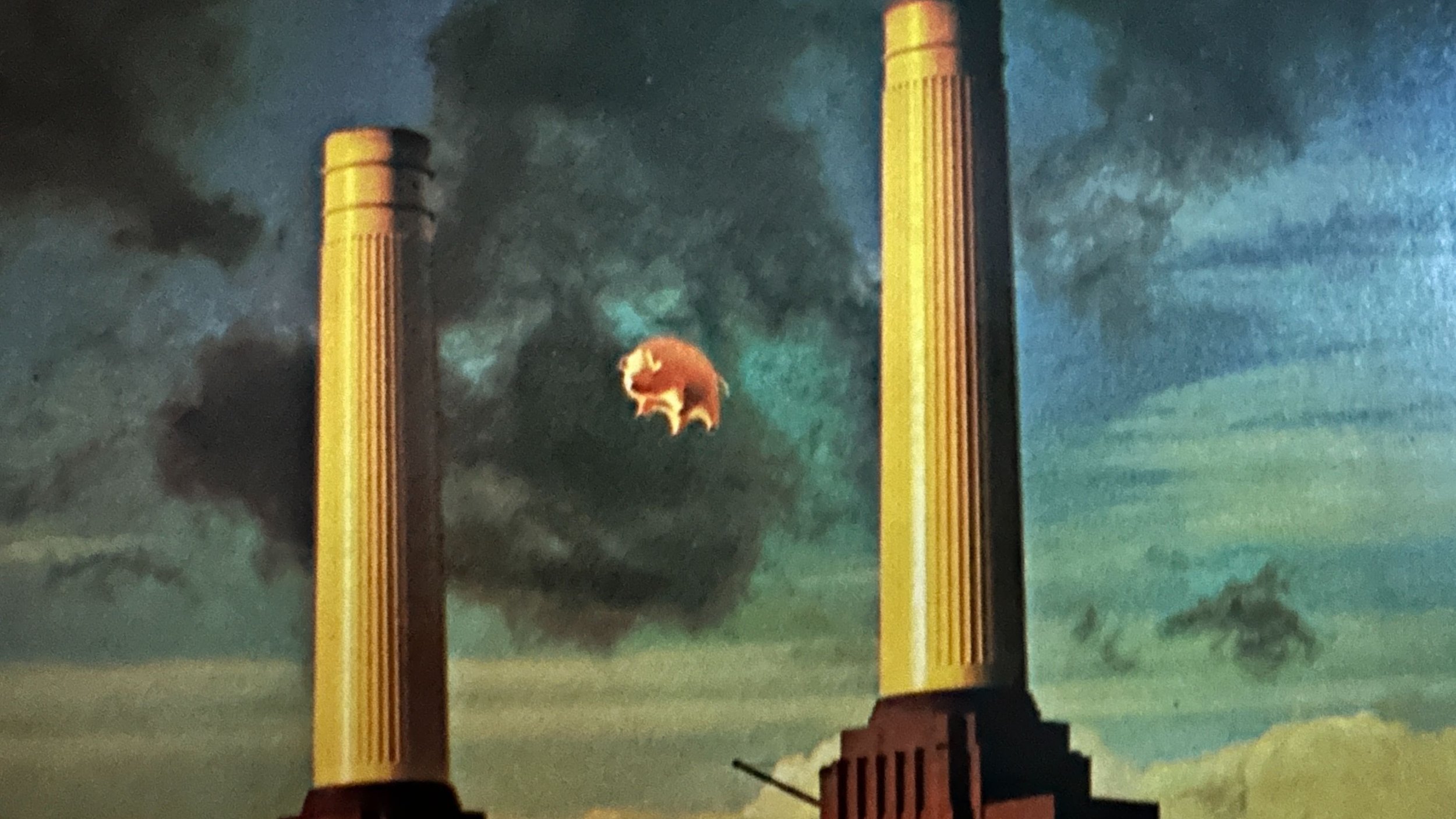
Pink Floyd’s Animals: Meaning, Music, and the 2018 Remix
Wedged between the massive success of Wish You Were Here and the global dominance of The Wall, Pink Floyd’s Animals remains one of the most fierce, direct, and socially pointed albums in their entire catalogue. The Vinyl Historian decodes the core meaning behind this 1977 classic, mapping its Orwellian themes, political satire, and the enduring legacy of its iconic industrial artwork.
An analysis of the album, its socio-political themes, and the history behind that unforgettable Battersea Power Station artwork.
Wedged between the massive success of Wish You Were Here and the global dominance of The Wall, Pink Floyd’s Animals can sometimes feel like the overlooked sibling. Yet this 1977 record remains one of the most direct, fierce and socially pointed albums in their catalogue. For listeners asking what Animals by Pink Floyd is about, the answer lies in its biting socio-political allegory. Drawing inspiration from George Orwell’s Animal Farm, the record recasts society into dogs, pigs and sheep through sprawling progressive rock arrangements. Driven by David Gilmour’s biting guitar work and Roger Waters' dystopian song structures, the result is a sharp look at ambition, manipulation and the danger of simply drifting with the crowd. While the record is often remembered for its striking visual presentation, the music establishes a powerful thematic foundation beside Wish You Were Here and foreshadows the darker, angrier writing that would take full form on The Wall and The Final Cut.
This was also a pivotal moment in the band’s own trajectory. Recorded at Britannia Row Studios in North London (one of London’s Lost Recording Studios), their newly built space gave them total control. The dreamy textures of Dark Side and the introspective warmth of Wish You Were Here were replaced by harder guitars, sharper lyrics and some of Nick Mason’s most powerful drumming.
What Is the Meaning of Animals by Pink Floyd?
To fully grasp the Pink Floyd Animals meaning, one must look at how the record divides society into three distinct groups. Rather than a simple collection of songs, the Animals album meaning functions as a harsh critique of modern capitalism, manipulation, and blind obedience. Each movement examines a specific slice of societal corruption in detail:
'Dogs': The Corporate Predators
These are the cutthroat operators of the world—people who climb through charm, calculation and self-interest until they eventually collapse under the weight of their own choices. The composition is long, bleak and brilliantly constructed. David Gilmour’s vocals and guitar work drive the piece, but it is the middle instrumental section that always stood out for me. Nick Mason’s kick drum becomes a steady, thumping heartbeat while distant canine effects echo around it. It creates a tense and unsettling atmosphere, exactly as intended.
“You gotta sleep on your toes, and when you’re on the street / You gotta be able to pick out the easy meat with your eyes closed” — Dogs
'Pigs': The Moral Hypocrites
Here are the figures who try to control, influence or moralise. Waters went after censors, politicians and the sanctimonious voices of the day, including Mary Whitehouse. Musically, this socio-political anger translates into classic mid-seventies rock aggression; Gilmour’s talkbox guitar gives the track an aggressive snarl, matching Waters’ frustration with those who preach one thing while doing another.
“Big man, pig man / Ha, ha, charade you are” — Pigs
'Sheep': The Blind Followers
If the first two movements represent active forces, Sheep focuses on the passive followers who drift along without question. It begins more gently, almost pastoral, before building into something far more forceful. The narrative turns from resignation to revolt as the sheep finally push back against those who have controlled them. It remains one of the most surprising transitions on the album.
“Only dimly aware of a certain unease in the air” — Sheep
Despite the heavy subject matter, the album is not depressing. It feels alive. Animals is muscular, intense and purposeful, carrying a conceptual weight that rewards deep, repeated listening.
Is Animals Still Relevant Today?
Completely. In many ways it feels even more current. The themes of manipulation, media influence and blind obedience remain familiar. The names have changed, the platforms have changed, but the underlying behaviours have not. Waters has continued to highlight this in his live shows. At Desert Trip in 2016, Pigs was performed against a giant caricature of Donald Trump. On the more recent This Is Not a Drill tour, the sheep were singled out for accepting the status quo before finally turning against their tormentors. The anger driving the album is not stuck in 1977.
Animals and Battersea Power Station
The album’s imagery is inseparable from its music and meaning. The concept for the cover was to fly an inflatable pig over Battersea Power Station. Roger Waters could see the power station from his home and thought the active, stark industrial backdrop perfectly suited the capitalist powerhouse themes of the record.
The shoot was booked, the airspace was closed, and the concert pig was launched. On the second day of shooting, it broke free of its chains and drifted toward Heathrow, causing genuine concern for air traffic and leaving the designers at Hipgnosis without the shot they wanted. That is why the final iconic artwork features a painted composite.
That image has since become one of the most recognisable in rock history. The connection between the power station and the album has never faded. For many music fans, including me, it remains a key London rock landmark. Today there is even a small plaque at the redeveloped Power Station complex commemorating the connection.
The 2018 Remix of Animals
The long-delayed 2018 remix was finally released in 2022, and it genuinely improves the listening experience of this classic album. The contrast between instruments is stronger, the overall sound is sharper and clearer, and you notice far more subtlety in Nick Mason’s incredible drumming. I often struggle to hear meaningful differences in modern remixes, but this version stands out. It sharpens the edges of the original without losing its atmosphere. To celebrate the release, the chimneys of Battersea Power Station were lit up one clear September evening, creating a visual echo of the album’s legacy.
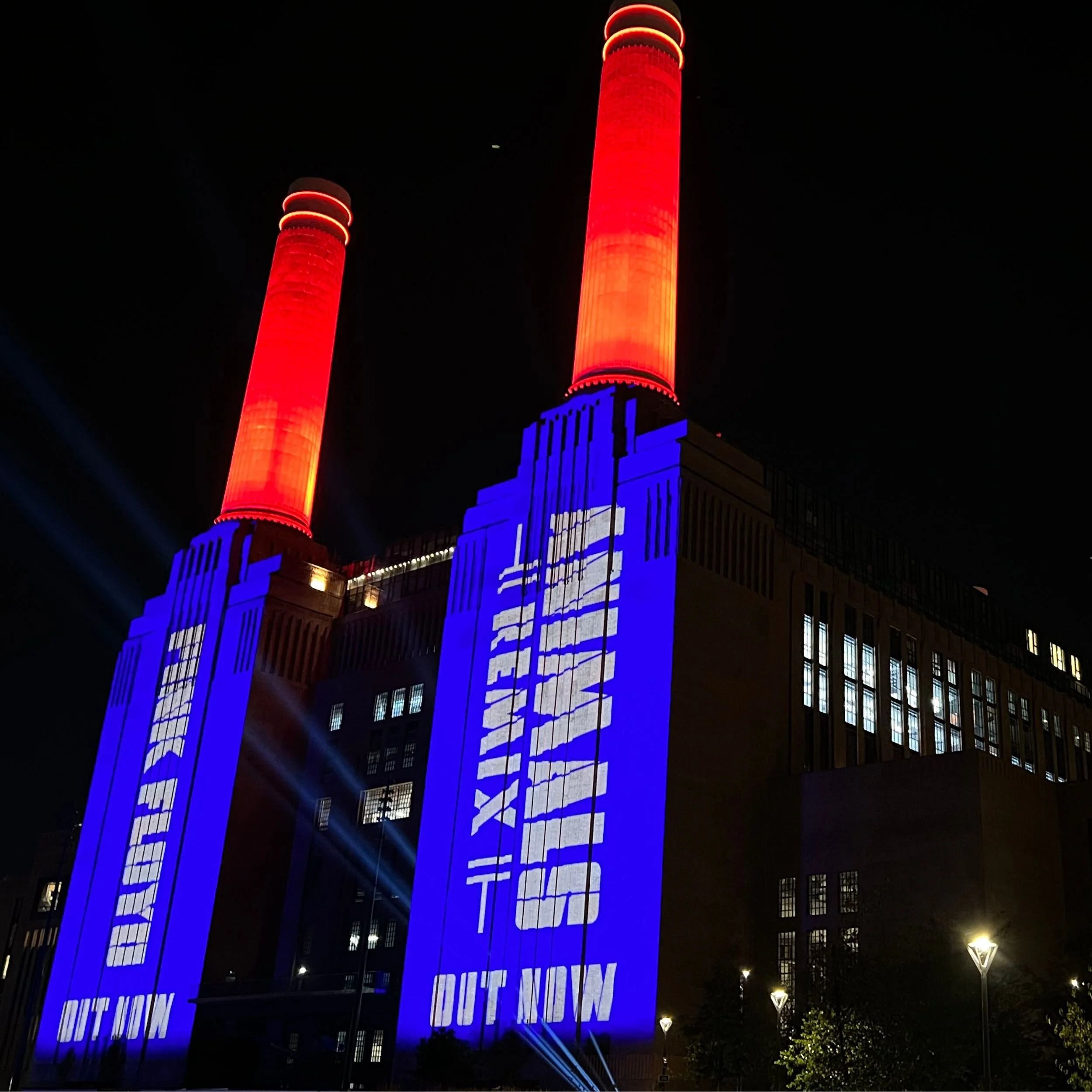
A close-up view of the iconic London landmark glowing in red and blue, celebrating the arrival of Pink Floyd’s Animals remix.

Battersea Power Station lit up against the London night sky, featuring the striking blue projections and illuminated red chimneys that marked the release of the long-awaited Animals remix.
Where Was the 2018 Animals Redux Cover Photo Taken?
We all recognise the original cover, with Battersea Power Station viewed from a distance beneath a heavy London sky. The remix introduces a new image, taken from a different angle, showing the building beneath a pile of cranes during its redevelopment. I set out to discover where it was photographed to capture my own version. It adds another layer to the ongoing story of an album deeply connected to one of London's most striking structures.
Forty-five years after its release, Pink Floyd's Animals still sounds as fresh, clear, and relevant as ever before. It is a vinyl record I return to regularly, finding inspiration from every track.
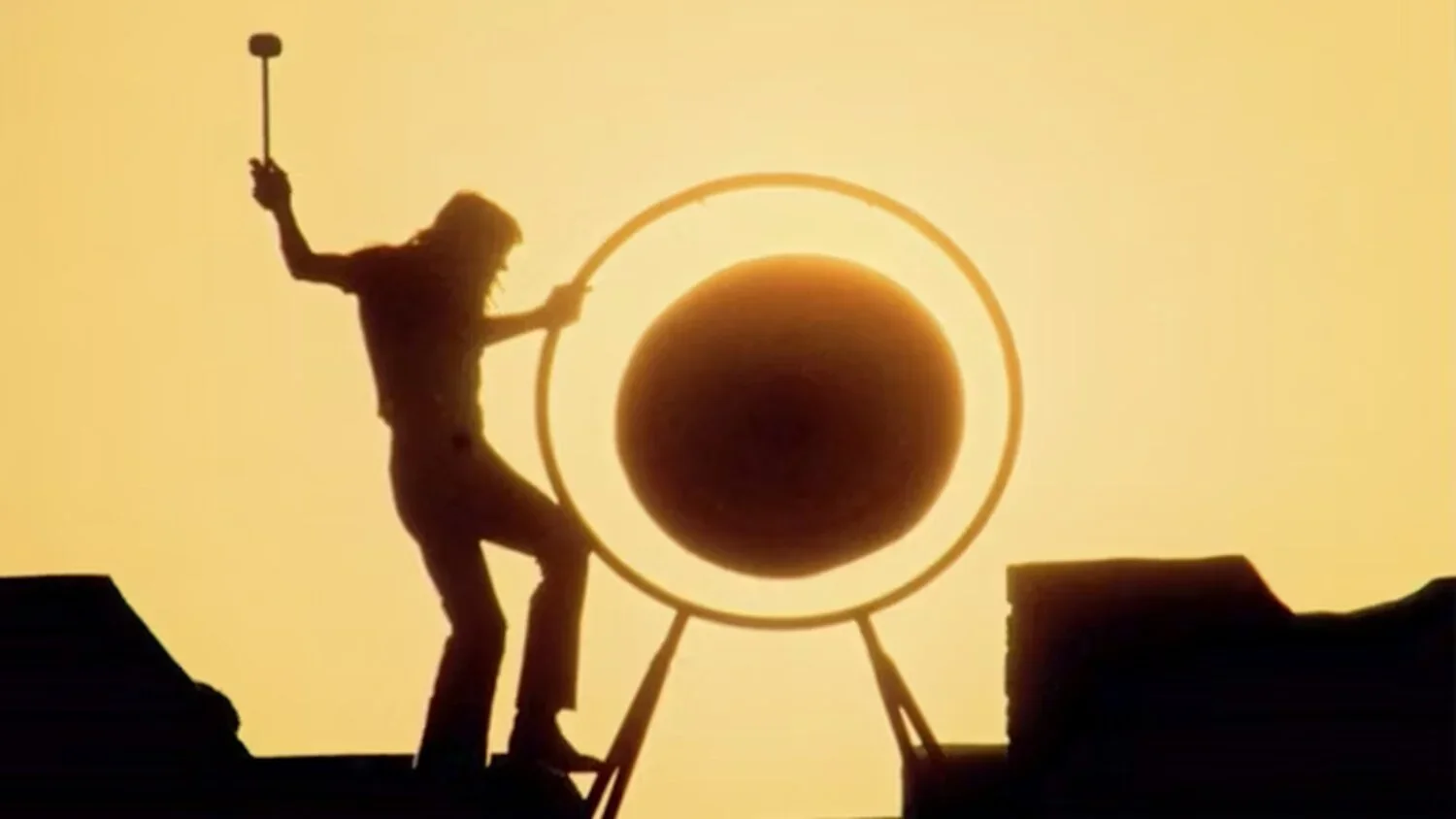
Pink Floyd at Pompeii MCMLXXII Review: 4K Film and Album
Pink Floyd at Pompeii MCMLXXII returned in 2025 as both a restored concert film and an official live album. Here is why this release gives one of Pink Floyd’s most mythic performances a stronger place in the catalogue.
Digitally restored and remixed in full 4K, the legendary Pink Floyd at Pompeii MCMLXXII returned in 2025 as both a restored concert film and, for the first time, an official live album on vinyl, CD and streaming. But does this new release offer anything beyond sharper visuals and improved sound, or does it finally give one of the most mythic performances in Pink Floyd history its proper place in the catalogue?
Pink Floyd Live at Pompeii 2025: Film Restoration and Album Release
When I first saw Live at Pompeii, it was on a tiny black-and-white portable television, grainy, tinny, and utterly mesmerising. I’ve since owned it on VHS and DVD, and watched it countless times in different versions. Yet it always felt more like a sonic artefact than a polished concert film. Sony Music Vision and Trafalgar Releasing have now given it the treatment it deserves, with a 4K restoration from the original 35mm negatives, a Dolby Atmos mix by Steven Wilson, and screenings from April 2025 in cinemas and IMAX, followed by digital downloads, streaming, and vinyl.
What also changes in 2025 is that Pink Floyd at Pompeii MCMLXXII no longer exists only as a film experience. It now stands as an album in its own right, with the performance officially issued as a standalone live release on vinyl, CD and streaming. For years, Live at Pompeii occupied an unusual place in the Pink Floyd story, part concert film, part visual document, part missing live album. The 2025 release finally gives these performances a clearer identity as an album, letting listeners hear Pompeii not just as a restored film, but as one of the key live statements from the band’s pre-Dark Side period.
Where Live at Pompeii Sits in Pink Floyd’s Album Timeline
Filmed in October 1971, Live at Pompeii slots neatly between the releases of Meddle and Obscured by Clouds, the latter recorded at Château d’Hérouville months later, and just before The Dark Side of the Moon in March 1973.
By the following spring, Pink Floyd would release The Dark Side of the Moon, the album that transformed them from psychedelic outsiders into global superstars. Just a few years later, Animals would take the band’s sound into darker, more politically charged territory. Seen in that context, Live at Pompeii now feels closer to an official bridge between Meddle and The Dark Side of the Moon, not just a film from the period, but a live album document of the band in transition.
Director Adrian Maben envisioned an anti-Woodstock, no audience, just the band echoing through ancient stones. The tracklist highlights what Floyd were comfortable performing live at that point: ‘Echoes’, ‘Careful with That Axe, Eugene’, ‘Set the Controls for the Heart of the Sun’, ‘A Saucerful of Secrets’, ‘One of These Days’, and ‘Mademoiselle Nobs’, a playful callback to Meddle. Atom Heart Mother was omitted not only because of the orchestration involved, but because, as Nick Mason later revealed, the band regarded it as something of a musical cul-de-sac. And Obscured by Clouds was not yet in the picture. Pink Floyd would record that album soon afterwards at Château d’Hérouville, the French residential studio also closely associated with Elton John’s Honky Château.
Pink Floyd at Pompeii – MCMLXXII — Echoes, Part 1
Is the 2025 4K Restoration and Album Release Worth It?
Visually, it is the same film, but now crisp, detailed, and vibrant. The restoration brings out textures in the ruins, the cables, the sweat, details that small-screen transfers never really captured. You get a clearer view of both the band and the various shirtless engineers working hard in the beating sun. The trippy snippets of the band walking past the geysers, which I still think may have helped inspire the look of the Stone Roses’ ‘Fools Gold’, feel even more striking in 4K.
Sonically, it is transformative. Steven Wilson, acclaimed musician, producer, and one of the great modern remix specialists, treats the material with real care, delivering a mix that is punchier, clearer, and more atmospheric. The bass hits harder. Gilmour’s guitar cuts sharper. Vocals and effects feel more immediate, and ‘Echoes’ now lands with a depth that older versions never quite managed.
In short, the restoration does not rewrite history. It presents it in the best possible light. For fans who have lived through VHS, DVD and older transfers, this is the version we have always wanted. For newcomers, it is not only a powerful gateway into Pink Floyd on film, but a convincing way to hear Pompeii as an album as well.
Pink Floyd at Pompeii MCMLXXII as an Album
Heard as an album, the 2025 release changes the weight of the material. These performances no longer feel like something borrowed from a film and filed under archive viewing. They feel like a missing chapter in Pink Floyd’s catalogue, capturing the band at the precise moment when the spacious experimentation of the early years was beginning to harden into something more focused and monumental.
That matters especially with ‘Echoes’, which has always been the centre of the film and now feels even more like the centrepiece of a proper live album. The same goes for ‘One of These Days’, which sounds leaner, nastier and more physical in this new mix. Heard away from the screen, the set has its own shape and momentum. For a band whose official live catalogue has always felt selective, Pink Floyd at Pompeii MCMLXXII now has a stronger claim to sit alongside the key releases rather than hovering at the edge of them.
Pink Floyd at Pompeii, and the Legacy of the Amphitheatre
While the film offers no new footage or bonus material, no studio documentary, no unseen takes, its legacy still speaks loudly. Live at Pompeii is to Pink Floyd what Berlin is to Bowie, a place that has transcended geography to become part of the story itself, much like Battersea Power Station.
That Pompeii legacy lives on. David Gilmour returned to the amphitheatre in July 2016 during his Rattle That Lock tour, the first public performances in the arena since AD 79. In July 2023, Nick Mason and his Saucerful of Secrets ensemble performed at Pompeii’s Grand Theatre. Floyd and Pompeii remain permanently linked, a landscape of sound that continues to hold its place in the band’s mythology.
Like fans of Bowie’s Berlin era, or U2’s Joshua Tree landscape, Floyd fans carry Pompeii with them.
Final Verdict on Pink Floyd at Pompeii MCMLXXII
No, there is nothing new in the footage itself, but that is precisely the point. This is Live at Pompeii distilled, the clearest, cleanest presentation of its atmosphere and artistry. It does not suddenly become a different film. It finally looks and sounds right.
And in 2025, it does something else as well. By emerging as a proper standalone audio release, Pink Floyd at Pompeii MCMLXXII now feels less like a revered side document and more like an album with a rightful place in the Pink Floyd canon.
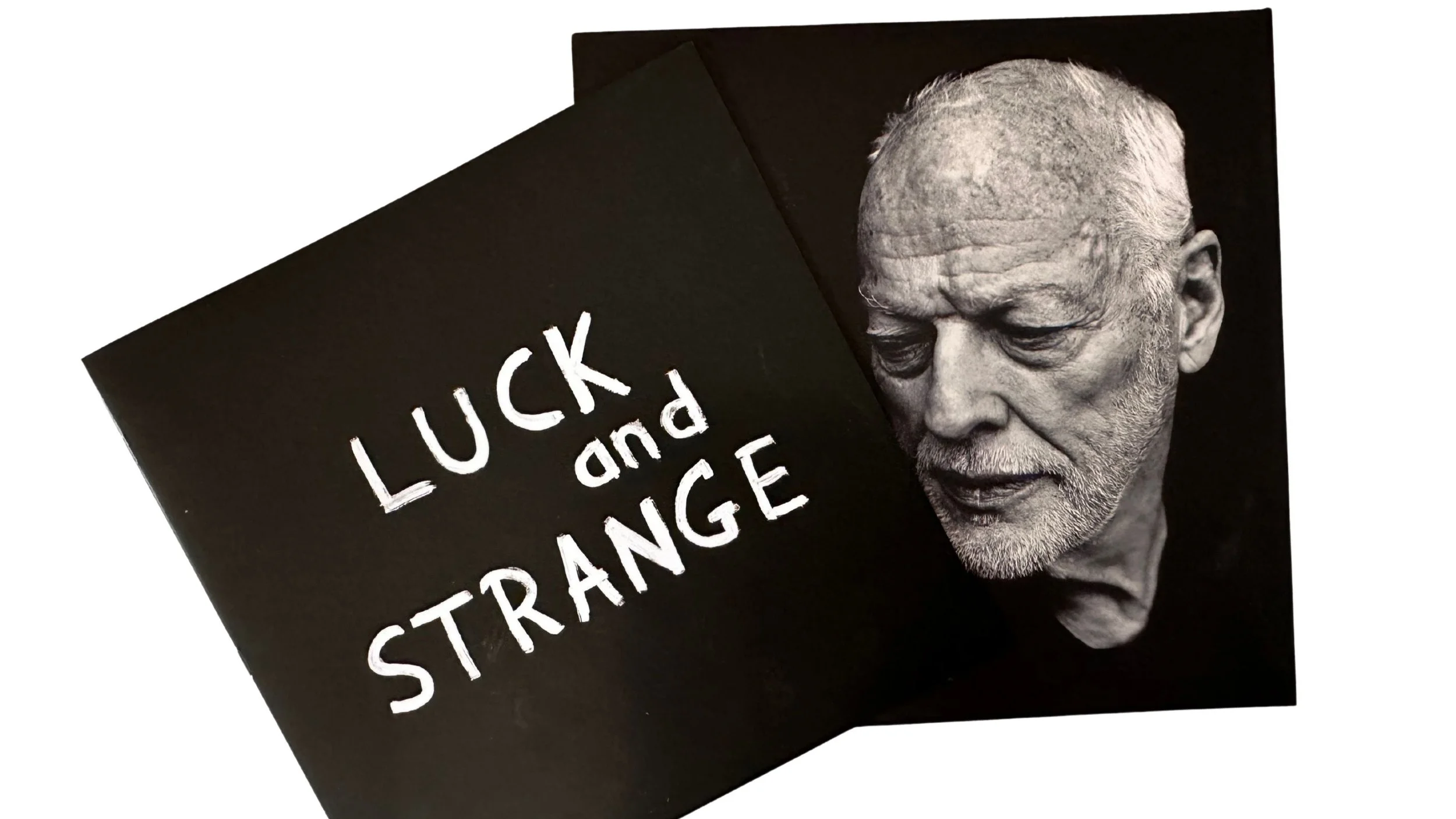
David Gilmour’s Luck and Strange Review: A Late-Career Album with Depth
With Luck and Strange, David Gilmour set himself a high bar, calling it his best work since The Dark Side of the Moon. This review looks at the album’s reflective tone, the importance of Romany Gilmour’s contribution, and why its deeper qualities emerge over time.
David Gilmour will always be compared with Pink Floyd. That is the burden, and the privilege, of having been instrumental in making some of the most admired records in rock history. With Luck and Strange, Gilmour arrived with a striking claim of his own, saying this was the best work he had made since The Dark Side of the Moon. That is a bold standard to set for any new album, especially one released more than fifty years after the record that changed everything.
Yet Luck and Strange is not trying to recreate the sweep of Gilmour’s past. It works in a different register. This is a thoughtful, inward-looking record, shaped by memory, family, unease and reflection. On first listen it sounds strong. Over time, its deeper qualities begin to emerge.
The recording of the album was not exactly a secret. Through Polly Samson’s Instagram posts, we had seen glimpses of it taking shape over a long period. I chose not to listen to the first singles, ‘The Piper’s Call’ and ‘Between Two Points’, instead waiting to hear the album as a whole. That proved to be the right decision. Luck and Strange feels like an album that benefits from being taken in as a complete work, its mood and themes gathering force across the running order.
A David Gilmour album shaped by family
One of the most distinctive things about Luck and Strange is how deeply it feels rooted in family collaboration. During lockdown, the growing Gilmour family gave a number of live performances from their home. They were charming evenings, sometimes theatrical, sometimes intimate, mixing music with poetry and showing a household full of warmth and creativity. In hindsight, those performances now feel like a prelude to this album.
Polly Samson remains central, not only as lyricist but as one of the key voices shaping the emotional world of the record. Her son Charlie contributes lyrics to ‘Scattered’, and anyone who has read his memoir Featherhood will already know that he is a gifted writer. The result is an album that does not feel solitary, even in its quieter moments. There is a sense of close creative company running through it.
That family presence matters most clearly in the appearance of Romany Gilmour. At first, I was sceptical about her sharing credits on ‘Between Two Points’, a song originally written and recorded by The Montgolfier Brothers. I should have known better. Her performance is one of the album’s defining moments.
Why ‘Between Two Points’ is the heart of the record
‘Between Two Points’ is so beautiful it makes me want to cry. It shifts the emotional temperature of the album and widens its frame. Rather than sounding like a dutiful family collaboration, it feels completely natural, almost inevitable, once you hear it. Romany’s vocal has a delicacy that gives the song a strange stillness, and David’s playing is all the more affecting for the restraint around it.
It is the track that stayed with me most strongly after the first listen, and over time it has only grown in stature. It also came into even sharper focus in performance. Seeing Romany Gilmour sing it live at the Royal Albert Hall gave the song an added emotional weight, and it was one of the clearest reminders that Luck and Strange was not simply a studio project. These songs could carry themselves into the room.
That live dimension also gives this article a natural companion in the Royal Albert Hall concert review, because hearing material from the album on stage helped confirm what the record was doing so quietly in the studio.
The sound of Luck and Strange
This certainly feels like a more introspective album. There is not quite the open-armed warmth of On an Island, nor the brighter ease that sometimes lifted Rattle That Lock. Luck and Strange is more inward, more measured, and less interested in easy release. It asks a little more of the listener.
That may be why it has drawn mixed reactions from those hoping for a more immediate statement. Yet that reserve is part of its appeal. This is not an album built around obvious grand gestures. It is built around atmosphere, phrasing, tone and the slow accumulation of feeling. Gilmour’s voice, weathered but expressive, suits this material. His guitar remains unmistakable, not as a display of virtuosity, but as a means of carrying mood and memory.
Gilmour has also spoken openly about working with a different set of musicians, choosing players who could bring a fresher approach to the sessions. The only familiar face is Guy Pratt, who by now is almost family. Pratt toured with Pink Floyd on both the A Momentary Lapse of Reason and The Division Bell tours, later played with Nick Mason’s Saucerful of Secrets, and is married to Gala Wright, daughter of Rick Wright. Wright is present here too, through keyboard recordings from 2007 woven into the title track by Gilmour and producer Charlie Andrew.
Even with new musicians and a fresh production approach, the album still sounds unmistakably like a David Gilmour record. That is no bad thing. Few guitarists have a style so immediately recognisable, and Luck and Strange never tries to deny that identity.
The Luck and Strange album cover
The main cover photograph, shot by Anton Corbijn, shows a striking degree of confidence from Gilmour. His face fills the sleeve, clear, aged and unguarded. For an artist so bound up with one of the grandest catalogues in rock history, there is something unusually direct about that choice. It suggests a man comfortable in his own skin, quite literally owning the record.
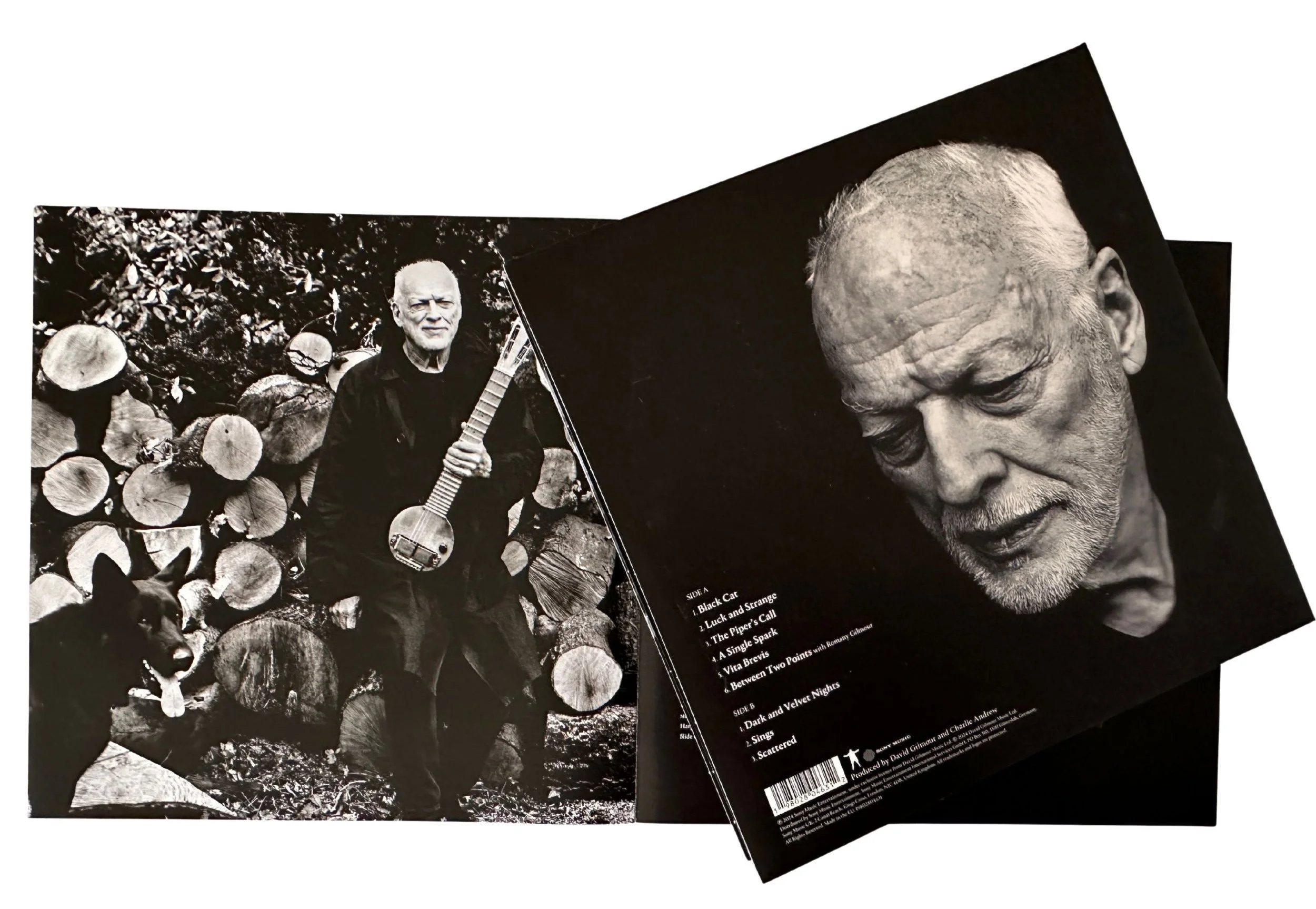
The Luck and Strange gatefold sleeve pairs an intimate Anton Corbijn portrait with stark black and white inner artwork, reinforcing the album’s reflective mood.
That sense carries through into the images inside the sleeve. The black and white photographs feel relaxed rather than staged, and they reinforce the mood of the album itself: reflective, intimate and quietly self-aware. Some, taken by Polly Samson, add to that feeling of closeness. Together, the visuals do not present Gilmour as a figure trapped by his past, but as an older artist willing to be seen plainly, with all the weight and calm that now brings.
Pink Floyd echoes in the background
It is just over thirty years since Gilmour actively recorded a Pink Floyd album, but as such a strong creative presence within the band, especially on the later records, it is impossible not to hear occasional reminders of that history. There are moments where certain textures, melodic shapes or pulses seem to glance back towards earlier work.
You can hear little traces here and there. A phrase, a mood, a heartbeat, a chord movement. The tail end of one era still flickers in the background of another. There are hints of The Division Bell, a touch of ‘Take It Back’, perhaps even something further behind that. These are not acts of self-imitation. They are the natural residue of a musical language Gilmour helped form decades ago.
Luck and Strange carries those echoes lightly. It acknowledges the past without leaning on it. The album’s best moments do not come from reminding you of Pink Floyd. They come from the confidence of a record content to stand on its own.
The meaning of Luck and Strange
The title track sits near the centre of the album’s argument. Lyrically, it feels reflective and autobiographical, the work of an artist looking back over a life shaped by talent, chance, decisions and accidents. What does ‘Luck and Strange’ mean? Is it serendipity, fate, a recognition that a career can be shaped by forces beyond planning or control? The phrase itself suggests both fortune and dislocation, the sense that a life can be blessed and bewildering in equal measure.
That tension runs through the album. Luck, good and bad. Strange, the places life can take you. Samson’s lyrics often invite listeners to read them through the lens of Pink Floyd or through Gilmour’s long and damaged relationship with Roger Waters, but that can be too narrow a reading. David Gilmour has lived a long life since those years, and these songs feel wider than any single old fracture. They are full of age, memory, ghosts, family and perspective.
The autobiographical feel is strongest in lines that look back on youth, fame and possibility from a much later vantage point. There is a sense of somebody taking stock, not with melodrama, but with calm unease. That tone gives the album much of its staying power.
‘Scattered’ and the closing stretch
If one song draws the album’s themes together most completely, it may be ‘Scattered’. Charlie’s contribution to the lyric gives it an added layer of intimacy, and the result feels like one of the most moving late-career performances Gilmour has put on record. The song carries thoughts of ageing, loss and dusk without turning heavy-handed. It feels lived-in.
The closing lines are especially affecting:
“Take my arm and walk with me
Once more down this dusty old path
The sunset cuts the hill in half
Our shadows stretch back to touch the night
The light’s fading, you say
But these darkening days
Flow like honey
These days slowing down
A whole life in a glance”
The Eagles Desperado Album: The Outlaw Concept That Built a Legend
Inside Eagles’ Desperado: who wrote the key songs, how the album was made in London, and why its outlaw myth still defines its legacy.
The Eagles were in a hurry. By the time they came to make their second LP, commercial success had arrived before the band had fully worked out what it wanted to be.
Released in 1973, the eagles desperado album was their answer. Framed around outlaws, drifters and Old West mythology, this landmark desperado album gave the group a larger identity than the clean-lined country rock of their debut had suggested. The songs, the cover, and the whole presentation pushed the Eagles towards something more theatrical and more self-aware—a band not just writing hits, but building a legend around itself. It was the kind of vinyl-era release that aimed to work as a complete statement, where the songs, the sleeve and the sequencing all carried the same idea.
That larger sense of design is a big part of why Desperado still holds such a firm place in the Eagles story. It was not the record that made them the biggest band in America, and it did not resolve every part of their sound. But it was the moment the Eagles began turning image, theme and songwriting into something more unified and more ambitious.
What followed was a record full of striking contrasts: an American outlaw fantasy recorded in London, a highly controlled studio production built around drifters and fugitives, and a concept record whose most enduring songs often reach beyond the concept itself.
Why the Eagles Turned to Outlaws
After the success of their debut, the Eagles could easily have made a safer follow-up. Instead, they reached for a concept. Don Henley described Desperado as a broad commentary on the dangers of fame and success, filtered through a cowboy metaphor. It was an ambitious idea for such a young band, and one that now looks like an early sketch for themes Henley and Glenn Frey would sharpen years later on Hotel California.
The outlaw frame gave the band more than a run of Western references. It gave them a language for independence, risk, self-invention and isolation. Rather than simply presenting themselves as laid-back California songwriters, the Eagles began casting themselves in a more mythic light, somewhere between frontier drifters and modern rock stars.
The album’s inspiration drew in people around them too. Jackson Browne, part of the band’s wider circle, shared cowboy stories that helped shape the mood. Real outlaw names such as Bill Doolin and the Dalton gang entered the imagination of the record. The theme also ran deeper than the title track and the famous sleeve. Randy Meisner’s ‘Certain Kind of Fool’, for example, follows a young man leaving home to chase music before drifting towards a fugitive sort of life, showing how fully the band had absorbed the album’s wider world.
That is the key to Desperado. It is not a strict narrative album in the rock opera sense. It works more as a shared landscape, a record held together by recurring characters, images and moods.
Who Wrote Desperado? The Songwriters Behind the Eagles' Classic
Written by Don Henley and Glenn Frey, the title track of the eagles desperado album remains one of the defining songs in classic rock history. As the principal writers whose partnership was rapidly becoming the creative centre of the band, Henley and Frey crafted both ‘Desperado’ and ‘Tequila Sunrise’ to give the record much of its emotional weight. At the heart of an album full of gunslingers, drifters and outlaw imagery sits a song that is strikingly intimate.
The song is less a Western scene-setter than a character portrait, full of regret, pride and the weariness of someone who cannot quite let their guard down. For all the album’s styling, one of its most lasting songs is powerful because it sounds human, not theatrical.
The song’s afterlife helped confirm its stature. Linda Ronstadt recorded ‘Desperado’ for her 1973 album Don’t Cry Now, and her version helped carry the song further after its initial release. That wider exposure added to the growing sense that the Eagles were producing songs built to last, not just songs suited to a concept album. In time, ‘Desperado’ became one of the band’s signature compositions.
‘Tequila Sunrise’ has lasted just as well for different reasons. It is one of the least overtly outlaw-themed songs on the record, and perhaps one of the most natural. Loose, melancholy and beautifully turned, it feels less like part of a concept and more like a glimpse of the Eagles’ deeper songwriting instincts breaking through.
Doolin, Dalton and the Outlaw World
The Old West imagery of Desperado was not invented from thin air. The album drew on real outlaw lore, especially the figures linked to the Doolin-Dalton Gang, whose story fed directly into the record’s atmosphere of escape, danger and self-created legend.
Who Was the Doolin-Dalton Gang?
The Doolin-Dalton Gang was a late 19th-century outlaw group linked to the American Old West. It emerged after the failed 1892 Coffeyville raid associated with the Dalton Gang, with Bill Doolin becoming one of the main figures in the splinter group that followed. Their robberies, gunfights and evasions helped turn them into frontier folklore, exactly the kind of mythology the Eagles drew on for Desperado.
That reference point gave the album some historical texture, but the Eagles were never trying to make a history lesson. They were borrowing from the West as myth, using outlaws as a way to talk about ambition, distance, image and the cost of living by your own rules. In that sense, the cowboy setting was less about authenticity than symbolism.
The Desperado Album Cover That Built the Myth
If Desperado has remained so vivid in rock memory, the cover is a large part of the reason.
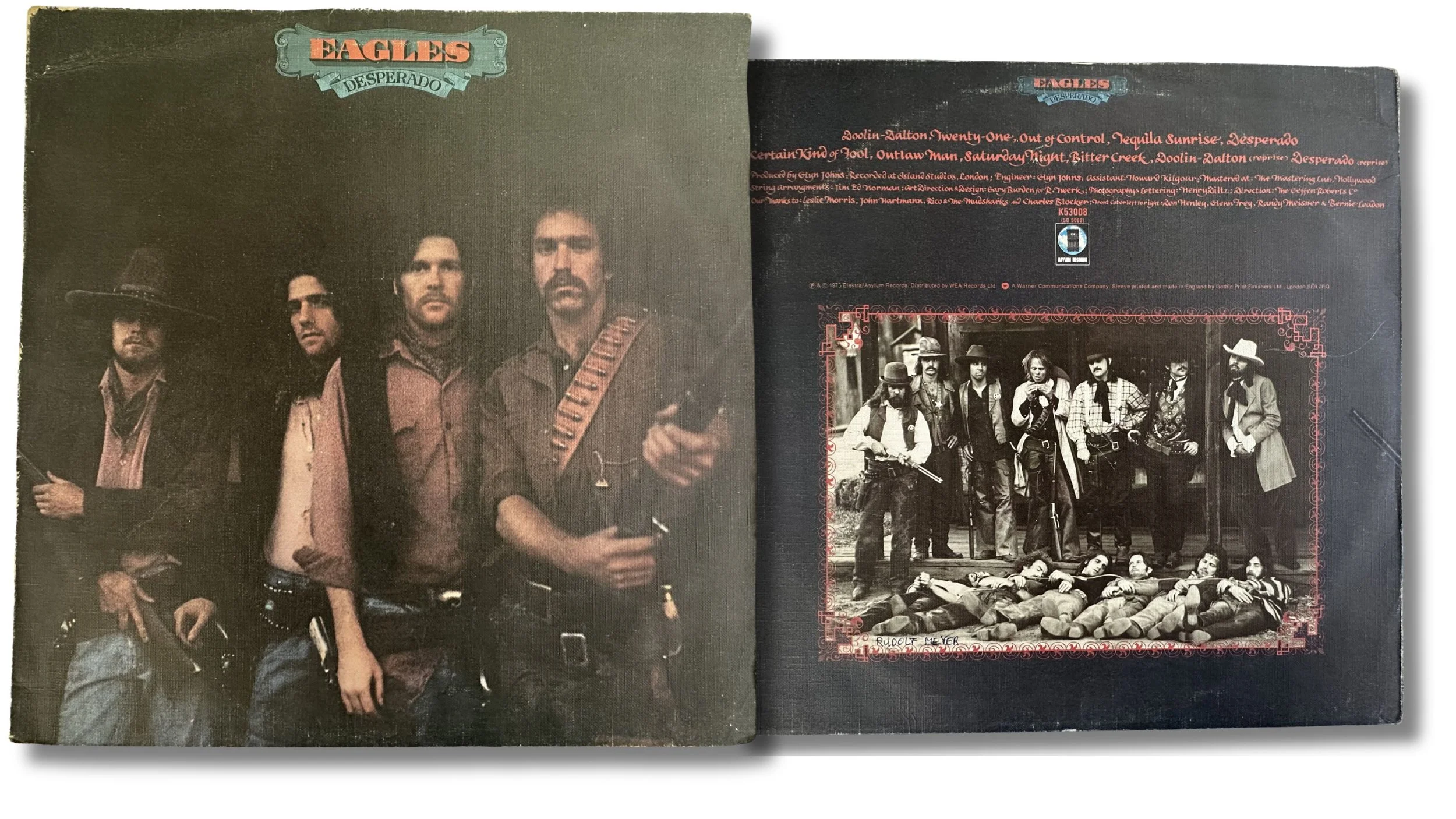
Designed by Gary Burden and photographed by Henry Diltz, it remains one of the most iconic images in the Eagles catalogue. The shoot took place on 18 December 1972 at Paramount Ranch in Agoura Hills, a location long associated with Hollywood’s version of the American West. That setting gave the album an instant cinematic authority. The band did not merely look dressed up. They looked as if they had stepped into a fully formed legend.
The back cover deepened the illusion, pulling in figures including Jackson Browne and Glyn Johns as part of the wider outlaw tableau. It was a clever move. Before listeners had spent much time deciding whether Desperado completely worked as an album, they had already absorbed its imagery. The sleeve sold the mythology with total confidence.
For a band still defining itself, that mattered in the best possible sense. The cover did not simply package the record. It enlarged it.
An Old West Myth: Making the Desperado Album in West London
One of the most intriguing things about Desperado is the distance between its imagery and its making. This was an album full of outlaws, drifters and frontier mythology, yet it was recorded not in California, Texas or Tennessee, but in London.
The sessions took place at Island Studios in Notting Hill, with Glyn Johns producing. That contrast is part of what gives the album its peculiar tension. Desperado presents itself as a vision of the American West, but the record itself was shaped through a swift, highly professional studio process in West London, under one of British rock’s most accomplished producers.
Johns brought discipline, clarity and experience to a band still working out how large it wanted to become. The whole album was completed in under three weeks. So while the songs and sleeve artwork projected myth, the recording process itself was brisk and practical. That gap between image and reality suits Desperado. It is an album fascinated by self-invention, and part of its own story lies in the difference between the legend it projected and the way it was actually made.
Seen from a wider Eagles perspective, the album also sits at an important midpoint. On the Border would push the band towards a tougher, more rock-oriented sound. One of These Nights would bring a darker, sleeker confidence and turn that ambition into a major commercial leap. Desperado sits between those records as the moment where the mythology arrived first, before the full sound of the imperial Eagles had quite caught up.
The Desperado Album Songs That Outlasted the Concept
That is why the strongest songs on the eagles desperado album still carry the record. These key desperado album songs do not depend entirely on the cowboy frame; they survive because they stand outside it.
The title track has become a standard because it reaches beyond the album’s imagery, while ‘Tequila Sunrise’ endures for its enduring mood and craft. Even some of the more thematic material is easier to appreciate when heard not as part of a rigid concept, but as pieces of a band trying to create a shared world. The outlaw idea gave the Eagles a dramatic frame, but the tracks that have lasted best are the ones where the group sounds most emotionally direct.
That tension makes the album more interesting than a simple success or failure. Desperado may not always play like a flawless front-to-back statement, but it reveals a band learning how image, songwriting and theme can reinforce one another. In that sense, it is one of the key records in the Eagles story, even if later albums delivered the idea with greater confidence and consistency.
Where Desperado Sits in the Eagles Story
Without Desperado, the path to the later Eagles is harder to imagine.
Eagles Album Timeline
This was the album where the band first tried to become larger than life. It gave them a mythology, one of the great sleeves of the 1970s, and two songs that have long outlasted the concept that first contained them. It also showed Henley and Frey reaching towards the larger themes that would come into sharper focus later: fame, illusion, identity and the cost of success.
It was also the last Eagles album to feature the full original band members of Don Henley, Glenn Frey, Bernie Leadon and Randy Meisner before the shifts that followed began to change the band’s character.
That is why Desperado remains essential. Not because it settled the Eagles into their final form, but because it caught them in the act of inventing it.
Classic Albums Recorded in the South of France
From the Stones at Nellcôte to Pink Floyd, Wham! and Radiohead, these albums reveal how the South of France became part of recording history.
The South of France has long attracted painters, film stars and millionaires, but it also holds a quieter place in music history. Hidden in the hills above Nice, tucked into Provençal estates, or improvised inside grand seaside villas, the region became an unlikely recording base for some of the biggest albums of the rock era. For British bands in particular, it offered privacy, distance and, in some cases, a financial escape route.
By the 1970s and 1980s, many artists came to the South of France for the tax advantages first and the peace second. For British musicians such as the Rolling Stones and Pink Floyd, money was often the trigger, but the distance from London helped turn that relocation into a productive recording period. Residential recording studios such as Super Bear allowed bands to live and work in one place, away from the usual distractions, with the kind of uninterrupted studio time that ambitious records often demanded.
This was not just a glamorous backdrop. It was a working musical landscape. The Rolling Stones turned Villa Nellcôte into one of the most notorious recording locations in rock history. Super Bear Studios, close to Nice, gave artists the seclusion of a residential studio with serious equipment. Miraval, in Provence, offered another version of retreat, later gaining a second life under Brad Pitt. Together, these places helped shape a distinctive chapter in the story of British artists, and gave us some classic albums.
Why the South of France Became a Recording Hub
What made the South of France so attractive was the combination of distance and comfort. Bands could escape the routine of London and Los Angeles without giving up serious recording facilities. At Super Bear, artists lived on site in the hills above Nice, with the studio becoming part retreat, part workplace. Miraval offered something similar in Provence, while Nellcôte showed that, with the right mobile equipment, even a villa basement could become the setting for a major album.
The region also sat at an interesting point between discipline and indulgence. Some artists came south to get away and work. Others arrived with more chaotic intentions. Either way, the result was a run of albums that tied the South of France to rock and pop history in a way that still feels slightly hidden.
The Rolling Stones, Exile on Main St. (1972)
Location: Villa Nellcôte, Villefranche-sur-Mer
If one album defines the Rolling Stones in France, it is Exile on Main St. In the spring and summer of 1971, the band relocated to the South of France during their period of tax exile, scattering themselves across rented houses while Keith Richards settled at Villa Nellcôte. It was there, in the basement of the Belle Époque mansion, that much of Exile on Main St. took shape, with the Rolling Stones Mobile Studio parked outside.
As Keith Richards later recalled in Life: “It was never our intention to record at Nellcôte. We were going to look around for studios in Nice or Cannes, even though the logistics were a little daunting. Charlie Watts had taken a house miles away in the Vaucluse, several hours’ drive. Bill Wyman was up in the hills, near Grasse…”
Exile on Main St. remains one of the key albums in the Stones story because it sounds both loose and indestructible. The songs feel dragged through heat, late nights and frayed nerves, yet the record holds together with remarkable force. ‘Rocks Off’, ‘Tumbling Dice’ and ‘Loving Cup’ all carry that worn, humid atmosphere. Nellcôte was not a conventional studio, and that helped give the record both its mythology and part of its sound. Much of the recording took place in the vaulted cellars beneath the villa. With little ventilation, the space soon became hot, airless and claustrophobic, helping inspire the title ‘Ventilator Blues’.
Pink Floyd, The Wall (1979)
Studios: Super Bear Studios, Berre-les-Alpes, and Miraval Studios, Correns
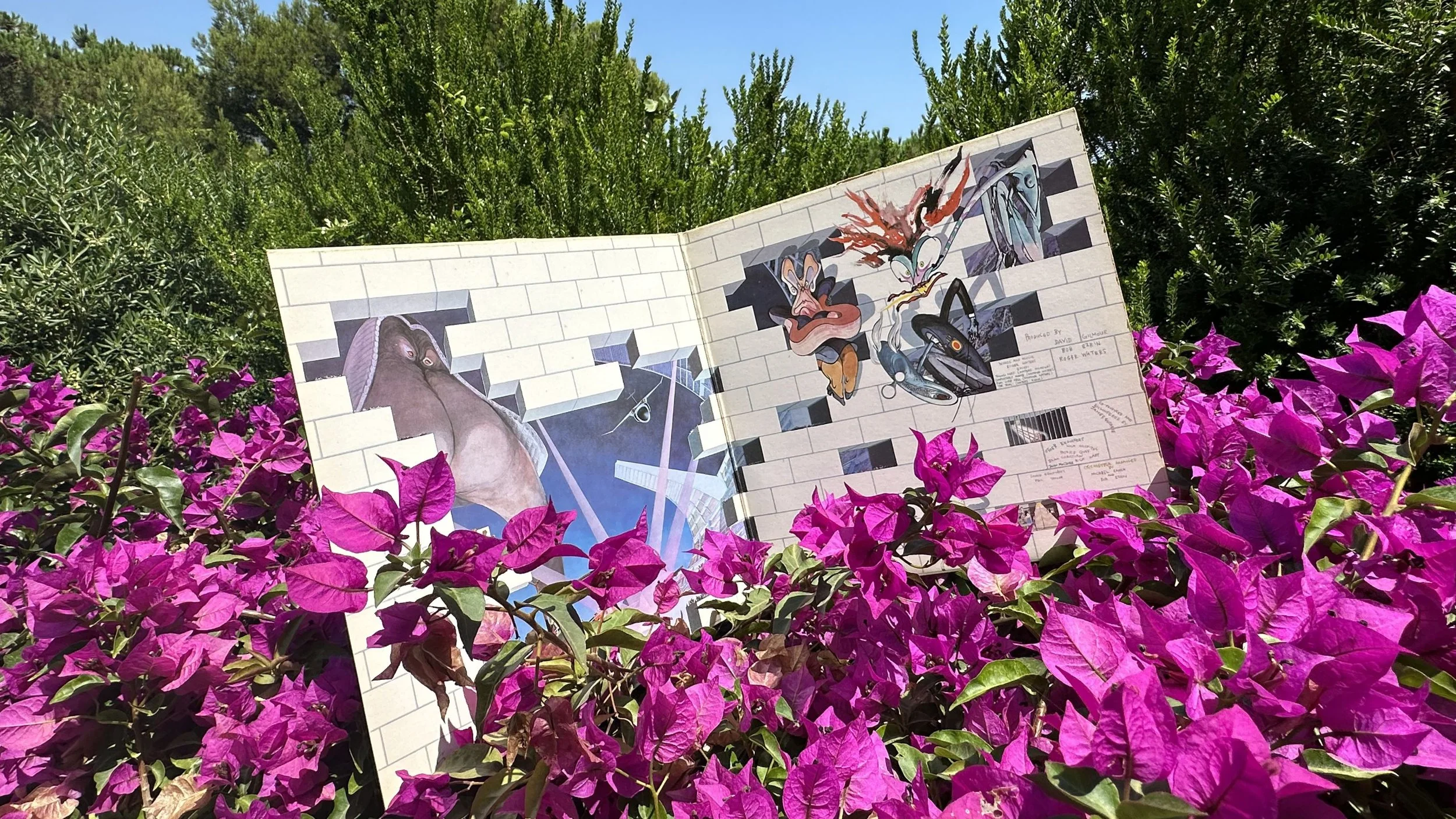
A combination of tax pressures and the technical limitations of their own Britannia Row Studios sent Pink Floyd to the South of France for the recording of The Wall. The band based themselves at Super Bear Studios near Nice, with two members staying on site while Roger Waters and David Gilmour rented villas nearby. Producer Bob Ezrin checked into the Negresco for the duration of the sessions, taking the band to dinners at Le Chantecler and quietly charging them back to the record label.
As Nick Mason later wrote in Inside Out, the move offered more than a change of scenery: “The prospect of not only one year of tax-free income to pay the debts, but also the opportunity to make a new start on our music without the distractions of lawyers and accountants, was irresistible… Like naughty children abandoning an untidy playroom, we were able to leave the financial mess behind for the professionals to clear up.”
The pressure to finish the album on time soon pushed the band beyond a single location. To meet the record company’s deadline, work expanded to a second studio, Miraval, around fifty miles away. Mason remembered it as “a fat château”, owned by jazz pianist Jacques Loussier, adding that “apart from anything else you could dive off the walls and swim in the moat”. He also noted, with typical dry humour, that while every studio liked to boast of its special features, Miraval managed to outdo most of them.
That slightly unreal setting sat in sharp contrast to the album itself. The Wall is theatrical, controlled and often claustrophobic, yet part of its creation took place amid sunshine, sea air and distance from Britain. The project also arrived at a difficult point in Pink Floyd’s history, with Waters taking firmer control and tensions already beginning to rise. Super Bear was not merely a footnote in that story. It became part of Pink Floyd’s wider orbit in this period, linking the band to one of the most intriguing recording studios in the South of France.
Queen, Jazz (1978)
Studio: Super Bear Studios, Berre-les-Alpes
Queen’s Jazz helps establish Super Bear as more than a curious pin on a map. The band began work there before moving on to Mountain Studios in Montreux. Jazz may not always rank at the very top of Queen lists, but it produced some of their most recognisable late seventies songs, including ‘Fat Bottomed Girls’, ‘Bicycle Race’ and ‘Don’t Stop Me Now’.
Super Bear offered Queen the sort of removed, high-spec setting that suited a band already operating on an international level. By the time they arrived, the studio was building a reputation as a serious destination for major acts rather than a novelty hidden in the hills above Nice. Queen help show that Super Bear was part of a wider pattern, as major bands increasingly chose to record away from the usual London routine.
Queen did not simply shut themselves away at Super Bear. Brian May later recalled that as the Tour de France passed through Nice, it became part of the background to songs such as ‘Bicycle Race’ and ‘Fat Bottomed Girls’. It is a small but memorable South of France detail, showing that the world outside the studio still found its way into the record.
Kate Bush, Lionheart (1978)
Studio: Super Bear Studios, Berre-les-Alpes
Kate Bush arrived at Super Bear at a pivotal moment. Still only twenty, she was making her second album in surroundings that could hardly have felt further from London. As Graeme Thomson notes in Under the Ivy, Super Bear was “a slice of luxury” compared with Air Studios, set high in the mountains rather than in the grime of Oxford Circus. The studio occupied a large whitewashed villa, with residential quarters below, swimming pools, games rooms and the sort of distractions that made it feel more like a retreat than a workplace.
Yet the sessions for Lionheart were not entirely carefree. Changes in personnel halfway through the recording meant that musicians from The Kick Inside returned to help complete the album, while members of Bush’s preferred touring band suddenly found themselves with unexpected time on their hands. Thomson’s account catches the strange mixture of tension and indulgence, with friends lingering by the pool, occasional trips to Monaco, and even Rick Wright turning up with champagne and a plan to visit the casinos.
That contrast suits Lionheart itself. This was not the raw arrival of The Kick Inside, but a record made under greater pressure, in more luxurious surroundings, with Bush already moving into a more complicated phase of her career. Super Bear gave the album an unusual backdrop, glamorous on the surface, but far from entirely relaxed underneath.
Wham!, Make It Big (1984)
Studio: Miraval Studios, Correns
Wham! arrived at Miraval at a more complicated moment than the finished record suggests. With their legal dispute with Innervision still hanging over them, George Michael and Andrew Ridgeley were sent to the South of France to begin work on their second album while management dealt with the mess back in Britain. George later described the break as valuable breathing space, giving him time to collect his thoughts and write. Once the legal position cleared and Epic wanted a hit single quickly, the mood sharpened. Make It Big may sound bright and effortless, but part of its force comes from that mix of pressure and momentum.
Miraval gave Wham! the distance to reset, but it also became the place where George Michael’s control as a writer and producer came more clearly into view. The album delivered huge songs including ‘Wake Me Up Before You Go-Go’, ‘Freedom’ and ‘Everything She Wants’, while ‘Careless Whisper’ stood slightly apart from the rest. It was the one track on Make It Big completed in London rather than at Miraval, recorded at Sarm West, which makes it a useful bridge to the next phase of George Michael’s studio story. Even within a massively successful Wham! album, it already hinted at the more self-directed career that would follow.
Radiohead, A Moon Shaped Pool (2016)
Studio: La Fabrique, Saint-Rémy-de-Provence
Radiohead are the outlier here, but a useful one. The band used La Fabrique in Saint-Rémy-de-Provence during the making of A Moon Shaped Pool, giving the South of France a place in one of their most intimate and quietly affecting albums. Songs such as ‘Burn the Witch’, ‘Daydreaming’ and ‘True Love Waits’ give the record a bruised, slow-burning beauty that feels far removed from the more theatrical side of their catalogue.
La Fabrique was not the only studio involved, but it seems to have been one of the album’s decisive settings. Radiohead shaped the sound as they recorded, and their time in Provence helped the record settle into focus. That makes A Moon Shaped Pool a fitting final entry here: proof that the South of France remained a creative refuge long after the classic studio era had passed.
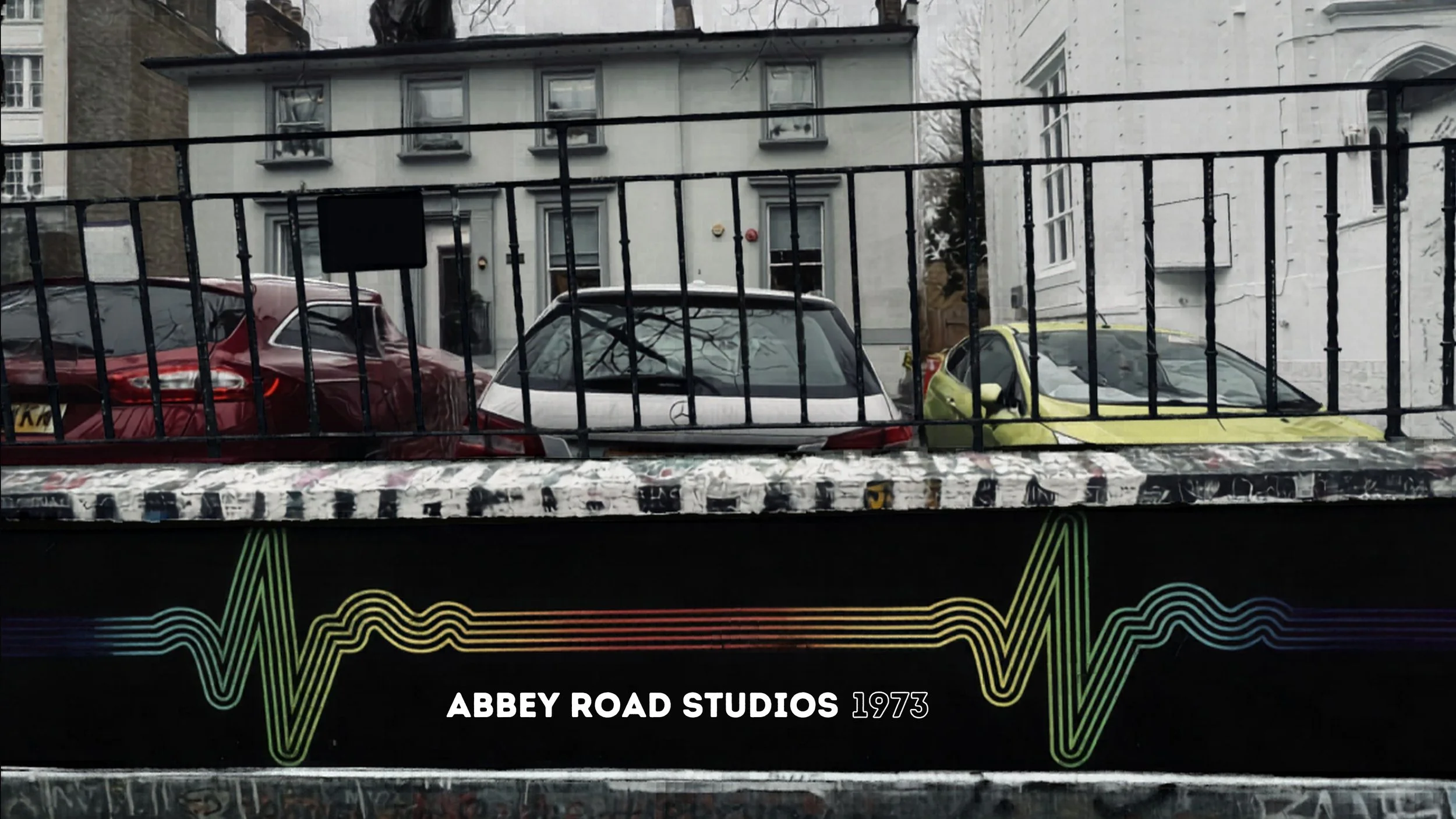
Classic Albums Recorded in London: 11 Landmark Records from Abbey Road to AIR
London shaped some of the most important albums of the vinyl era and beyond. From Abbey Road and Trident to AIR, Sarm West and Sound Techniques, these 11 records show how the city’s studios helped define the sound of modern music.
London shaped some of the most important albums of the vinyl era and beyond. From the engineered clarity of Abbey Road Studios to the quiet corners of Sound Techniques in Chelsea, the city’s rooms and engineers helped define the sound of modern music. With so many classic albums to choose from, we have picked eleven favourites that help tell the story of London as a recording city.
Why London Became a Recording Capital
For much of the twentieth century, London offered a concentration of studios, engineers and session musicians unlike anywhere else in Europe. Labels invested heavily in purpose-built rooms, and new technology often arrived here first. Artists could move between Abbey Road, Trident, Olympic, AIR and dozens of smaller spaces within a single day. The result was a city where ideas travelled quickly, and where some of the most recognisable records in rock history took shape.
Classic Albums Recorded in London
The Beatles, Abbey Road (1969)
The Rolling Stones, Let It Bleed (1969)
Nick Drake, Five Leaves Left (1969)
David Bowie, The Rise and Fall of Ziggy Stardust and the Spiders from Mars (1972)
The Who, Quadrophenia (1973)
Pink Floyd, The Dark Side of the Moon (1973)
Roxy Music, For Your Pleasure (1973)
Al Stewart, Year of the Cat (1976)
Joy Division, Closer (1980)
Phil Collins, Face Value (1981)
George Michael, Faith (1987)
The Beatles, Abbey Road (1969)
Studio: Abbey Road Studios, St John’s Wood
A defining moment in British music, Abbey Road was the last album the Beatles completed together. Recorded during the summer of 1969, it sounds far more unified than the strained circumstances behind it might suggest. The Moog synthesiser added new colour, while George Martin’s production and the studio team’s engineering gave the record its remarkable clarity. George Harrison also came fully into his own as a songwriter, contributing two of the album’s most loved songs, ‘Here Comes the Sun’, written in Eric Clapton’s garden, and ‘Something’, his love song to Pattie Boyd.
The Abbey Road crossing on the cover still draws fans to St John’s Wood every day, making the studio one of London’s most recognisable musical landmarks. If any classic album is inseparable from London, it is this one.
The Rolling Stones, Let It Bleed (1969)
Studio: Olympic Studios, Barnes
Let It Bleed arrived at the end of a turbulent decade for the Rolling Stones and marked the beginning of their strongest run of albums. Recorded at Olympic Studios, it captured a darker, heavier sound that would carry the band into the seventies. ‘Gimme Shelter’ set the mood with its apocalyptic opening, while ‘You Can’t Always Get What You Want’ closed the album with scale and ambition. Songs such as ‘Monkey Man’ and ‘Midnight Rambler’ showed how the band were tightening their sound without losing any of their menace.
Let It Bleed also sits at a pivotal point in the band’s history. Engineered by Glynn Johns, it was the last of their major sixties albums recorded fully in London before they shifted their base to warmer, less tax-punitive locations. Within a few years they would be working in the South of France, first with Olympic’s mobile studio and later at Villa Nellcôte for Exile on Main St. In that sense, Let It Bleed marks the end of the Stones’ London studio era and the beginning of the creative run that would define their seventies identity.
Nick Drake, Five Leaves Left (1969)
Studio: Sound Techniques, Chelsea
Five Leaves Left introduced a voice that felt out of step with the late sixties and has only grown in stature since. Recorded at Sound Techniques off Sloane Street in Chelsea, the album paired Nick Drake’s quiet intensity with arrangements that were carefully shaped rather than overstated. The studio’s warm, natural acoustics suited Drake’s delicate guitar style, allowing every note to sit clearly in the mix without losing its intimacy.
‘River Man’ remains one of his most distinctive recordings, built around a winding string arrangement that sits in gentle contrast to Drake’s calm vocal. ‘Cello Song’ and ‘Three Hours’ show the influence of the room itself, capturing the late-night quality that became a hallmark of Drake’s early work. Engineer John Wood and producer Joe Boyd kept the sessions focused on clarity and performance, giving the album a tone that still feels close and unforced.
Sound Techniques was a small studio, but it became central to the English folk sound of the period. Five Leaves Left stands among its finest achievements and remains one of the most quietly influential albums ever recorded in London.
David Bowie, The Rise and Fall of Ziggy Stardust and the Spiders from Mars (1972)
Studio: Trident Studios, Soho
Recorded over several late 1971 and early 1972 sessions, The Rise and Fall of Ziggy Stardust and the Spiders from Mars is the album where Bowie’s songwriting, Mick Ronson’s arrangements and the Spiders’ energy aligned. The record balances gritty, guitar-led songs with moments of theatrical drama. ‘Starman’ introduced the character to a wider audience. ‘Moonage Daydream’ and ‘Hang On to Yourself’ captured the immediacy of the band’s live sound, while ‘Rock and Roll Suicide’ brought the story to a close with a sense of finality Bowie rarely revisited.
Trident Studios gave Bowie the clarity he was chasing during this period. The room was known for its high-end equipment, disciplined engineering and brightness, all of which suited Ronson’s guitar tone and the precision of Trevor Bolder and Woody Woodmansey. Several takes were recorded quickly, helping keep the album sharp and uncluttered.
Trident also sat close to the world Ziggy came to inhabit. Heddon Street, where the cover photograph was taken, was only a short walk away, while the nearby Marquee Club had already become one of London’s key rock venues. Together, those Soho locations tie Ziggy Stardust to a very specific part of London that shaped Bowie’s early career.
The Who, Quadrophenia (1973)
Studio: Ramport Studios, Battersea
Quadrophenia is the Who at full scale. Pete Townshend had already tackled the rock opera with Tommy, but here he built something more grounded and emotionally complex. The story of Jimmy, the disillusioned mod searching for identity along the English coast, gave the band a framework for some of their most disciplined and powerful music.
Most of the sessions took place at Ramport Studios in Battersea, the space the band built for themselves so they could work without interruption. The room allowed Townshend to layer brass, synths, guitars and sound effects with a precision that still feels impressive. ‘The Real Me’ and ‘5:15’ show the band at their most urgent, while ‘Bell Boy’ captured Keith Moon’s chaotic brilliance. ‘Love, Reign O’er Me’ brought the album to an enormous, cathartic close.
Olympic Studios played a supporting role, providing additional recording and the level of technical refinement the band trusted. The combination of Ramport’s freedom and Olympic’s engineering helped Townshend realise the scale of the project.
Quadrophenia also marked a turning point for the Who. It was the last album to capture the classic line-up at this level of ambition before the band moved towards a more straightforward rock sound. Its focus on British youth culture, Brighton and the South Coast places it firmly within the geography that shaped the Who’s early identity.
Pink Floyd, The Dark Side of the Moon (1973)
Studio: EMI Studios, Abbey Road
Recorded at Abbey Road between 1972 and 1973, The Dark Side of the Moon is the album that fully realised Pink Floyd’s studio imagination. Using the technical possibilities of Abbey Road to their advantage, the band built a record of ticking clocks, spoken voices, tape loops and aching melodies that still feels seamless from start to finish.
Time, Money and Us and Them gave the album its emotional and musical weight, while the success of the record transformed Pink Floyd from an ambitious London band into one of the biggest names in the world.
Roxy Music, For Your Pleasure (1973)
Studio: AIR Studios, Oxford Circus
Recorded at George Martin’s AIR Studios in London in early 1973, For Your Pleasure captured Roxy Music at their most stylish and experimental. The album moved beyond the art-school glamour of their debut into something stranger, sleeker and more controlled, with Bryan Ferry’s cool detachment set against Brian Eno’s sonic restlessness.
Songs such as ‘Do the Strand’ and the title track showed how well AIR suited a band drawn to texture, atmosphere and studio detail. It remains one of the defining records made at George Martin’s original Oxford Circus studio.
Al Stewart, Year of the Cat (1976)
Studio: Abbey Road Studios, Abbey Road
Released just as EMI Studios officially became Abbey Road Studios, Al Stewart’s Year of the Cat marked a turning point for both artist and studio. Produced by Alan Parsons, it gave Stewart’s literary songwriting a smoother, more expansive setting, helping turn him from a respected British troubadour into an international recording artist.
The title track became the obvious signature, but songs such as ‘Lord Grenville’ and ‘On the Border’ reveal the album’s wider appeal, where history, movement and atmosphere are matched by polished London studio craft.
Joy Division, Closer (1980)
Studio: Britannia Row Studios, Islington
Closer is one of the most striking British albums of its era. Recorded at Britannia Row Studios in Islington, it captures a clarity and stillness that shaped Joy Division’s sound in their final months together. Where Unknown Pleasures carried a darker, more abrasive energy, Closer feels stark and controlled. The production gives space to every part of the arrangement, allowing the emotional weight of the album to sit in plain view.
‘Isolation’ sets the tone with its sharp drum pattern and detached vocal. ‘Twenty Four Hours’ is one of the band’s most powerful recordings, shifting from quiet reflection to sudden, tightly wound intensity. ‘The Eternal’ brings the album to a slow, uneasy close, supported by the studio’s clean acoustic environment. The precision of Pink Floyd’s Britannia Row studio helped Joy Division create a record that feels suspended between calm and collapse.
Closer was both an ending and a beginning. Released in July 1980, two months after Ian Curtis’s death, it would be Joy Division’s final album. Ahead lay New Order and a very different kind of global attention.
Phil Collins, Face Value (1981)
Studio: The Townhouse, Shepherd’s Bush
Face Value launched Phil Collins as a solo artist and became one of the defining albums of the early eighties. Written during a period of personal upheaval, it balanced emotional candour with confident, inventive production. Much of its distinctive sound came from the Stone Room at The Townhouse, whose natural reverb helped shape the powerful drum sound heard on ‘In the Air Tonight’.
There were quieter moments too, including ‘The Roof Is Leaking’, which featured Eric Clapton on guitar, an early sign of the Collins and Clapton partnership that would later resurface on Behind the Sun. The album established Collins’s solo identity and confirmed The Townhouse as one of London’s key studios of the period.
George Michael, Faith (1987)
Studio: Sarm West Studios, Notting Hill
Faith marked George Michael’s move from pop star to fully fledged songwriter, producer and multi-instrumentalist. He was already familiar with Trevor Horn’s Sarm West, having recorded the vocals for ‘Careless Whisper’ there, while much of Make It Big was made in the South of France. He had also briefly passed through the studio for ‘Do They Know It’s Christmas?’.
Working largely alone, often late into the night, Michael shaped Faith with the level of control that would define his solo career. Songs such as ‘Father Figure’, ‘One More Try’ and ‘Kissing a Fool’ show how confidently he blended soul, pop and introspection, with vocals and arrangements refined to a remarkable degree. Sarm West gave him the freedom to build tracks piece by piece until every harmony, keyboard part and drum pattern sat exactly where he wanted it. Faith remains one of the key London-recorded albums of the eighties, and a defining statement from an artist stepping fully into creative independence.
London’s Recording Studios and Their Global Influence
These eleven albums show how much modern music passed through a relatively small group of London studios. From Abbey Road and Trident to Olympic, Sound Techniques, AIR, Ramport, Britannia Row, The Townhouse and Sarm West, each room brought its own sound, discipline and atmosphere to the records made there.
Many of those spaces have now disappeared into the history of the lost London recording studio, but the albums remain as markers of a period when London stood at the centre of modern music.
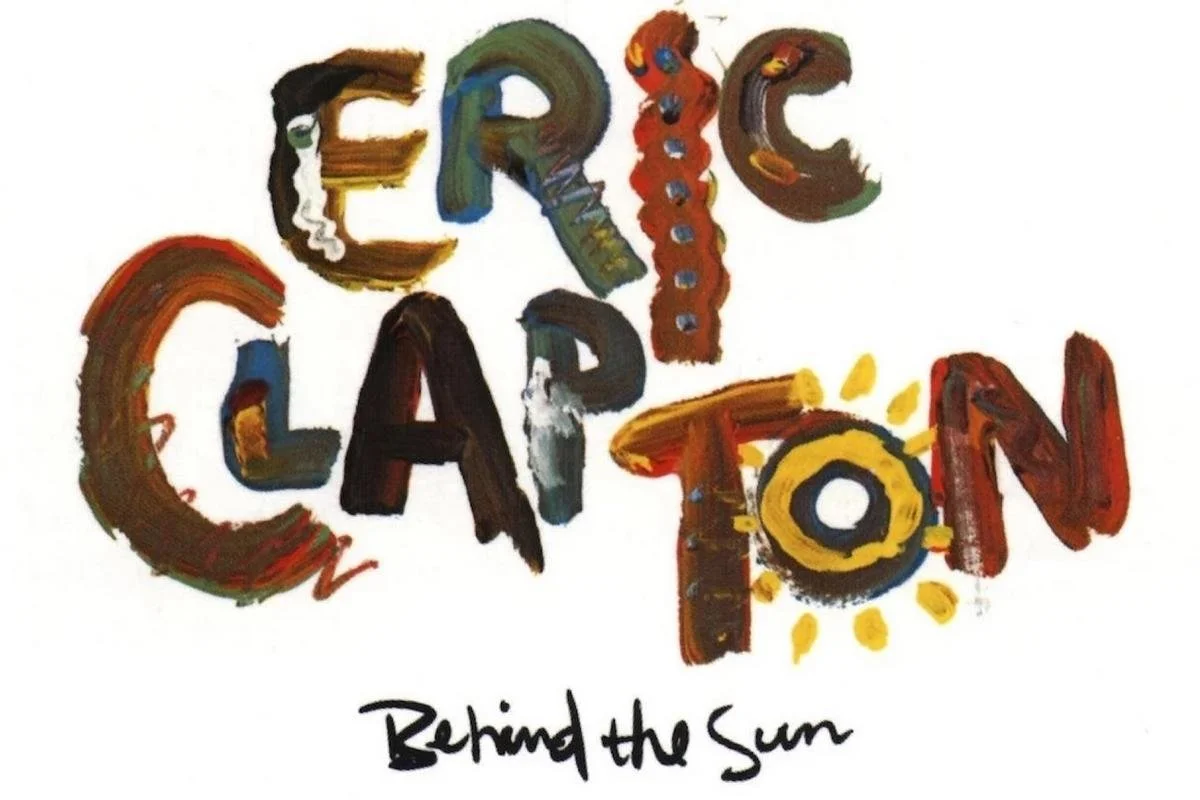
Eric Clapton’s Behind the Sun: When the Layla Story Unravelled
Recorded largely at AIR Studios Montserrat, Behind the Sun found Eric Clapton at a turning point. As his marriage to Pattie Boyd deteriorated, the album paired personal turmoil with a brighter, more contemporary sound shaped in part by Phil Collins. The result was a return to form of sorts, and the closing chapter of the story that had once inspired Layla.
If Layla captured the tortured beginning of Eric Clapton’s love affair with Pattie Boyd, Behind the Sun arrived as that story was beginning to unravel. Released in 1985, the album is often heard as a return to form, but it also marks the closing of one of the most famous romantic chapters in rock history.
The blues purist of the late 1960s had, by the 1980s, become a reflective and sometimes restless artist looking for a way back to a wider audience. Money and Cigarettes (1983), recorded in the aftermath of Clapton confronting his alcoholism, was a stripped-back, guitar-focused record that suggested a fresh start, but it did not fully revive his commercial fortunes. Behind the Sun would move in a different direction, bringing in synthesisers and a more energised mid-80s sound that would offer Clapton a new musical direction and success.
Eric Clapton Eighties Albums
A Caribbean Studio and a New Collaboration
Much of Behind the Sun was recorded at AIR Studios Montserrat, the Caribbean studio built by producer George Martin. By the early 1980s, the studio had become a prized retreat for artists looking to escape the pressures of London or Los Angeles and focus on making records in more tranquil surroundings. Like Elton John’s Too Low for Zero, which was also recorded there, Behind the Sun represented a return to form of sorts for Clapton, while also nudging him towards a brighter, more modern sound.
“I called Phil and told him I had a few new songs, and we decided to go and work on them in George Martin’s Air Studios in Montserrat, in the Caribbean. The idea was to jam a little, try out my songs, see if we could write something together and maybe do some covers. ”
Clapton arrived on Montserrat with a small group of musicians and a valuable ally in Phil Collins. By this point Collins was one of the biggest figures in pop, balancing his role as Genesis frontman with a solo career that had taken off after Face Value. Living near Clapton at Hurtwood Edge, he became a key part of the project as drummer, collaborator and producer, helping to wrap Clapton’s guitar playing in a more contemporary mid-eighties sound.
“It’s a great feeling being here in this paradise as producer for my mate and his band of legends.”
Those “legends” included bassist Nathan East, whose association with Clapton would prove far from fleeting. East went on to become one of the most important musicians in Clapton’s world, collaborating and touring with him for decades afterwards.
The sessions produced a set of songs that balanced Clapton’s familiar blues phrasing with the crisp, radio-friendly production style that dominated the mid-1980s.
Although Clapton’s time in the Caribbean coincided with a return to drinking, his stay on Montserrat would prove productive in more ways than one.
Songs from a Complicated Moment
The personal backdrop to the album was far from calm. Clapton’s marriage to Pattie Boyd—the relationship that had already inspired songs such as Layla and Wonderful Tonight—was beginning to unravel, and that tension seeps into several of the record’s strongest moments. The blistering opener, “She’s Waiting,” captures both emotional distance and a sense of frustration, not least at Clapton’s own behaviour. Framed by Phil Collins’ atmospheric drums and keyboards, the song wraps Clapton’s guitar in a polished mid-80s sound while remaining one of the album’s most personal statements. It would also become a memorable part of his Live Aid set in 1985.
The covers Eric was keen to recorded included a version of “Knock on Wood” that would showcase the vocal collaboration of Clapton and Collins.
Trouble in Paradise?
However the original tracks, delivered to the record label were not well received.
“... Warner Brothers had sent back he Montserrat tapes, saying the songs weren’t strong enough. There weren’t enough enough potential hit singles amongst them, and we could either re-record the album, removing some of the songs and adding new ones, or we could find another record company.”
The answer was a further round of recording in Los Angeles, with Clapton joined by musicians including Steve Lukather and Jeff Porcaro. From those sessions came some of the album’s biggest songs, most notably “Forever Man,” which reached number one on Billboard’s Top Rock Tracks chart and helped push sales beyond half a million copies.
My love has gone behind the sun…
There was one final track Clapton wanted to add to the album. He turned to his friend and producer Phil Collins, heading to Collins’ neighbouring home to record it in a homemade studio, alone with his guitar. The result was an introspective piece that seemed to capture exactly where Clapton found himself at that moment.
My love has gone behind the sun
Since she left, the darkness has begun
The smile that used to shine on me
Is nothing more than a memory
I see her face, I hear her voice
She made a move, I had no choice
But walk and cry, wipe tears with my hand
The one that carries a wedding band
And the clouds hang low
And the flowers that used to grow in my heart
Are dying now
Dying now
Dying now
That productivity extended beyond the studio. During his time on Montserrat, Clapton began an affair that would lead to the birth of his daughter, Ruth, in 1985.
Critical reaction to Behind the Sun was mixed. Some reviewers welcomed the stronger songwriting and polished production, while others felt the album leaned too heavily into contemporary studio trends. Rolling Stone didn’t hold back on their contempt for the new material.
Writing in Rolling Stone, Critical reaction to Behind the Sun was mixed. Some reviewers welcomed the stronger songwriting and polished production, while others felt the album leaned too heavily into contemporary studio trends.
“ One shudders to think of Clapton really going in the direction Behind the Sun is pointing him toward... Maybe that’s why he sounds so desperate and convincing, like a man who wants to jump not only out of his skin but right off the track, as he sings “Just Like a Prisoner.” For Clapton, there’s still time — and hope — for escape.”
Commercially, however, the record succeeded in restoring momentum to his career. The success of Forever Man in particular ensured that Clapton’s music was once again heard on mainstream radio and emerging platforms such as MTV.
The collaboration with Phil Collins also continued. The next album, August (1986), leaned even further into the glossy sound of the decade and produced several well-known singles. By that point Clapton had firmly entered a new phase of his career: less the fiery guitar hero of the 1960s, and more the seasoned artist navigating the changing landscape of popular music.
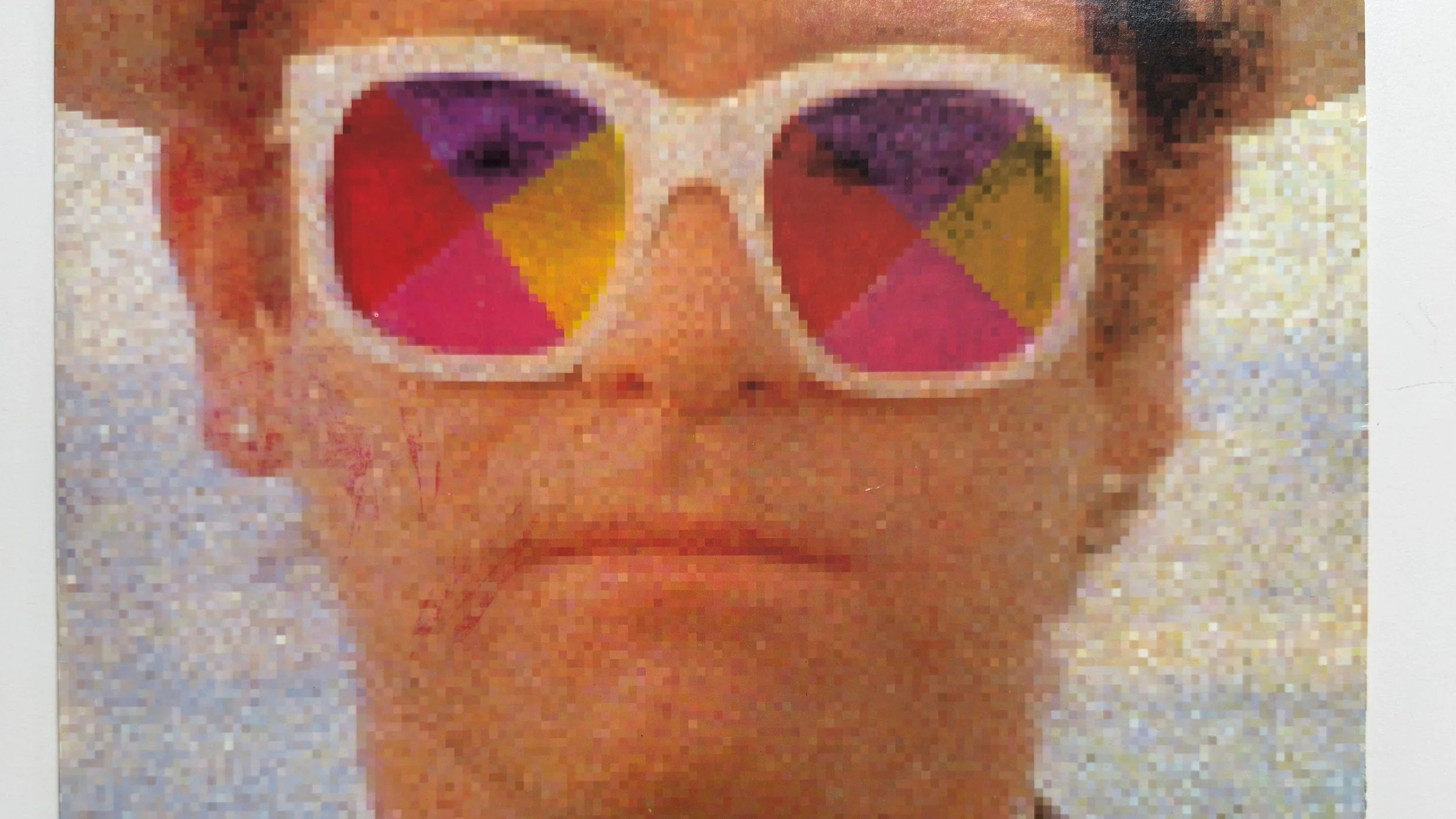
Too Low for Zero - Elton John Finds His Feet Again
Recorded at AIR Studios Montserrat in 1983, Too Low for Zero marked a return to form for Elton John. Reuniting him with lyricist Bernie Taupin and members of his classic band, the album produced enduring hits including I’m Still Standing and I Guess That’s Why They Call It the Blues.
By the early 1980s, Elton John had already lived several musical lifetimes.
During the first half of the 1970s he seemed unstoppable, releasing a stream of landmark albums and hit singles with lyricist Bernie Taupin. Records such as Goodbye Yellow Brick Road and Captain Fantastic and the Brown Dirt Cowboy turned the flamboyant piano prodigy from London into one of the biggest stars on the planet.
But after that extraordinary run, the early years of the new decade felt less certain. The hits were fewer, the albums less cohesive, and the creative partnership that had once driven Elton’s success had loosened.
Then, in 1983, came Too Low for Zero — an album that reminded audiences exactly why the Elton John story had been so compelling in the first place. Not a reinvention, but something simpler and far more powerful: a return to form.
“We flew to George Martin’s studio in Monserrat to record, where the producer Chris Thomas had assembled a really good team of engineers.”
The Elton–Bernie partnership restored
At the heart of that revival was the renewed collaboration between Elton and Bernie Taupin.
Throughout the 1970s their partnership had produced a remarkable catalogue of songs. Taupin’s evocative lyrics paired perfectly with Elton’s melodic instincts, creating music that felt both personal and cinematic.
By the late 1970s, however, the partnership had become less consistent. Several Elton John albums relied on a mixture of lyricists, and the distinctive voice that once defined their work was diluted. Too Low for Zero changed that.
For the first time in years, Taupin returned to write the entire lyric set, restoring the creative partnership that had built Elton’s career. Apart from rare exceptions such as “Song for Guy” — an instrumental hit written by Elton alone — the two artists had always been strongest together.
The result was an album that felt immediately familiar: vivid storytelling, memorable melodies and a renewed sense of purpose.
The return of the classic Elton John Band
The sense of renewal extended beyond the songwriting. Two musicians who had been central to Elton’s classic 1970s recordings returned for the sessions, drummer Nigel Olsson and Dee Murray on bass. This was the first time the ‘original Elton John band’ had played together since Captain Fantastic and the Brown Dirt Cowboy. Kiki Dee, another Seventies collaborator would contribute backing vocals to the opening track.
Producer Chris Thomas shaped the sessions into a sound that balanced familiar Elton John piano pop with the crisp production style of the early 1980s.
““It was like a well oiled. machine coming back to life, but the results didn’t sound like the albums we had made in the 1970s, they sounded really fresh”
Recording Paradise: AIR Studios Montserrat
Much of the album was recorded at AIR Studios Montserrat, the Caribbean studio founded by legendary Beatles producer George Martin.
During the early 1980s the secluded complex had become one of the most desirable recording locations in the world. Artists travelled there not only for its state-of-the-art equipment but for the atmosphere of creative escape far removed from London or Los Angeles.
Elton John had already begun recording there with the 1982 album Jump Up! and would return again for Breaking Hearts in 1984. For a few years, Montserrat became something of a creative base for him — just as the French countryside studio at Château d’Hérouville had been during his early-1970s breakthrough.
Songs of heartbreak, reflection and survival
Bernie Taupin’s lyrics across the album revolve around relationships, emotional distance and recovery, yet the record itself feels remarkably optimistic. The songs are energetic, melodic and confident — reflecting an artist rediscovering his momentum rather than dwelling on disappointment. Even the more reflective lyrics carry a sense of resilience.
The album opens with Cold as Christmas (In the Middle of the Year), a song about the chill that follows the breakdown of a relationship. One striking line refers to “the lure of the tropics”, a poetic coincidence given that the album itself was being recorded in the Caribbean.
Another highlight is Kiss the Bride, a bittersweet song about attending the wedding of someone you once loved — one of Taupin’s classic narrative perspectives.
The emotional centre of the album is I Guess That's Why They Call It the Blues. The song captures the quiet ache of missing someone you love, elevated by the instantly recognisable harmonica performance from Stevie Wonder. No stranger to Montserrat, Stevie Wonder had already recorded at AIR Studios, a couple of years earlier while working with Paul McCartney on the hit single Ebony and Ivory.
“I’m Still Standing”
The album’s most famous track is undoubtedly “I'm Still Standing”. Often interpreted as Elton John’s personal comeback statement, the lyric was actually Bernie Taupin’s declaration of survival, a response to critics who believed the songwriting partnership had run its course.
The colourful music video, filmed on the French Riviera in Cannes and Nice, quickly became one of the defining visuals of the early MTV era.
A genuine return to form
Looking back now, Too Low for Zero stands as one of the most important albums of Elton John’s 1980s career.
It reunited him with Bernie Taupin, restored the chemistry of the classic Elton John Band and delivered songs that balanced emotional depth with the melodic brilliance that had always defined his music.
More than anything, it proved that after more than a decade at the top, both Elton & Bernie still had something vital to say. Despite everything they had gone through, they were still standing.
In retrospect, Too Low for Zero marked the moment when Elton John firmly re-established himself in the pop landscape of the 1980s. The album became his most commercially successful release of the decade and reminded audiences that the creative partnership with Bernie Taupin was far from finished.
The success of the record opened the door to a renewed run of hits and collaborations, and the Elton–Taupin catalogue would later be rediscovered by a new generation through the 1991 tribute album Two Rooms: Celebrating the Songs of Elton John & Bernie Taupin, which featured artists such as Eric Clapton, George Michael and Kate Bush interpreting their songs. By the time that project appeared, the message first delivered on Too Low for Zero still rang true: Elton John and Bernie Taupin were not a relic of the 1970s but their music was still very much alive.
The recording paradise of Montserrat would offer a similar restoration of Eric Clapton’s reputation, when he made Behind the Sun there with Phil Collins in 1985.
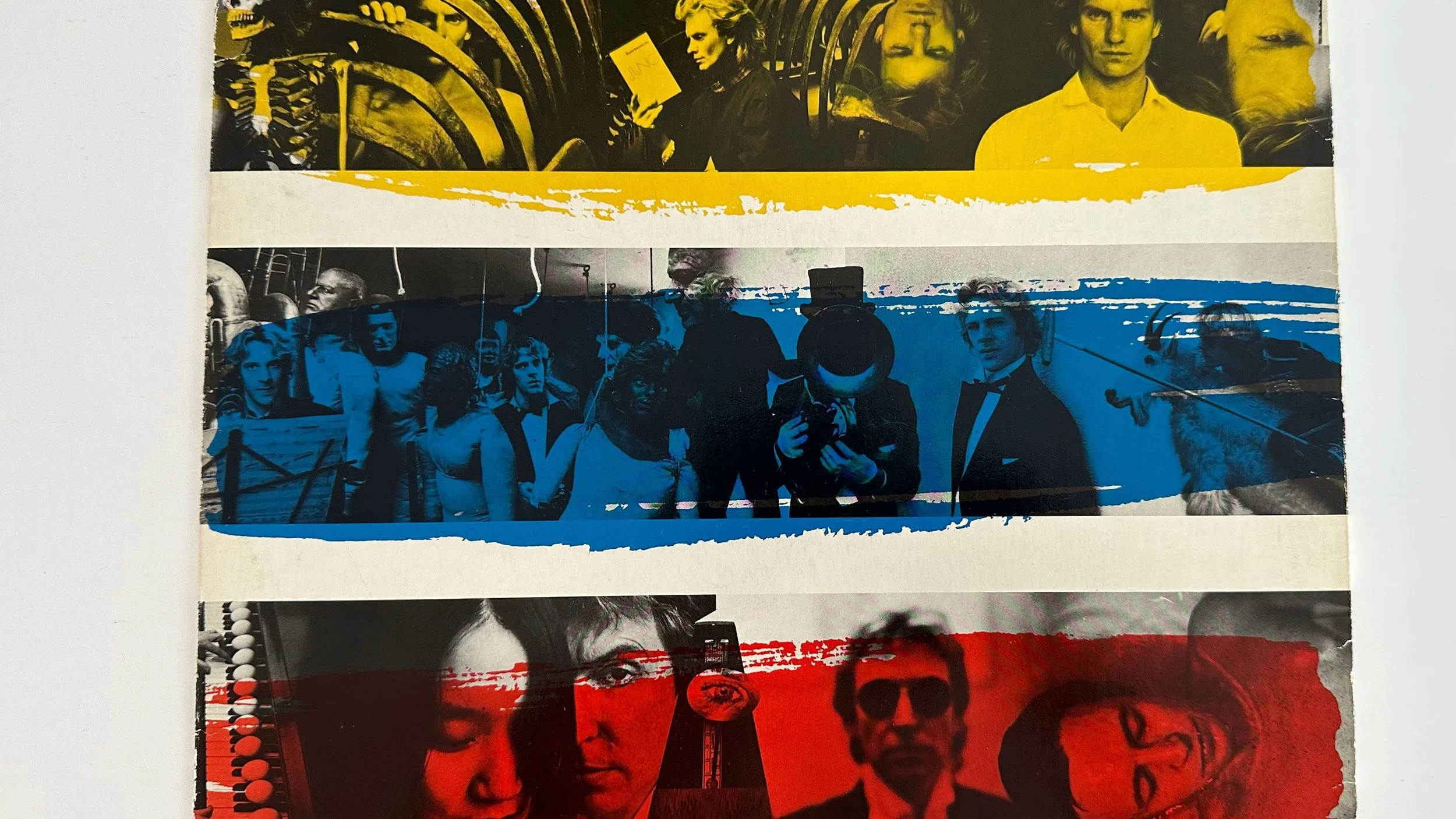
Synchronicity: The Police Fall Out of Sync in the Sunshine
Released in 1983, Synchronicity became both the Police’s greatest commercial triumph and their final studio album. Recorded at AIR Studios in Montserrat while tensions inside the band were close to breaking point, it remains a fascinating paradox: a record made in fragments that somehow sounds tight, focused, and completely in sync. From Carl Jung’s influence on the title to the chance overlap with Dire Straits at the end of the sessions, Synchronicity is the sound of a band falling apart and making one last great record.
Released in 1983, Synchronicity became both the Police’s greatest commercial triumph and their final studio album. Recorded at George Martin’s AIR Studios in Montserrat under strained conditions, it remains a fascinating paradox: an album shaped by personal conflict, yet remembered as one of the defining records of the 1980s.
By the time the Police arrived in Montserrat, they were one of the biggest bands in the world. Ghost in the Machine had been a major hit, a gruelling 100-night world tour had cemented their status, and expectations for the follow-up were enormous. Behind the scenes, though, the group was close to breaking point.
Sting, Andy Summers, and Stewart Copeland were dealing with broken marriages, the grind of tax exile, and mounting creative friction. Sting had become the dominant songwriter, which helped drive the band’s success but also deepened the resentment within it. For Summers and Copeland, it increasingly felt like Sting’s band rather than a true three-way partnership.
They returned to AIR Studios on the Caribbean island of Montserrat hoping the setting might help. Instead, the tensions hardened. Parts were recorded separately, overdubs were done at different times, and the three men often kept out of one another’s way. It was hardly a picture of unity.
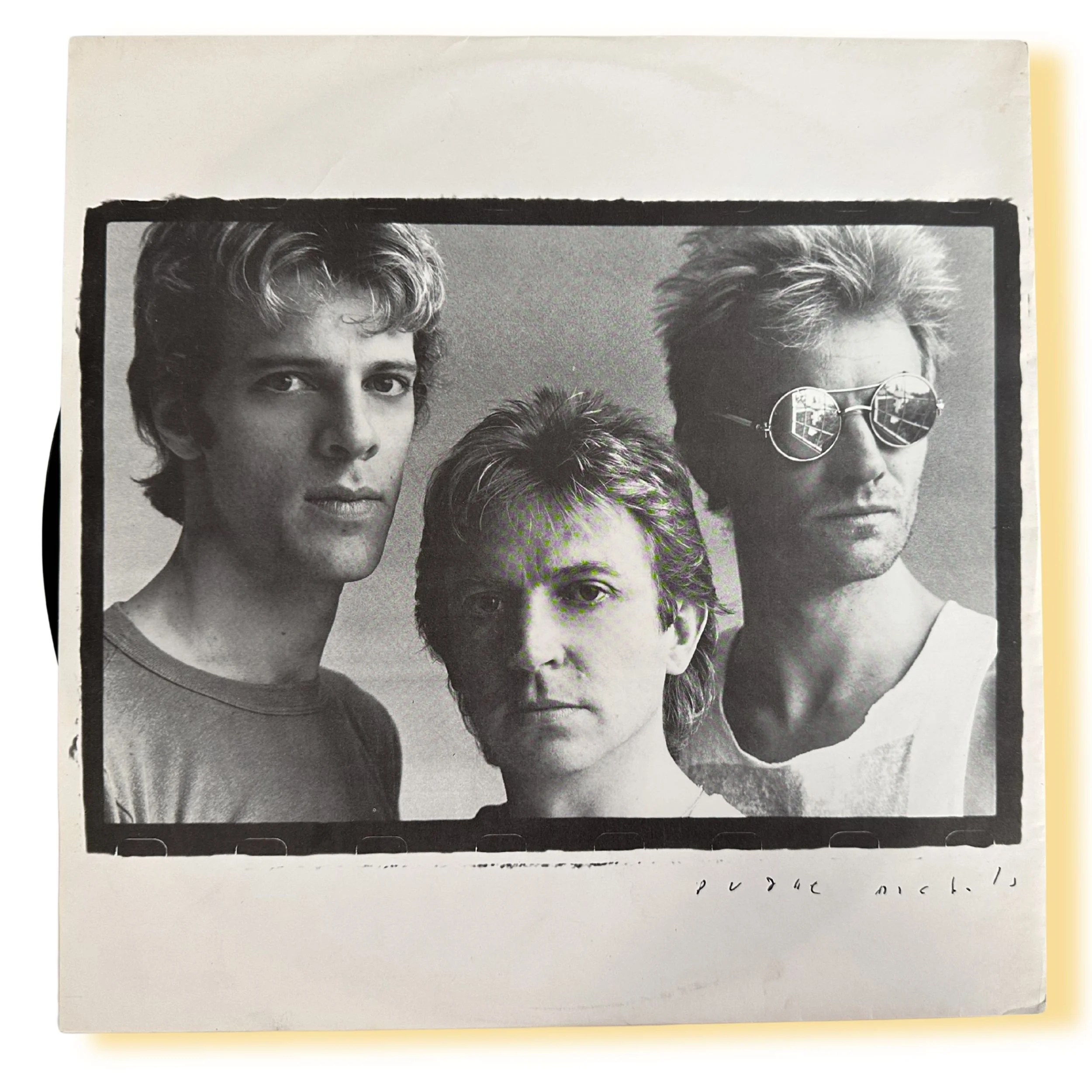
Inner sleeve portrait of the Police from Synchronicity.
And yet that is what makes Synchronicity so compelling. You would not know from the finished album that the band making it was splintering. The record sounds tight, sharp, and completely in command of itself.
The Meaning of the Title Synchronicity
The title came from Carl Jung’s idea of “synchronicity” — meaningful connections between events that do not have a straightforward cause-and-effect relationship. Sting, who was reading Jung at the time, used the concept as one of the record’s guiding ideas.
In Lyrics, Sting described writing many of the songs in the Caribbean while thinking about war, coincidence, and larger patterns of meaning. That mixture of distance, reflection, and unease runs through the album.
On Synchronicity, the Police move between songs that seem unrelated on the surface. “Walking in Your Footsteps” imagines prehistoric extinction. “Tea in the Sahara” turns to doomed longing and fatalism. Yet the record holds together through mood, tension, and atmosphere. The irony is hard to miss: an album named for hidden connections was made by a band whose own connections were fraying.
Songs That Hold the Album Together
However divided the recording process may have been, the finished album feels remarkably coherent. It opens with urgency and rarely lets go.
“Synchronicity I” is a frantic, tightly wound opening statement. “Walking in Your Footsteps” brings a moody, ominous feel, with lyrics that compare dinosaurs to humanity. “Tea in the Sahara”, inspired by Paul Bowles’ The Sheltering Sky, closes the album in a haunting and atmospheric way.
The major singles came thick and fast. “King of Pain” balances melancholy and melody with precision. “Wrapped Around Your Finger” is subtle and mesmerising, a masterclass in atmosphere.
“Every Breath You Take”, of course, became the album’s juggernaut single. The music video makes it look almost like a Sting solo piece, but the song remains inseparable from the Police story.
Andy Summers’ “Mother” remains the outlier. For some, it is a brave experiment; for others, it is the weakest track on the album. Either way, it adds to the sense that Synchronicity is not a polished machine. Its tensions are part of its character.
The Synchronicity Album Cover
The cover of Synchronicity matches the tensions inside the record. Designed by Jeff Ayeroff with photography by Duane Michals, it places black-and-white images of Sting, Andy Summers, and Stewart Copeland against bold strokes of red, yellow, and blue.
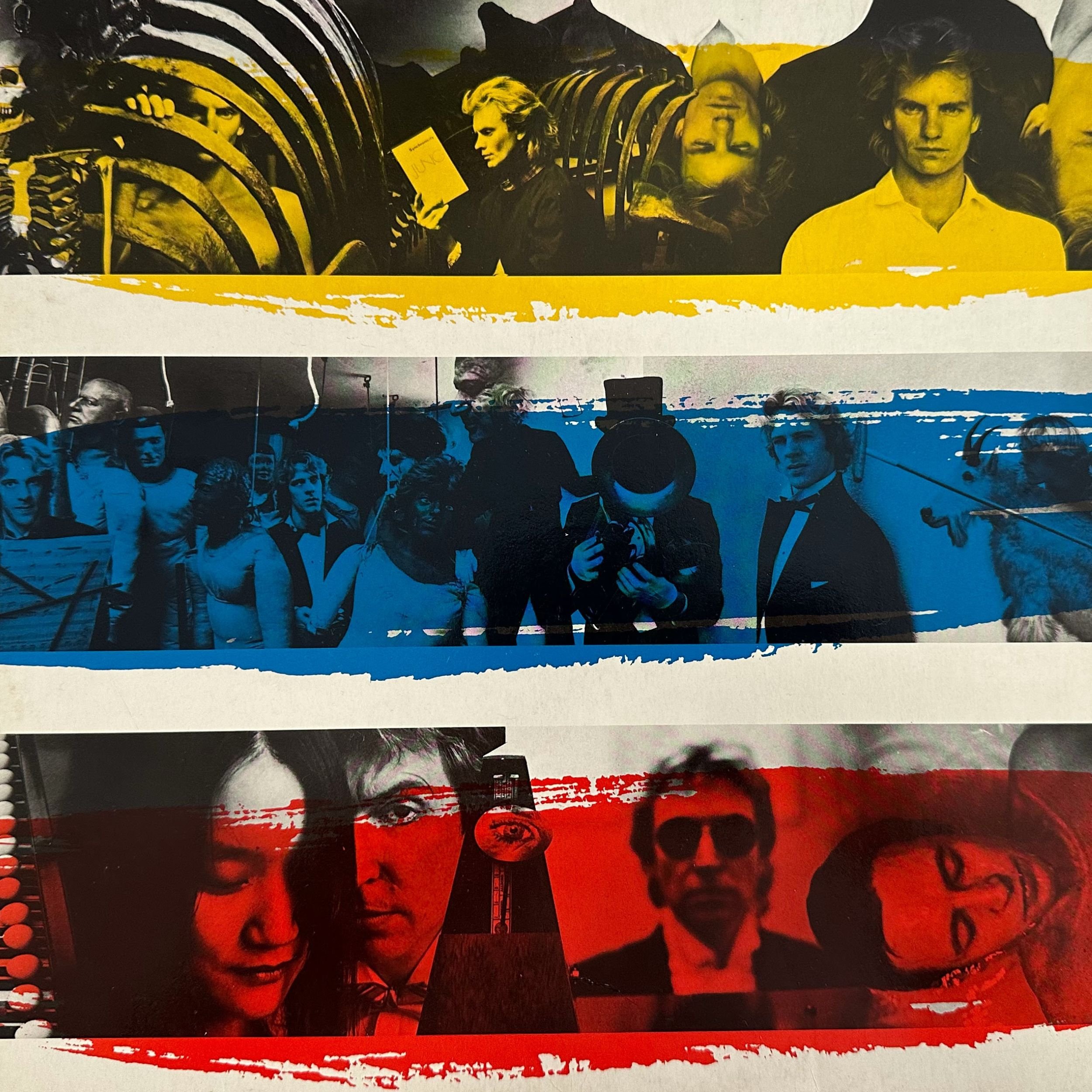
A close up of the Synchronicity ‘triptych’ album cover
Those colours suggest separation as much as unity. The three men share the same sleeve, but they do not quite look as though they belong in the same emotional space. That makes the artwork feel like a visual version of the album itself: fractured on the surface, but somehow still coherent.
Sting also pushed the idea further by having each band member choose his own imagery for the photographs without consulting the others. His choice of the American Museum of Natural History, with its dinosaur skeletons, tied neatly into “Walking in Your Footsteps”.
It is an iconic sleeve, but more importantly it suits the music. Like the album, it holds together even while its parts seem to pull away from one another.
Montserrat, Serendipity, and What Came Next
There is one final twist to the Montserrat story. After Synchronicity was finished, Sting stayed on the island. By chance, Dire Straits were the next major act in at AIR Studios, working on what would become Brothers in Arms. Out of that overlap came one of the most memorable moments in 1980s pop: Sting singing the “I want my MTV” line on “Money for Nothing”.
That moment feels fitting. Synchronicity was an album born out of tension, distance, and fractured relationships, yet it ended with a piece of pure studio serendipity. In its own way, that accidental connection suits the title perfectly.
Reception and Legacy
Upon release in June 1983, Synchronicity was a phenomenon. The album went on to top charts around the world, reached Platinum status in the United States within two months of release, and was eventually certified 8× Platinum by the RIAA.
It would prove the Police’s final studio album. Sting soon embarked on a solo career, while the band reunited only for tours and one-off events. That gives Synchronicity an unusual place in their catalogue: not just a hit record, but the final completed statement from one of the most successful bands of the era.
Getting It Together in the Country: Traffic, Led Zeppelin and Classic Albums Recorded in the Countryside
From Traffic’s John Barleycorn Must Die to Led Zeppelin IV, this article traces how rural houses, cottages and residential studios helped shape some of the vinyl era’s most distinctive albums.
At the end of the 1960s, some of Britain’s leading artists began moving away from city studios and into cottages, country houses, and rural hideouts. In the vinyl era, that was no small thing. Recording equipment was bulky, temperamental, and expensive to move, but the rewards could be considerable: privacy, rehearsal time, and a different creative atmosphere. The result was a run of distinctive albums shaped not only by the music itself, but by the places in which songs were written, arranged, and recorded.
The phrase “getting it together in the country” is often linked with Steve Winwood and Traffic. When the band regrouped at Winwood’s Berkshire cottage in 1969, they emerged with a sound that was looser, warmer, and more reflective than before. The music press noticed, and the phrase stuck.
For younger readers, the significance may not be obvious. Today, an artist can record almost anywhere with a laptop and a modest setup. In the late 1960s and early 1970s, things were very different. Tape machines were heavy, studios were specialised spaces, and taking recording beyond the city meant effort, improvisation, and expense.
Most of these records are now discussed as classic rock, folk-rock, or progressive albums, but they also belong to a broader story about how musicians in the vinyl era changed the spaces in which records were made. Rural settings offered more than scenery. They offered time, freedom, and distance from the pressures of the conventional studio.
Recording Beyond the City Studio
These albums were not defined simply by country views or romantic ideas of escape. They were shaped by the practical and creative advantages of working away from London and other urban centres: more space, fewer distractions, and the chance to develop songs in a less hurried environment.
Here are five classic albums associated with country houses, rural rehearsal spaces, and residential recording environments. Together, they show how location became part of the creative process.
Five Classic Albums Shaped by Rural Recording
Traffic – John Barleycorn Must Die (1970)
Sheepcott Farm, Aston Tirrold, Berkshire
Having disbanded the previous year, Traffic quietly regrouped at Steve Winwood’s country cottage. What emerged was looser, warmer, and far more acoustic, anchored by their arrangement of the traditional song “John Barleycorn”, which gave the album its title.
The record helped define the idea of artists retreating to the countryside to make music on their own terms. It was not only a change of address, but a change of method and mood. In that sense, John Barleycorn Must Die stands near the beginning of this wider movement.
Genesis – Trespass (1970)
Christmas Cottage, near Dorking, Surrey
Before they were filling arenas, Genesis were holed up in a cold cottage with damp floors and woolly jumpers. Trespass is perhaps their most pastoral record, full of medieval imagery, acoustic textures, and the distinctly English atmosphere that would shape the early Peter Gabriel years.
Although the album was ultimately recorded in London at De Lane Lea Studios and Trinity Studios, it carries the clear influence of that winter in rural Surrey. The countryside did not provide the finished master tapes, but it did help shape the writing, rehearsal, and identity of the album.
Mike Oldfield – Tubular Bells (1973)
The Manor, Shipton-on-Cherwell, Oxfordshire
Mike Oldfield took up residence at The Manor, Richard Branson’s newly established residential studio in a grand country house. There he assembled Tubular Bells almost entirely on his own, overdubbing dozens of instruments with extraordinary precision.
The setting mattered. The scale of the house, the isolation of the location, and the freedom of working in a residential environment gave Oldfield the time and concentration required for such an ambitious project. The result is expansive, eerie, and full of atmosphere: not folk music, but certainly a record that feels shaped by open space and distance from the city.
Led Zeppelin – Led Zeppelin IV (1971)
Headley Grange, Hampshire
One of the most famous examples of rural recording in rock history, Led Zeppelin IV was made in part at Headley Grange, a former workhouse in the Hampshire countryside. There was no conventional studio inside until the Rolling Stones Mobile Studio was parked outside, allowing the band to record in the building itself.
The house became part of the sound. From John Bonham’s thunderous drums to the quieter passages of “Stairway to Heaven”, Headley Grange gave the sessions an atmosphere that a standard studio could not easily reproduce. The album’s acoustic and folk-influenced side is just as important here as its weight and power. “The Battle of Evermore”, featuring Sandy Denny, is one of the clearest examples.
Genesis would later record parts of The Lamb Lies Down on Broadway at Headley Grange, though that album turned the setting toward something darker and more urban in spirit. Even so, Headley Grange remained one of the defining rural recording locations of the era.
Fairport Convention – Liege & Lief (1969)
Farley Chamberlayne, Hampshire
After the van crash that killed drummer Martin Lamble, Fairport Convention retreated to a house in the Hampshire countryside to mourn, regroup, and begin again. The result was Liege & Lief, the album that did more than any other to define English folk-rock.
While the music was electrified, its roots were deeply traditional: songs of war, drink, and death drawn from older sources and reshaped for a modern audience. From the opening “Come All Ye” onward, the album feels like a decisive statement of purpose. Rural retreat, in this case, was not just a matter of atmosphere. It was part of the band’s reinvention.
There is a small irony here: the band took its name from Fairport, the North London house where they had first rehearsed. Their story began in suburbia, but one of their defining records took shape in the countryside.
Other Albums with Rural Recording Connections
Not every artist made a full album in the countryside, but many were touched by the same impulse.
Paul McCartney recorded McCartney in his home studio in Campbeltown, Scotland, not long after the Beatles split.
Van Morrison channelled rural Ireland in Veedon Fleece, even if the album itself was recorded in California.
Heron recorded their debut largely outdoors in a Berkshire field, complete with birdsong.
John Martyn captured “Small Hours” by recording outside at Chris Blackwell’s house near a lake at Woolwich Green, with the surrounding hiss and ambience left on the track.
Taken together, these records suggest that rural recording was not a novelty. It was part of a broader shift in how artists thought about space, sound, and the making of albums.
Why Rural Recording Mattered in the Vinyl Era
There was a time when getting it together in the countryside was not just a metaphor. It meant hauling tape machines down muddy lanes, running power cables into draughty rooms, and accepting that birdsong, weather, and the character of a building might all find their way into the finished record.
That idea did not disappear. It evolved. Many artists later built professional studios in rural settings, formalising what had once been improvised.
Peter Gabriel’s Real World Studios, in the village of Box, is one notable example. Sting found inspiration for Ten Summoner’s Tales after moving his family to Lake House, a sixteenth-century manor in the English countryside. George Martin, after Abbey Road and AIR Studios in London, took the idea even further with AIR Montserrat, a destination studio designed to remove artists from everyday pressures altogether.
In the vinyl era, albums were shaped not just by songs, musicians, and producers, but by the places in which they came together. For a generation of artists, the countryside offered more than escape. It offered a different way of making records.
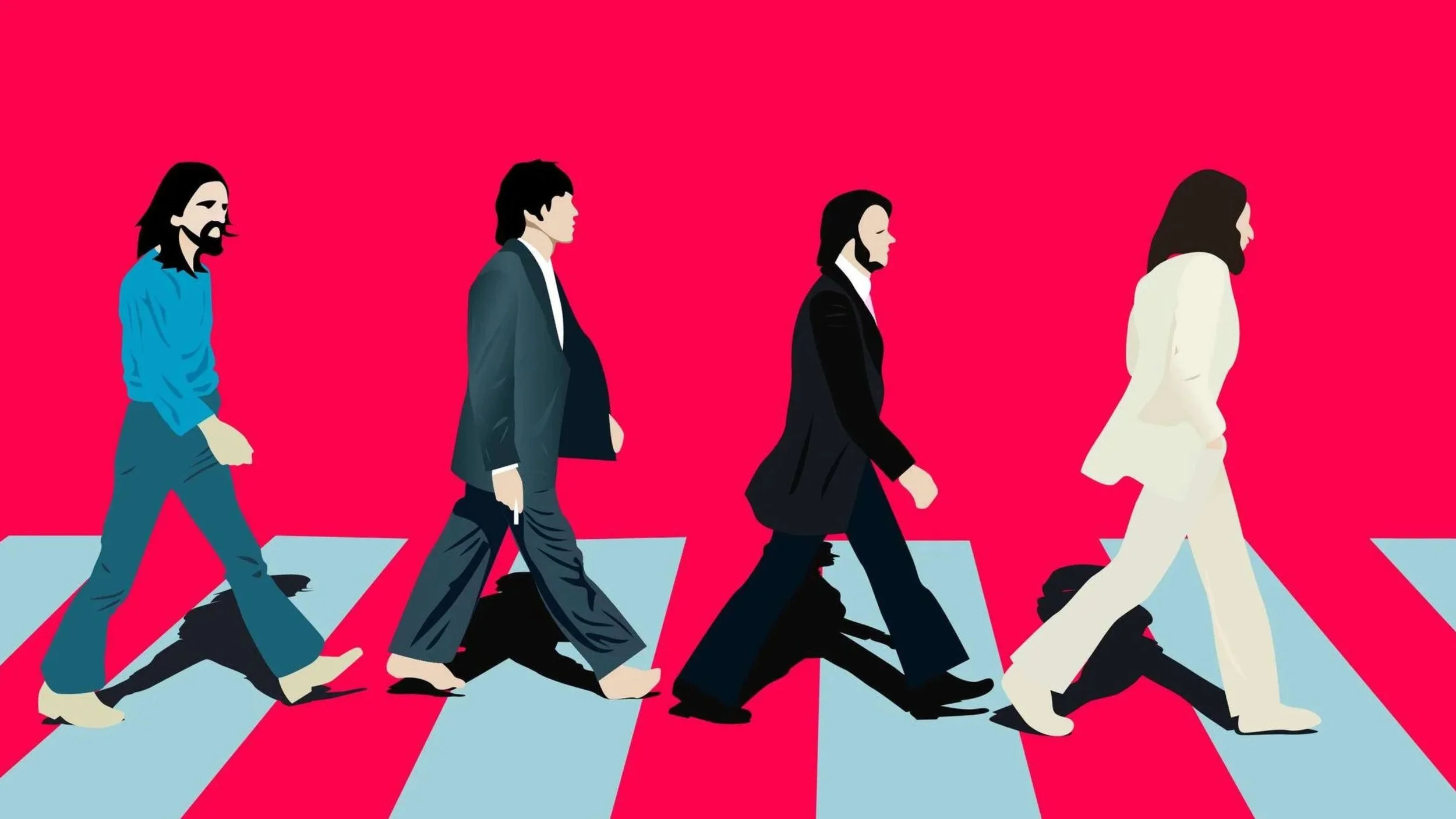
Abbey Road: The Story Behind The Beatles’ Final Recorded Album
Released in 1969, Abbey Road was the last album The Beatles recorded together, even if Let It Be arrived later. Its songs, sequencing and sleeve helped make it one of the defining LPs of the vinyl era.
Released in 1969, Abbey Road stands as the last album The Beatles recorded together, even if Let It Be would arrive later. That gives it a unique place in their story: not the final release, but the final completed work from the band as a functioning unit. Heard in the context of the vinyl era, Abbey Road feels like a closing chapter, polished, melodic, inventive and carefully sequenced, with one of the most celebrated second sides in popular music.
Abbey Road – Album Details
Release Date: 26 September 1969
Label: Apple Records
Recording Studio: EMI Studios, Abbey Road, London
The Backstory to Abbey Road
By the time The Beatles began work on Abbey Road, the group was no longer held together by the easy cohesion of its earlier years. The difficult Get Back sessions had exposed personal and creative strains, while the band’s business affairs were becoming harder to untangle. Brian Epstein was gone, Apple was proving chaotic, and the argument over management had opened a serious divide, with Allen Klein backed by John Lennon, George Harrison and Ringo Starr, but opposed by Paul McCartney. Around the same period, Lennon and McCartney were also losing control of Northern Songs, the company that held the publishing rights to their catalogue.
Yet the strain was not only financial. The Beatles had entered the second half of the 1960s as the most famous group in the world, but by 1969 they were also four wealthy, influential young men whose lives were moving in different directions. They still shared history, instinct and musical chemistry, but the old sense of moving as one was beginning to fade.
That is part of what gives Abbey Road its emotional force: it sounds like a band capable of extraordinary togetherness in the studio, even as that togetherness was becoming harder to sustain beyond it.
The Songs That Give Abbey Road Its Shape
Abbey Road opens in John Lennon’s voice, and Come Together gives the album an immediate sense of weight and mystery. Originally conceived around Timothy Leary’s political slogan before becoming something stranger, the song works less as a clear statement than as a mood piece: dense, bluesy and full of surreal detail. It gives the album a darker opening edge, one that runs through much of the first side.
That mood is balanced by Something, George Harrison’s great love song, inspired by Pattie Boyd. If Come Together is murky and elusive, Something is poised and direct. It is one of the clearest signs that Abbey Road was no longer driven only by Lennon and McCartney. Harrison had become a major writer in his own right, and on this album his songs do not feel like supporting contributions. They help define the record.
Ringo Starr’s Octopus’s Garden brings a note of warmth and release before side one closes with I Want You (She’s So Heavy), one of the most intense performances in the Beatles catalogue. Its abrupt ending gives the first side a jolt of finality, as if the tension surrounding the band had briefly broken through the album’s surface control.
Side Two: Release, Medley and Farewell
If side one carries strain and weight, side two opens with light. Here Comes the Sun, written by George Harrison at Eric Clapton’s Hurtwood Edge home, feels like release after pressure: warm, melodic and deceptively simple. Harrison later recalled escaping the business tensions around Apple, walking in the garden with one of Clapton’s acoustic guitars, and writing the song there. Placed at the start of side two, it does more than provide one of the album’s best-known songs.
From there, Abbey Road moves into the sequence that has helped define its reputation. The side-two medley turns fragments, sketches and unfinished ideas into something larger and more purposeful than the individual parts might suggest on paper. Sun King, Mean Mr Mustard, Polythene Pam and She Came in Through the Bathroom Window are not presented as isolated songs so much as linked movements, each one carrying momentum into the next.
That sense of movement is part of what makes the album such a strong vinyl experience. Side two feels designed to be heard in order, with each passage gaining meaning from what comes before and after it. Even She Came in Through the Bathroom Window, which would later enjoy a second life through Joe Cocker, works here as part of a larger design rather than a standalone set piece.
The medley then gathers itself for its final stretch: Golden Slumbers, Carry That Weight and The End. This closing run gives Abbey Road its feeling of arrival. It is grand without sounding inflated, emotional without losing control. Ringo Starr’s only ever drum solo adds to that sense of occasion, as do the traded guitar lines that follow, before the album reaches one of the most quoted closing sentiments in popular music.
“And in the end
The love you take
Is equal to the love you make”
Side two is a large part of what makes Abbey Road so enduring, showing The Beatles still capable of shape, discipline and surprise at a moment when the group itself was beginning to pull apart. Heard in sequence, Abbey Road feels less like a collection of songs than a carefully structured farewell.
The Abbey Road Cover
The sleeve of Abbey Road is as famous as the music it contains. Photographed by Iain Macmillan on 8 August 1969, the image shows John Lennon, Ringo Starr, Paul McCartney and George Harrison walking across the zebra crossing outside EMI Studios on Abbey Road in North London.
The shoot was famously simple: Macmillan stood on a stepladder in the middle of the road while police briefly stopped traffic, capturing a handful of frames as the band walked back and forth across the crossing. One of those images became the cover, and it quickly turned into one of the most recognisable photographs in popular music.
For vinyl listeners, it also captures something essential about the era itself: the album sleeve as part of the experience, a visual doorway into the record inside.
The crossing outside Abbey Road Studios remains one of the most visited music landmarks in London, and you can read more about it in our Wine, Travel & Song guide to the Abbey Road crossing and studios.
And in the end…
Abbey Road was not the final Beatles release, but it was the last album the band recorded together. Within a year the group had formally dissolved, and the four musicians moved into separate careers that would shape the 1970s in very different ways. The album itself endured not only as a creative high point but as a commercial landmark too, reaching Platinum status in the UK and remaining one of the Beatles’ most successful long players.
From Abbey Road to The Dark Side of the Moon, London’s studios shaped some of the most important records of the vinyl era. Read our guide to the classic albums recorded in London.
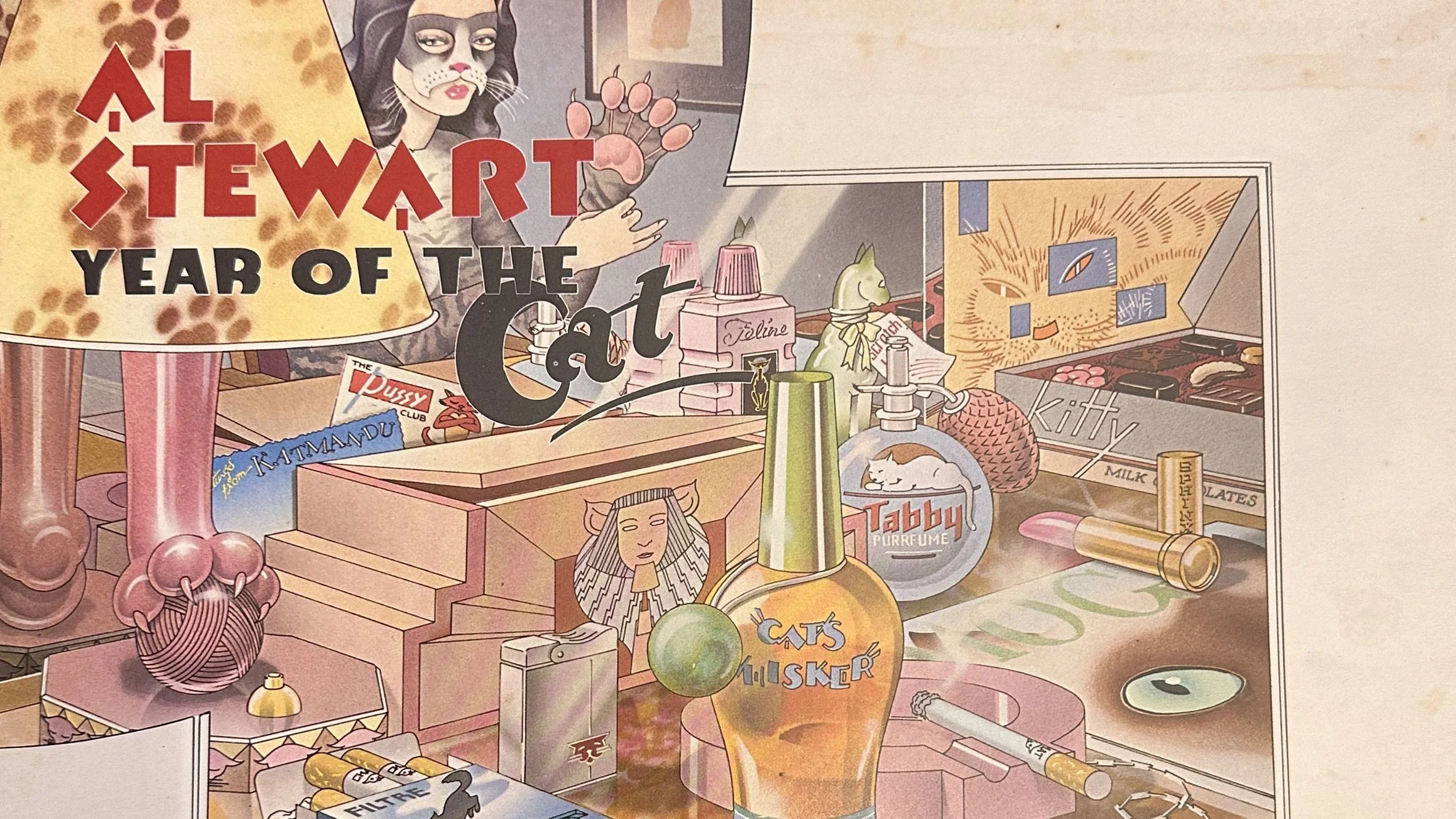
Al Stewart – Year of the Cat (1976 Album Story, Recording & Legacy)
Excerpt: Released in 1976, Year of the Cat marked Al Stewart’s breakthrough in America. Recorded at Abbey Road and produced by Alan Parsons, the album’s story extends far beyond its famous title track.
Released in September 1976, Year of the Cat was the album that transformed Al Stewart from respected British folk troubadour into an international recording artist. It was his sixth studio album, and although he had been active throughout the early seventies, this was the record that carried him into American FM radio rotation and lasting commercial success.
While the title track has never really left the airwaves, the album around it deserves equal attention. This is not simply a vehicle for one song. It marks a turning point in Stewart’s sound, production values and global reach.
The Breakthrough Moment in 1976
By the mid-1970s, Stewart had built a steady following through albums such as Past, Present and Future and Modern Times. His writing drew on history, literature and cinematic imagery rather than confessional autobiography. Year of the Cat refined that approach and placed it within a more expansive studio setting.
The album was released on RCA Records and became a major success in the United States, reaching No. 5 on the Billboard 200 and eventually achieving Platinum certification. In the United Kingdom, its chart performance was comparatively modest, but its long-term cultural footprint proved far greater than its initial peak suggested.
This was the record that crossed the Atlantic decisively.
Musical Themes
The musical arrangements expanded beyond acoustic folk textures into layered keyboards, clean electric guitars and extended instrumental passages. The production is precise but never clinical. There is space in the mix, and the dynamics are carefully controlled, allowing the storytelling to remain central.
The title track’s extended instrumental section, including the now-iconic saxophone solo performed by Phil Kenzie and the distinctive piano introduction by Peter Wood, reflects that studio confidence. At over six minutes, it was ambitious for a single, yet radio embraced it.
The album’s sound sits comfortably within the polished end of 1970s folk rock and soft rock, without losing Stewart’s literary core.
Beyond the Title Track
Although “Year of the Cat” became the signature song, the album opens with “Lord Grenville”, a maritime narrative that immediately signals Stewart’s historical leanings. “On the Border” carries Spanish Civil War imagery and political undertones, while “Sand in Your Shoes” offers a more reflective, almost wistful mood.
There is a consistent sense of movement throughout the record. Ports, borders, distant cities and shifting tides recur as themes. Stewart writes in scenes rather than confessions. His protagonists feel observed rather than autobiographical. In a sense this album shares similarities with Gerry Rafferty’s City to City that would soon achieve similar radio success, Stewart’s approach is less inward and more outward-looking. Where Rafferty’s songs often feel personal and urban, Stewart’s feel cinematic and geographically expansive.
Longevity Beyond the Charts
For such a great album, and certainly a ‘classic’ track the album spent only a brief period inside the UK Top 40. In the United States, however, it became a defining FM radio staple. Over time, the title track in particular grew into one of the most recognisable soft rock recordings of the decade that still gets airtime.
Its endurance is not built on chart statistics alone. It rests on structure, arrangement and atmosphere. The combination of Stewart’s narrative lyricism and Parsons’ controlled production created something that has aged more gracefully than many of its mid-seventies peers.
Nearly five decades later, Year of the Cat continues to represent the moment when British folk songwriting merged seamlessly with American radio sophistication.
“On a morning from a Bogart movie
In a country where they turn back time
You go strolling through the crowd like Peter Lorre
Contemplating a crime
She comes out of the sun in a silk dress running
Like a watercolour in the rain
Don’t bother asking for explanations
She’ll just tell you that she came”
Who was Peter Lorre?
Peter Lorre, name-checked in the opening verse of Year of the Cat, was a distinctive film-noir actor best known for roles in The Maltese Falcon, Fritz Lang’s M, and Casablanca. His presence in the lyric reinforces the song’s cinematic opening scene.
Where was Year of the Cat recorded?
Year of the Cat was recorded primarily at London’s Abbey Road Studios, with additional recording and mixing at Davlen Sound Studios in North Hollywood, Los Angeles. Alan Parsons, whose reputation had been cemented through his engineering work on Pink Floyd’s The Dark Side of the Moon, both engineered and produced the album. The title track itself was recorded at Abbey Road.
Further recording and mixing took place at Davlen Sound Studios, a relatively new facility at the time. Stewart would return there two years later to record parts of Time Passages (1978). The studio also hosted sessions for Fleetwood Mac’s Tusk, the ambitious follow-up to their hugely successful album Rumours. Davlen would later be purchased by Giorgio Moroder and renamed Larrabee Sound Studios, which remains active today.
Who Designed the Year of the Cat Album Cover?
The album cover was designed by Hipgnosis, the celebrated studio responsible for many iconic 1970s record sleeves, with illustration by Colin Elgie. It features a woman surrounded by feline imagery. In the mirror she appears to be preparing for a costume party, wearing cat-like makeup while the objects on her dressing table carry subtle cat motifs. The scene reflects the mysterious, slightly surreal atmosphere suggested by the album’s title track.
Elgie’s illustrations would also grace the covers of two Genesis albums: A Trick of the Tail and Wind & Wuthering.
Year of the Cat would remain Al Stewart’s greatest achievement. An album that still sounds as fresh as the day it was released.
From Year of the Cat to Abbey Road, London’s studios helped shape some of the most important records of the vinyl era. Read our guide to the classic albums recorded in London.
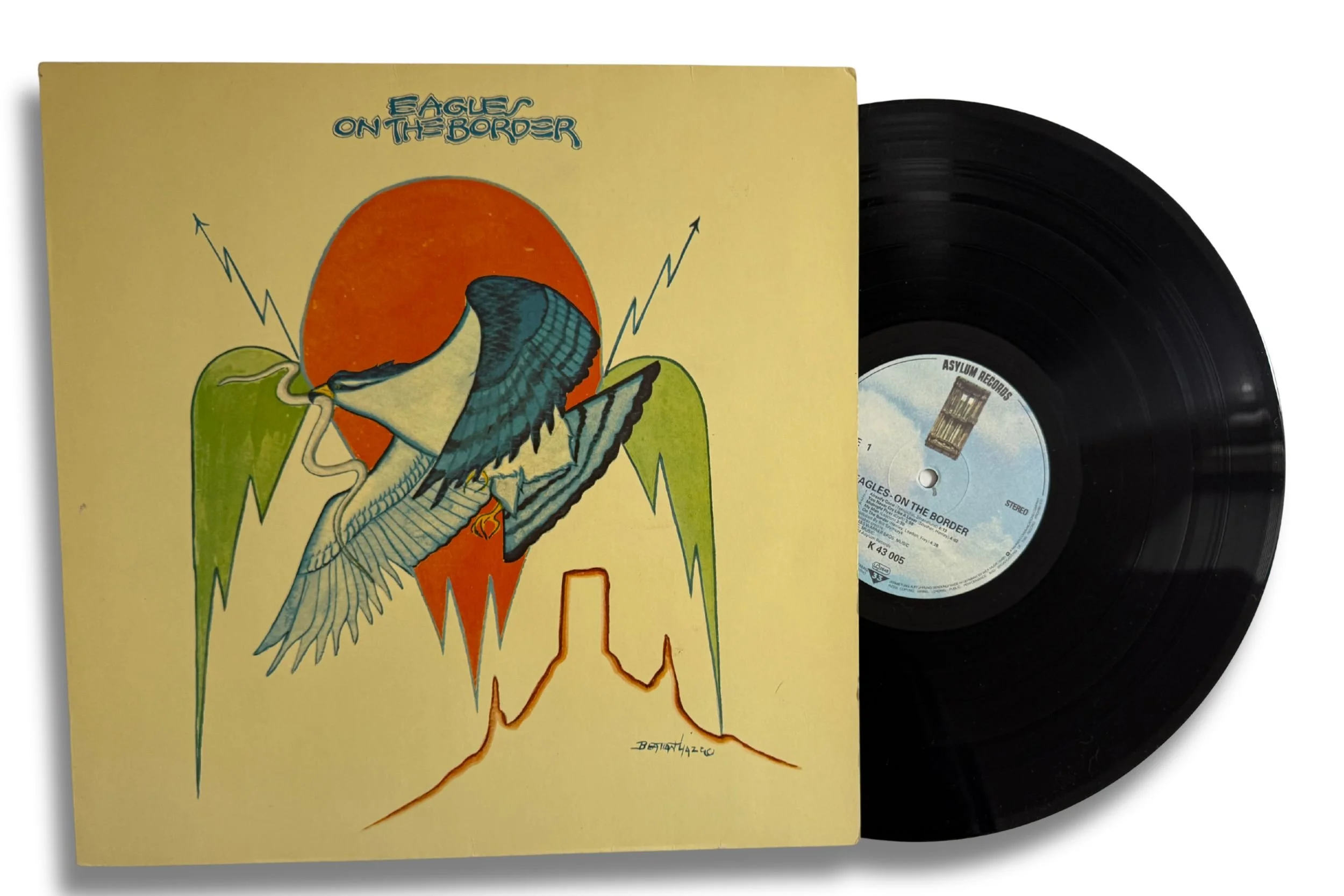
Eagles – On the Border (1974): Recording History, Songs and Review
Released in 1974, On the Border was the Eagles’ third studio album and a turning point in their sound. From the failed London sessions with Glyn Johns to the move to Los Angeles with Bill Szymczyk, this was the record that set the stage for Hotel California.
Released on March 22, 1974, On the Border was the Eagles’ third studio album and the record that marked their transition from country rock toward a harder, more radio-focused sound. Produced initially by Glyn Johns in London before being completed in Los Angeles with Bill Szymczyk, the album introduced Don Felder and set the band on the path toward One of These Nights and eventually Hotel California.
Commercially successful and home to the Eagles’ first US number one single, the album remains a pivotal moment in their evolution. Artistically, it is one of their more debated releases.
Recording On the Border: From London to Los Angeles
Once again, the album was to be recorded in London with Glyn Johns in the producer’s chair. His work with The Rolling Stones and The Who had established him as a producer known for clarity and restraint, and his approach had defined the spacious country-rock sound of the Eagles’ first two albums. Johns favoured balance, air and natural instrumentation, but by 1974 the band were beginning to move in a different direction.
Dissatisfied with the early sessions, the Eagles halted recording and returned to Los Angeles. At the Record Plant they brought in Bill Szymczyk, whose approach was firmer and more radio-conscious. The shift was immediate. The guitars became more assertive and the production tightened.
Don Felder was added to the line-up during these sessions, and his arrival marked the beginning of the more aggressive twin-guitar sound that would define the Eagles through the mid-1970s. Szymczyk would remain with the band through One of These Nights and Hotel California, becoming central to their commercial peak.
On the Border Album Details
Artist: Eagles
Released: March 22, 1974
Label: Asylum Records
Producers: Glyn Johns and Bill Szymczyk
Studios: Olympic Studios, London and Record Plant, Los Angeles
Billboard 200 peak: No. 17
UK Chart Park: No. 28
The album later produced the Eagles’ first US number one single, The Best of My Love, in March 1975.
Contemporary Reception in 1974
When On the Border was released, critics noted the change in direction. Writing in Rolling Stone on May 23, 1974, Janet Maslin described the album as
“...a tight and likable collection, with nine potential singles working in its favor and only one dud.”
The comment captured both the record’s accessibility and its unevenness. The shift toward a more radio-ready sound was clear, and commercially it proved effective. The album reached No. 17 on the Billboard 200, and the band’s breakthrough chart success soon followed.
Album Cover and Visual Identity
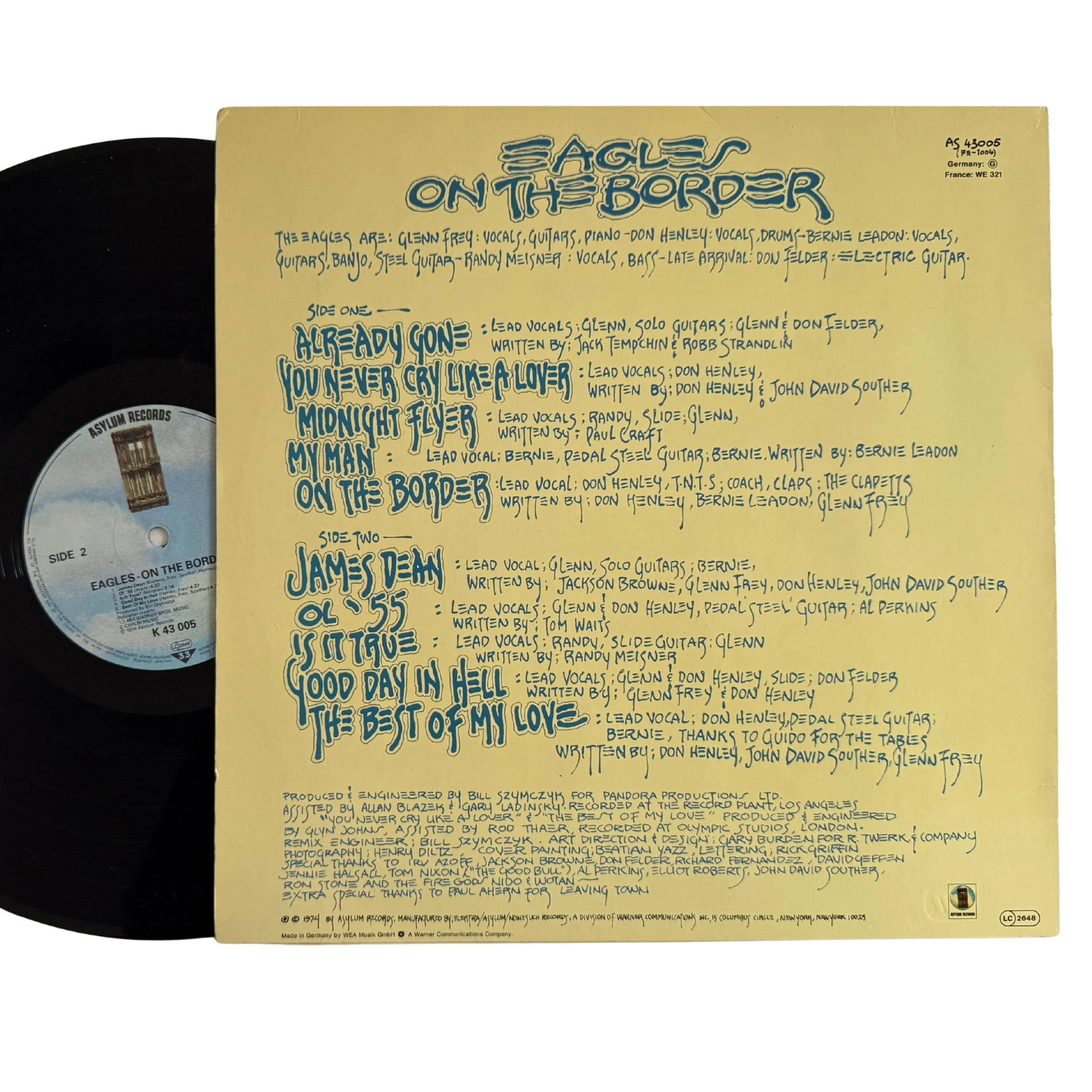
The cover of On the Border moves away from the character-driven outlaw imagery of Desperado and towards a more stripped-back desert aesthetic. The flowing “Eagles” script, first introduced on their 1972 debut, remains in place but is presented more prominently and with greater clarity. As the music tightened and moved toward mainstream rock radio, the visual identity became less theatrical and more direct.
On the Border Key Album Tracks
Already Gone
The closest thing here to a straight-ahead rocker. Confident and built for radio. It remains one of the few tracks from this album that I happily return to.
The Best of My Love
Written by Henley, Frey and J.D. Souther, this became the Eagles’ first Billboard number one in March 1975. It is easily the strongest track on the record. Controlled, melodic and emotionally measured, it hinted at the band’s ability to balance intimacy with mass appeal.
James Dean
Originally left over from the Desperado sessions. Some fans admire its energy. I have never fully warmed to it. It did not chart significantly, though it became a staple of their early live shows.
On the Border
The title track revisits outlaw imagery, but the thematic cohesion of Desperado is absent. What remains is looser and less focused.
You Never Cry Like a Lover
Polished and co-written with J.D. Souther, but not especially memorable within the wider Eagles catalogue.
Is On the Border the Eagles’ Weakest Album?
For me, yes.
Can I call myself an Eagles fan if I do not love all of their albums? I think so. They have been part of my listening life for decades. Hotel California and Desperado still spend time on the turntable. But On the Border is the one I return to least.
It lacks the cohesion of Desperado and the consistency of what followed with One of These Nights. Beyond The Best of My Love and Already Gone, the record feels uneven. It is also the only Eagles album that contains a song I actively dislike, and that inevitably colours my overall view.
Yet it was a necessary transitional record. Without the friction of the London sessions, without the move to Los Angeles, and without the arrival of Don Felder and Bill Szymczyk’s firmer production, the band might never have reached the creative and commercial peak of Hotel California.
On the Border may not be their finest hour, but it is the album that set the stage for what came next. In that sense, its importance outweighs my reservations.
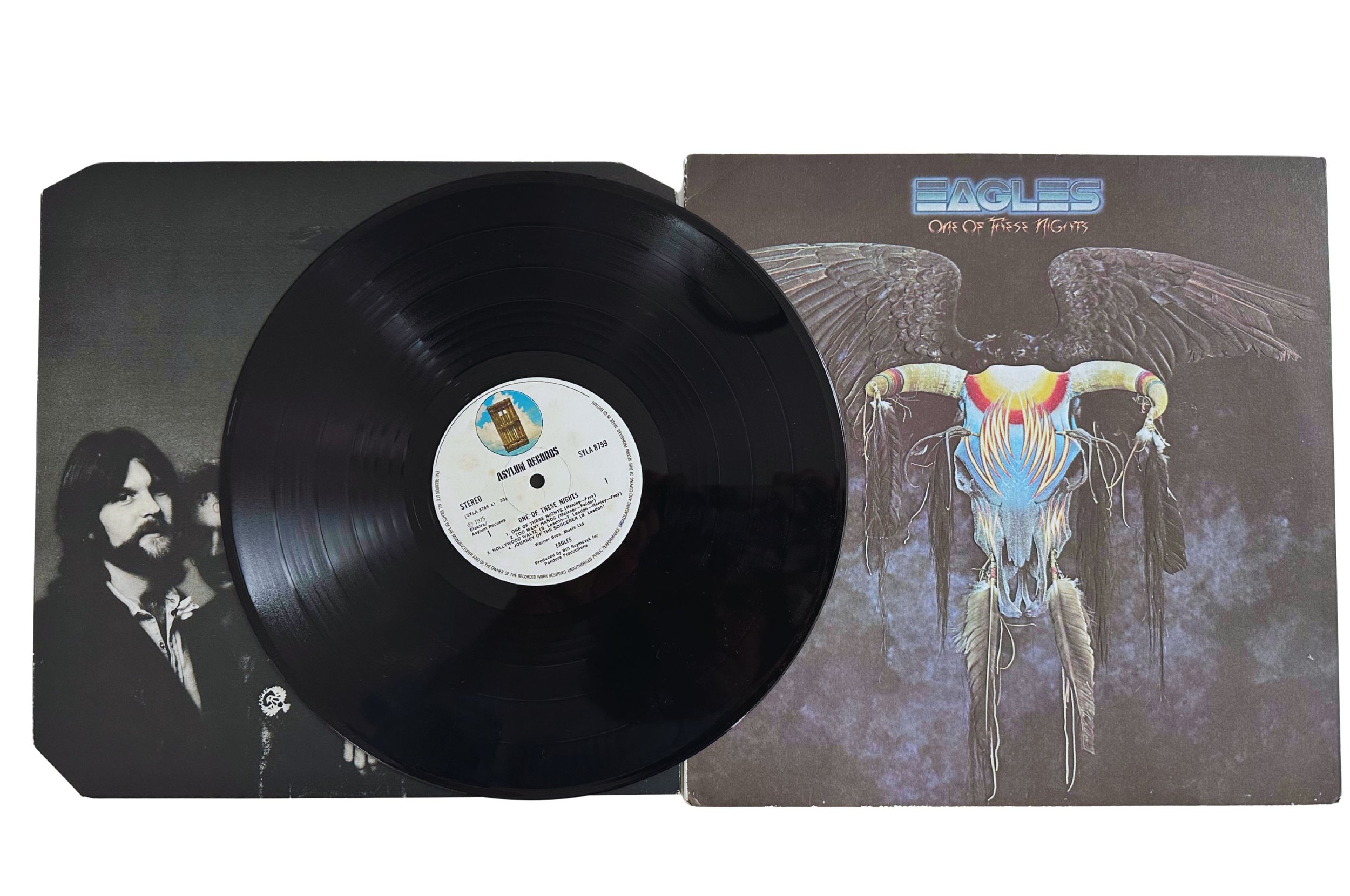
One of These Nights (1975): The Eagles’ Turning Point Album
Released in June 1975, One of These Nights marked the moment the Eagles sharpened both their sound and their identity. Recorded with producer Bill Szymczyk, the album bridged the gap between their early country-rock roots and the darker, more controlled direction that would soon lead to Hotel California.
Released in June 1975 on Asylum Records, the eagles one of these nights album arrived at a moment when the band was moving beyond their country-rock roots and defining the polished California sound that would soon make them one of the biggest acts in the world.
Arriving a year before Hotel California, this landmark album one of these nights became their first No.1 on the US Billboard 200 and confirmed a group reaching full confidence in the studio. Produced by Bill Szymczyk, it brought together tighter songwriting, darker subject matter, and a growing sense of ambition.
Listening from England, it felt like another dispatch from a distant America. Stories of Hollywood, the Sunset Strip, and nocturnal Los Angeles seemed far removed from overcast skies at home, yet the record’s success made those places feel strangely familiar.
Artist: Eagles
Album: One of These Nights
Released: June 1975
Producer: Bill Szymczyk
Studios: Criteria Studios (Miami), Record Plant (Los Angeles)
Label: Asylum Records
Key Songs and Cultural Impact
The album opens with its title track, a moody, slow-burn groove built on Don Felder’s distinctive chord progression. Sung by Don Henley and co-written with Glenn Frey, it captures the dark glamour of mid-70s Los Angeles — desire, danger, and a sense of restless nights that might lead anywhere.
Searchers still ask “who sang One of These Nights?” and “what does it mean?” At its heart it’s a song about chasing passion and release in the neon-lit California night. It remains one of their defining singles, still racking up millions of streams.
The Songs That Shaped One of These Nights
One of These Nights
Written by Don Henley and Glenn Frey, the title track of the one of these nights album captures the dark glamour of mid-Seventies Los Angeles—desire, danger, and a restless sense of nocturnal tension. Built on Don Felder’s distinctive chord progression and driven by Henley’s soaring lead vocal, the song explores the pursuit of passion and escape in the neon-lit California night. Henley described it as a song about an elusive object of desire, "part angel, part devil," while Frey often pointed to the simple procrastination of everyday ambition: promising yourself you will finally chase what you want "one of these nights." With its lush harmonies and brooding groove, it remains one of their defining singles and a masterclass in atmospheric songwriting.Lyin’ Eyes
Perhaps the most enduring song on the album, Lyin’ Eyes tells the story of a young woman who trades freedom for security, only to slip back to the Strip at night in search of escape. Don Henley later linked the song to evenings spent observing the quiet dramas unfolding at Dan Tana’s, just along the street from The Troubadour, where the band watched relationships play out across candlelit tables. That sense of lived-in detail gives the song its credibility, with rich harmonies carrying a narrative that feels grounded rather than theatrical.
Lyin’ Eyes As one of the standout tracks on the one of these nights album, "Lyin’ Eyes" is perhaps the most enduring song in the Eagles' catalogue. It tells the story of a young woman who trades freedom for security, only to slip back to the Sunset Strip at night in search of escape. Don Henley later linked the song to evenings spent observing quiet dramas at Dan Tana’s, just along the street from The Troubadour, where the band watched relationships play out across candlelit tables. That lived-in detail grounds this essential album track with a narrative credibility that elevates it far beyond standard pop storytelling.
Take It to the Limit Serving as a major vocal showcase for bassist Randy Meisner on the one of these nights album, this sweeping ballad quickly became a live concert highlight and one of the Eagles' signature songs. Its yearning for “one more night” of love or freedom captures the soaring ambition of the record, standing as one of the group's most polished studio achievements during their mid-Seventies peak.
journey of the Sorcerer As a banjo-led instrumental, Bernie Leadon’s composition stands distinctly apart from the rest of the one of these nights album. While the wider record signalled the Eagles’ shift toward a tougher, more refined rock sound, this track pulls from their earlier country-rock roots, recalling the looser production style of On the Border. In hindsight, it marks the definitive end of an era for the band. Beyond its role on the album, it holds a special place for British listeners as the iconic theme music for Douglas Adams’ The Hitchhiker’s Guide to the Galaxy on BBC Radio, transforming what once felt out of step into an enduring cult favourite.
I Wish You Peace ends out the album. This gentle acoustic ballad was written by Bernie Leadon alongside his then-girlfriend Patti Davis, daughter of Ronald Reagan. Often overlooked in retrospective reviews, its wistful lyrics and stripped-back arrangement reveal a softer side of the Eagles. With Leadon departing shortly after release, the track functions as an intimate parting gift within the broader arc of the album.
One of These Nights Meaning
The meaning of One of These Nights is two fold. On the surface there is an alluring feeling of attraction. Don Henley suggests there is an object of desire, "part angel and part devil," which captures the tension between attraction, danger, and complexity in a relationship. Co-writer Glenn Frey offers another meaning, “one of these nights” as that feeling of putting something off. “One of these nights I’m gonna do that thing ; one of these nights I am gonna get that girl.”
There is a potential third meaning, almost an in-joke with the band. The recording sessions were long and sometimes arduous as the band sought perfection, “one of these nights we’re gonna finish this record!”
Release and Commercial Impact
One of These Nights was both a critical and commercial success. It sold over four million copies in the US and was nominated for Album of the Year at the 1976 Grammys (losing to Paul Simon’s Still Crazy After All These Years). The single Lyin’ Eyes did win a Grammy for Best Pop Vocal Performance by a Duo, Group or Chorus.
The album’s consistency stood out. Where Desperado and On the Border felt patchy, this was a cohesive, confident work — a band finally arriving at their classic sound.
Album Artwork and Visual Identity
After the Western imagery of Desperado and the looser symbolism of On the Border, One of These Nights established the eagle as the defining visual emblem of the band.
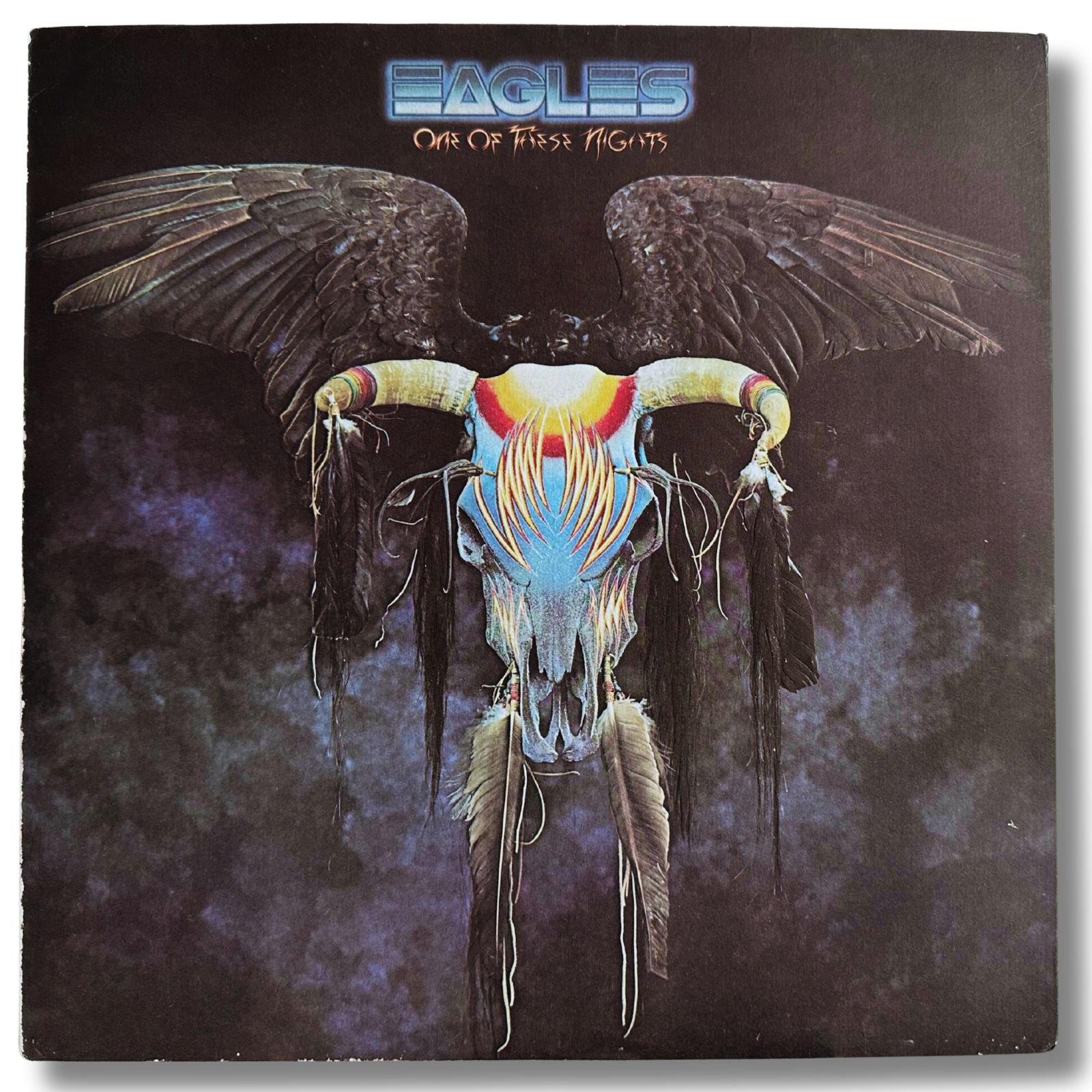
One of These Nights album cover, designed by Boyd Elder, released in 1975
As The Eagles album with the skull on the cover One of These Nights has become one of the Eagles’ most recognisable images. It presents a stylised eagle skull set against a dark, cosmic backdrop, stark and confrontational in tone, and very different from the imagery that had come before.
Designed by Boyd Elder, an artist whose work with painted animal skulls had already begun to attract attention in the American Southwest. His imagery fixed the eagle as a permanent part of the band’s visual identity, one that is still reflected in how the Eagles present themselves today.
One of These Nights marks the point where the Eagles’ direction became clear. Its controlled production, narrative songwriting, and visual identity set the framework for what would follow on Hotel California.
Nearly fifty years later, the album still stands as a precise record of a band arriving at full definition.
Exploring Tumbleweed Connection, Elton John’s Americana Experiment
Tumbleweed Connection was recorded in London, yet it draws deeply on American folklore and frontier mythology. Released in 1970, the album marked a creative turning point for Elton John and Bernie Taupin, as their writing moved into richer, more cinematic territory.
Elton John and Bernie Taupin were only a few years into their partnership when they created Tumbleweed Connection, a sepia-toned dive into American folklore recorded in the middle of London. More than five decades later, it remains one of the most confident and imaginative albums of their early years.
When Tumbleweed Connection arrived in 1970, Elton John was just twenty-three years old and already beginning to attract attention. This third studio album confirmed the promise of those first records and marked the moment when he and Bernie Taupin pushed their writing into richer, more cinematic territory, channelling Americana through imagined landscapes, frontier imagery and sepia-toned storytelling.
Recorded at Trident Studios in London with producer Gus Dudgeon, the album could hardly have been further removed from the dusty landscapes it evokes. Taupin had been steeped in stories of the frontier and the Civil War for years, reading American history long before either of them had travelled there. Those obsessions shaped the album far more than geography ever could. Together, they created a fully imagined world that felt old, weathered, and strangely believable.
John F. Higgins, writing on the official Elton John site, noted the creative shift between albums. He described how the pair moved away from the poetic British landscapes of their previous record and instead reached for the sepia colours of the American West, painting with broader, bolder strokes this time around.
Taupin’s lyrics are the backbone of the record. His storytelling brings to life the plains, mountains, saloons, and quiet backwaters of the American West. The imagery is vivid and confident, the writing full of small observations that deepen the atmosphere without drawing attention to themselves. Elton’s vocal delivery completes the picture. He sings with real conviction, carrying the weight of characters who feel older than he was at the time.
The album opens with “Ballad of a Well-Known Gun”, an energetic scene setter that drops you straight into its world. “Where to Now St Peter?” is a more reflective moment, following a worn-out gunslinger at the end of his life as he looks back on violence, regret and the choices that shaped him. “Amoreena” lightens the mood, a song about a gunslinger’s lover that drifts along on a gentle melody filled with longing.
Elton’s performance across the album feels inspired. His voice has both power and restraint, shifting between characters and moods with a maturity that belies his age. One of the great moments is “My Father’s Gun”, a moving piece about a young man trying to reconcile himself with his father’s past as a Confederate soldier. The vocal is full of emotion without tipping into sentimentality, and the production gives the song real presence.
Writing in Rolling Stone at the time, Jon Landau praised the strength of the melodies, the quality of the lyrics, and the overall assurance of the performances. Audiences seemed to agree. The album climbed to number two in the UK and number five in the United States, establishing Elton and Bernie as a partnership with remarkable range.
If you have not played Tumbleweed Connection for a while, give it another listen. The writing is sharp, the arrangements are full of character, and the album still feels as fresh and imaginative as it did in 1970.

What Makes a Classic Album? The Four Essential Ingredients, from a Vinyl Historian
A classic album is more than a collection of great songs. By looking at defining records from the vinyl era, this article explores four key ingredients that help explain why some albums endure, invite repeated listening, and continue to resonate decades after their release.
A classic album is a body of work that rewards repeated listening, defines a moment in an artist’s career, and continues to resonate long after its release. By looking at some of the defining albums of the vinyl era, can we identify the essential ingredients that turn a record into a classic? In this article, we suggest four key ingredients that support a classic album, with examples of records that fit the pattern and others that deliberately break it.
The Perfect Length: 45 Minutes or Less
Most classic albums come in at under 45 minutes. This is no coincidence. The limitations of a vinyl record mean that going beyond this point usually requires a double album, but length alone is not the deciding factor. What matters is how those 45 minutes are used.
Yes, the songs need to be strong, but just as important is the track sequencing and the way an album tells its story. Hotel California would not land in the same way without the title track opening the record. Rumours fades out to the restless howls of Stevie Nicks on Gold Dust Woman, rather than closing with the gentle calm of Songbird. And with Dark Side of the Moon, Pink Floyd created a continuous stream of music that works far more powerfully as a complete album experience than as a set of individual tracks.
A classic album should invite repeated listening. The right length allows you to flip the record over and start again without feeling fatigued. Compare this to sprawling double albums. Some are rightly legendary, including Exile on Main St. and The Wall. Others, however, like the White Album feel bloated or unfocused, with the discipline of editing replaced by excess.
Albums that get this right:
Pet Sounds - Beach Boys
Rumours - Fleetwood Mac
Dark Side of the Moon - Pink Floyd
Let it Be - the Beatles
Double albums that push the limit but still work:
The Wall - Pink Floyd
Quadrophenia - The Who
The Lamb Lies Down on Broadway - Genesis
Multiple Lead Singers: A Richer Soundscape
Some of the greatest albums feature more than one lead vocalist, adding contrast, depth, and variety. The interplay between different voices can give an album greater emotional range and help individual tracks feel connected rather than isolated.
Dark Side of the Moon gains much of its power from the way different voices are used not least fromClare Torry’s performance on The Great Gig in the Sky. Abbey Road is another masterclass in vocal variety, with McCartney, Lennon, Harrison, and Ringo each contributing a distinct character.
And what about the Harmony Game? he same is true of Crosby, Stills & Nash and their Laurel Canyon debut. Would Bridge Over Troubled Water be as powerful without Art Garfunkel’s lead vocals or the harmonies of both Simon & Garfunkel. Or the combined talents of Crosby, Stills and Nash on their eponymous debut album? Listen to the momentous Suite: Judy Blue Eyes to hear the power of many voices.
But that variety is not essential in every case. Some classic albums are shaped around a single, unmistakable voice Marvin Gaye, Joni Mitchell and Carole King are just three voices that carry a classic album without the need for more.
Albums that get this right:
Abbey Road - the Beatles
Crosby, Stills & Nash - Crosby, Stills & Nash
Dark Side of the Moon - Pink Floyd
Classic Albums with One Lead Singer
Blue - Joni Mitchell
Tapestry - Carol King
What’s Going On? - Marvin Gaye
A Mix of Tempos: Light and Shade
A great album takes you on a journey, with ebbs and flows, moments of intensity, and moments of reflection. If every track is an all-out rocker, it can become exhausting. If every song is a slow ballad, it risks becoming background music.
A classic album balances light and shade, shifting naturally between moods. Hunky Dory moves from the bright optimism of Changes to the reflective beauty of Life on Mars?. Purple Rain pairs anthemic highs such as Let’s Go Crazy with moments of emotional restraint like The Beautiful Ones. Sticky Fingers follows a similar pattern. It opens with the swagger and intensity of Brown Sugar, slows to the calm of Wild Horses, and continues to alternate tone and pace until the closing notes of Moonlight Mile.
Albums that balance tempo perfectly:
Hunky Dory - David Bowie
Sticky Fingers - The Rolling Stones
Love Over Gold - Dire Straits
Albums that stick to one mood, beautifully:
Nebraska - Bruce Springsteen
Harvest - Neil Young
A Cohesive Theme: The Album as a Journey
Many classic albums have an overarching theme, whether deliberate or subconscious. A strong theme unites the tracks, making the album feel like a complete work rather than just a collection of songs.
Hotel California explores fame, excess, and disillusionment. TAnimals uses allegory and satire to examine power, inequality, and control, drawing loosely on George Orwell’s Animal Farm. What’s Going On reflects Marvin Gaye’s response to war, race, and society. Lou Reed’s Berlin tells a bleak, linear story of love, addiction, and collapse, unfolding track by track like a novel set to music. Even when a theme is less explicit, a classic album often carries an emotional or sonic thread that runs from start to finish.
That doesn’t mean every great album needs a theme. Some albums are simply the result of a band working at its peak, as heard on Brothers in Arms, Thriller, and 1999. For many classics, however, a clear theme lifts the album beyond its individual songs and gives it the weight of an artistic statement.
Thematic masterpieces include:
Animals - Pink Floyd
Berlin - Lou Reed
Tommy - The Who
Classic albums with no obvious theme:
Music from the Big Pink - The Band
Led Zeppelin IV - Led Zeppelin
Do These Ingredients Make an Album Classic?
Of course, the beauty of music is that it's deeply personal. Some of my favorite albums break these 'rules' entirely. But when I look at the records that are widely considered classics, they tend to share these elements.
What about you? What’s your definition of a classic album? Drop us a comment or message. We’d love to hear your take.