
Synchronicity: The Police Fall Out of Sync in the Sunshine
Released in 1983, Synchronicity became both the Police’s greatest commercial triumph and their final studio album. Recorded at George Martin’s AIR Studios in Montserrat under strained conditions, it remains a fascinating paradox: an album shaped by personal conflict, yet remembered as one of the defining records of the 1980s.
By the time the Police arrived in Montserrat, they were one of the biggest bands in the world. Ghost in the Machine had been a major hit, a gruelling 100-night world tour had cemented their status, and expectations for the follow-up were enormous. Behind the scenes, though, the group was close to breaking point.
Sting, Andy Summers, and Stewart Copeland were dealing with broken marriages, the grind of tax exile, and mounting creative friction. Sting had become the dominant songwriter, which helped drive the band’s success but also deepened the resentment within it. For Summers and Copeland, it increasingly felt like Sting’s band rather than a true three-way partnership.
They returned to AIR Studios on the Caribbean island of Montserrat hoping the setting might help. Instead, the tensions hardened. Parts were recorded separately, overdubs were done at different times, and the three men often kept out of one another’s way. It was hardly a picture of unity.
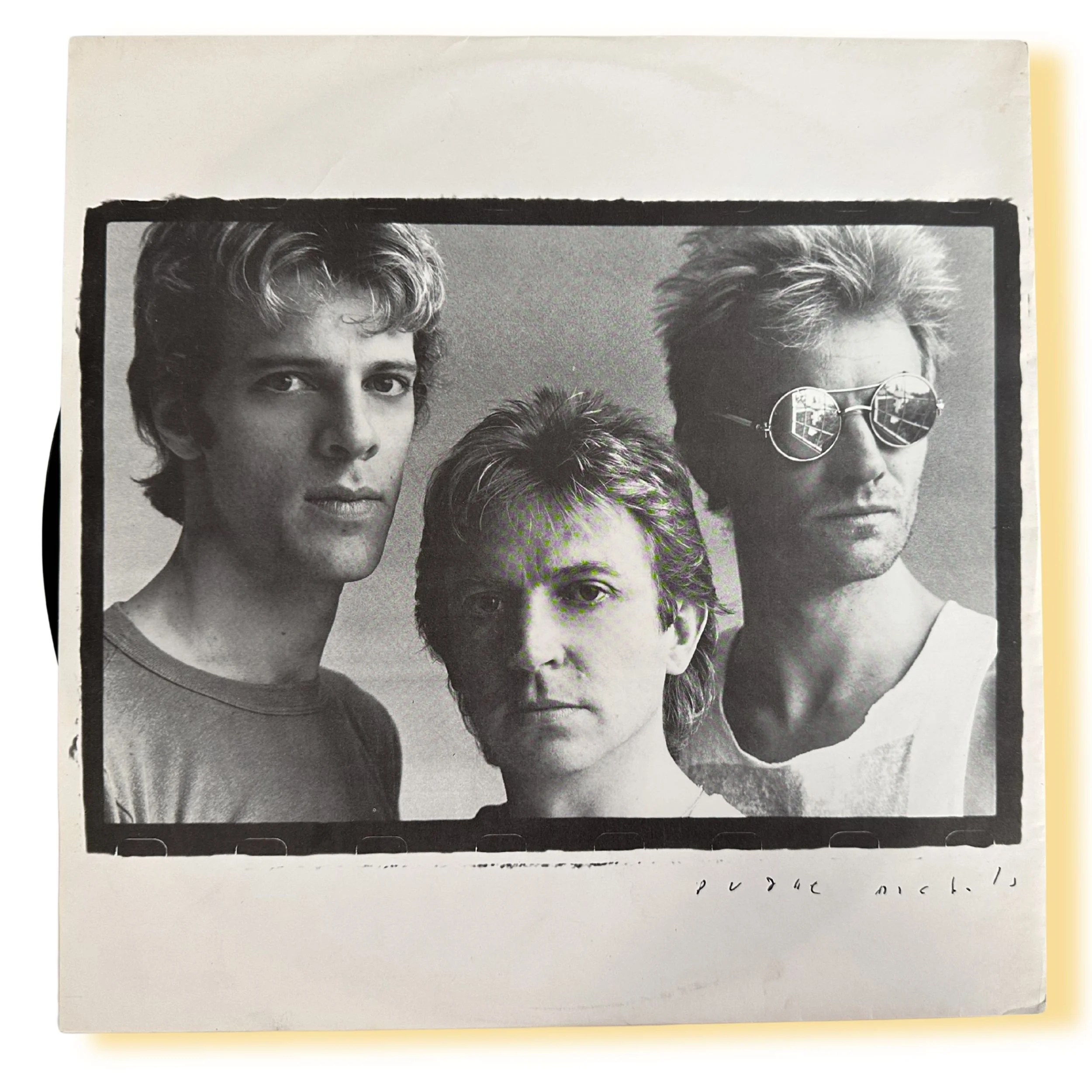
Inner sleeve portrait of the Police from Synchronicity.
And yet that is what makes Synchronicity so compelling. You would not know from the finished album that the band making it was splintering. The record sounds tight, sharp, and completely in command of itself.
The Meaning of the Title Synchronicity
The title came from Carl Jung’s idea of “synchronicity” — meaningful connections between events that do not have a straightforward cause-and-effect relationship. Sting, who was reading Jung at the time, used the concept as one of the record’s guiding ideas.
In Lyrics, Sting described writing many of the songs in the Caribbean while thinking about war, coincidence, and larger patterns of meaning. That mixture of distance, reflection, and unease runs through the album.
On Synchronicity, the Police move between songs that seem unrelated on the surface. “Walking in Your Footsteps” imagines prehistoric extinction. “Tea in the Sahara” turns to doomed longing and fatalism. Yet the record holds together through mood, tension, and atmosphere. The irony is hard to miss: an album named for hidden connections was made by a band whose own connections were fraying.
Songs That Hold the Album Together
However divided the recording process may have been, the finished album feels remarkably coherent. It opens with urgency and rarely lets go.
“Synchronicity I” is a frantic, tightly wound opening statement. “Walking in Your Footsteps” brings a moody, ominous feel, with lyrics that compare dinosaurs to humanity. “Tea in the Sahara”, inspired by Paul Bowles’ The Sheltering Sky, closes the album in a haunting and atmospheric way.
The major singles came thick and fast. “King of Pain” balances melancholy and melody with precision. “Wrapped Around Your Finger” is subtle and mesmerising, a masterclass in atmosphere.
“Every Breath You Take”, of course, became the album’s juggernaut single. The music video makes it look almost like a Sting solo piece, but the song remains inseparable from the Police story.
Andy Summers’ “Mother” remains the outlier. For some, it is a brave experiment; for others, it is the weakest track on the album. Either way, it adds to the sense that Synchronicity is not a polished machine. Its tensions are part of its character.
The Synchronicity Album Cover
The cover of Synchronicity matches the tensions inside the record. Designed by Jeff Ayeroff with photography by Duane Michals, it places black-and-white images of Sting, Andy Summers, and Stewart Copeland against bold strokes of red, yellow, and blue.
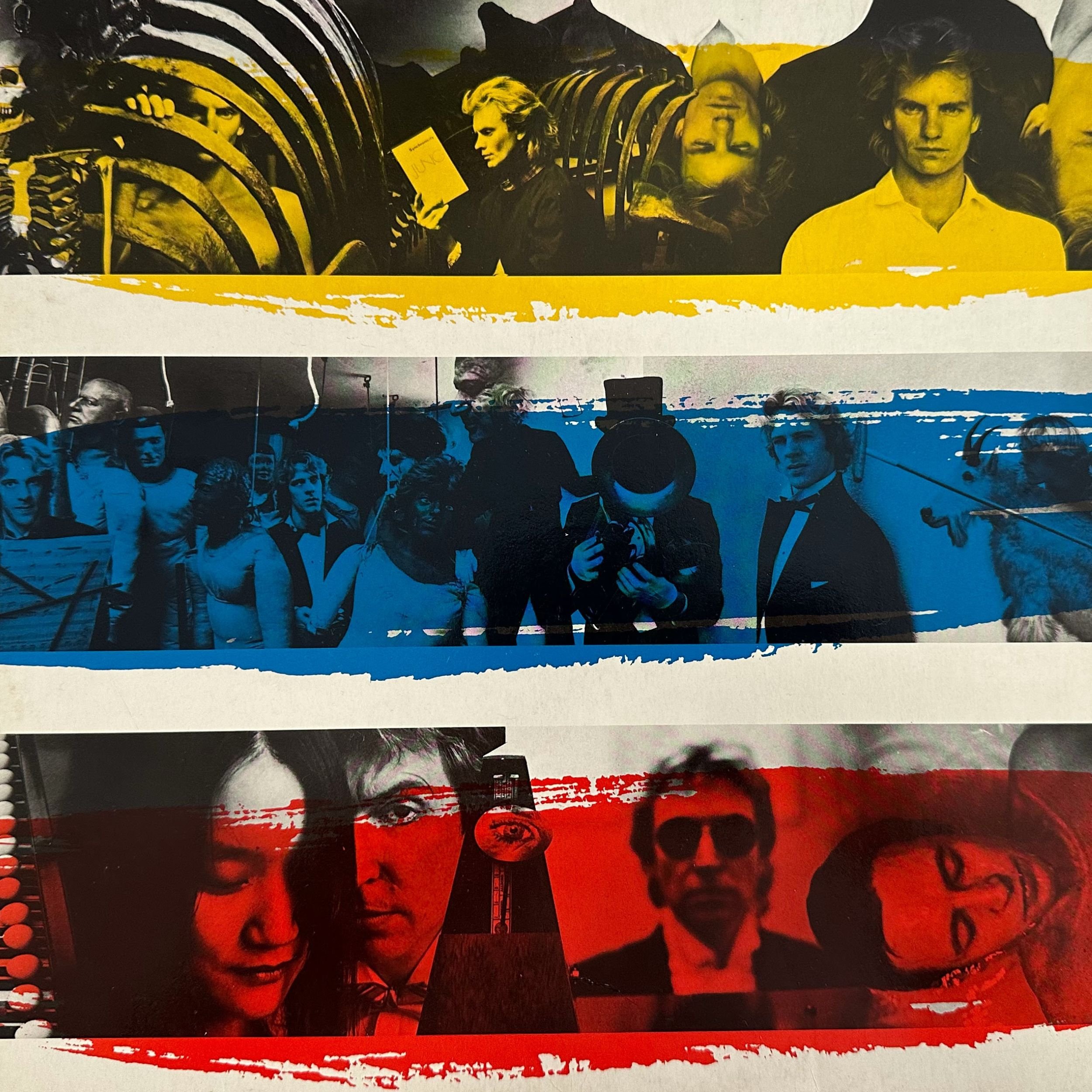
A close up of the Synchronicity ‘triptych’ album cover
Those colours suggest separation as much as unity. The three men share the same sleeve, but they do not quite look as though they belong in the same emotional space. That makes the artwork feel like a visual version of the album itself: fractured on the surface, but somehow still coherent.
Sting also pushed the idea further by having each band member choose his own imagery for the photographs without consulting the others. His choice of the American Museum of Natural History, with its dinosaur skeletons, tied neatly into “Walking in Your Footsteps”.
It is an iconic sleeve, but more importantly it suits the music. Like the album, it holds together even while its parts seem to pull away from one another.
Montserrat, Serendipity, and What Came Next
There is one final twist to the Montserrat story. After Synchronicity was finished, Sting stayed on the island. By chance, Dire Straits were the next major act in at AIR Studios, working on what would become Brothers in Arms. Out of that overlap came one of the most memorable moments in 1980s pop: Sting singing the “I want my MTV” line on “Money for Nothing”.
That moment feels fitting. Synchronicity was an album born out of tension, distance, and fractured relationships, yet it ended with a piece of pure studio serendipity. In its own way, that accidental connection suits the title perfectly.
Reception and Legacy
Upon release in June 1983, Synchronicity was a phenomenon. The album went on to top charts around the world, reached Platinum status in the United States within two months of release, and was eventually certified 8× Platinum by the RIAA.
It would prove the Police’s final studio album. Sting soon embarked on a solo career, while the band reunited only for tours and one-off events. That gives Synchronicity an unusual place in their catalogue: not just a hit record, but the final completed statement from one of the most successful bands of the era.