
The History of Vinyl and the Album Era
The 12-inch record most of us recognise has a history of its own. It’s usually black, but it hasn’t always been “vinyl”. Earlier discs spun at 78 RPM, not 33⅓ or 45, and record sleeves weren’t yet the kind of artistic statement they became in the vinyl era. If you’ve ever wondered how the record ended up looking and working the way it does, here is the story.
Before Vinyl: Shellac and 78 RPM
For most of the first half of the twentieth century, the “record” most people knew was the 78. Collectors often call them shellac records because shellac resin became a common base material, mixed with fillers. The result was a disc that could sound surprisingly vivid, but it was also hard and brittle. Handle it badly, drop it once, and it could crack clean through. (Laquer discs were also a thing, but more for demos, test cuts and radio transcription so they wouldn’t typically appear in record collections.)
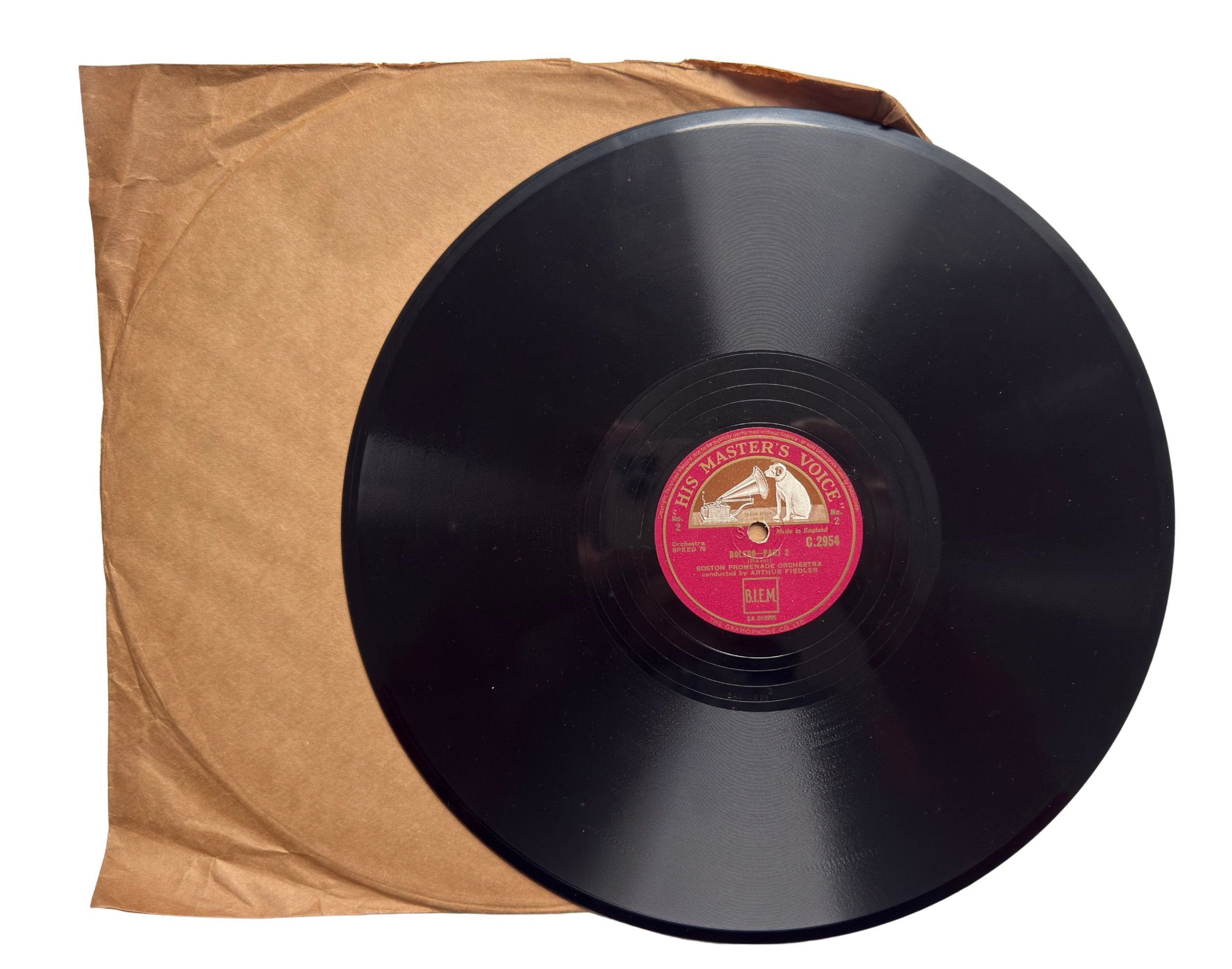
An old HMV Shellac Record, from The Vinyl Historian Collection
The bigger limitation was time. Speed alone explains part of it: at 78 RPM you’re running through groove more than twice as fast as a 33⅓ LP (78 ÷ 33⅓ ≈ 2.34), so the minutes disappear quickly. But the real killer was groove spacing — 78s used much wider “coarse” grooves, so you could fit far fewer turns of the spiral on a side meaning less music.
The limitations of shellac did not just restrict sound; they prevented the album from emerging as a coherent artistic form.
The ‘Vinyl Era’ and 33 RPM
When Columbia Records unveiled the 33⅓ rpm Long Playing (LP) record in 1948, its 12-inch diameter was a deliberate compromise between sound quality, playing time and practicality. Twelve-inch discs had already been used for higher-end 78 rpm classical releases, so manufacturing infrastructure and turntables required adaptation rather than reinvention. At the slower LP speed, that surface area delivered around twenty minutes per side — enough to capture extended classical works without constant side changes. Ten-inch LPs briefly served the jazz and popular markets, while RCA Victor’s 7-inch 45 rpm disc, launched the following year, became the dominant format for singles. By the early 1950s, 12-inch, 10-inch and 7-inch records had established the physical grammar of recorded music for decades to come.
How the Groove Shaped the Album
As important as size and speed were, the vinyl groove itself quietly shaped how albums were constructed. Because a record spins at a constant speed, the outer edge of a 12-inch LP travels faster beneath the stylus than the inner grooves near the label. That difference in linear velocity meant the start of each side could reproduce brighter high frequencies, stronger transients and greater overall volume, while the inner grooves were more prone to distortion and reduced detail — particularly in dense, treble-heavy passages.
Producers and mastering engineers understood this, and sequencing became a technical as well as artistic decision. Impactful singles or rhythmically sharp tracks were often placed early in a side for maximum clarity — the crisp hi-hats and bass definition of “Come Together” opening Abbey Road, or the percussive attack of “Money” launching Side Two of The Dark Side of the Moon.
By contrast, slower, more spacious or textural pieces were often better suited to the closing grooves, where atmosphere mattered more than bite. Long-form works such as Pink Floyd’s Echoes on Meddle, which occupies an entire side, were constructed in ways that worked with these constraints rather than against them, unfolding gradually rather than relying on sharp transients that might suffer near the centre. The same can be said of Roxy Music’s “For Your Pleasure”, the nearly seven-minute closing title track on the 1973 album of the same name, recorded at AIR Studios London.
Its slow build, sense of space and growing studio abstraction feel perfectly matched to the inward pull of the side-ending groove, and it also hints at Brian Eno pushing further into the textural ideas he would later develop with David Bowie.
The Sleeve Becomes a Canvas
If the groove shaped how music was heard, the sleeve shaped how it was seen. Early records were sold in plain paper covers, functional and disposable, until 1938 when Alex Steinweiss at Columbia Records introduced the first illustrated album sleeve. Sales reportedly rose, and the industry quickly recognised that packaging could do more than protect shellac — it could persuade.
With the arrival of the 12-inch LP in 1948, designers suddenly had a twelve-by-twelve inch canvas to work with. By the 1950s, labels such as Blue Note Records were treating that space as part of the artistic statement itself. Under designer Reid Miles, working from photographs by Francis Wolff, Blue Note sleeves paired stark typography with high-contrast session imagery, creating covers that critics have described as something to “study” while the music played. The sleeve was no longer protective wrapping; it became visual accompaniment.
By the late 1960s, this idea expanded beyond graphic sophistication into conceptual art. Albums such as Sgt. Pepper’s Lonely Hearts Club Band by The Beatles and The Dark Side of the Moon by Pink Floyd demonstrated that a record cover could carry symbolism, narrative and identity as powerfully as the music in its grooves.
By the 1970s, album designers and photographers were no longer anonymous technicians but central creative collaborators. Design collective Hipgnosis treated the 12-inch sleeve as conceptual territory, crafting enigmatic imagery for artists including Pink Floyd that invited interpretation as much as admiration.
Photography, too, became a defining force of the vinyl aesthetic. The cover of Hotel California by Eagles — shot by photographer David Alexander and art-directed by Kosh — transformed the Beverly Hills Hotel into a symbol of West Coast opulence and unease, its dusky, grain-softened glow mirroring the album’s themes of decadence and disillusion. The image was not illustrative; it was atmospheric, almost cinematic.
In the vinyl era, the sleeve became a site where designers, photographers and musicians converged. Sequencing shaped by groove physics, music structured across two sides, and artwork conceived as mood and mythology all worked together. The LP was not simply a carrier of songs but a complete cultural artefact — something to hear, to hold, and to study while the record turned.
Defining the Vinyl Era
For The Vinyl Historian, the “Vinyl Era” is not merely the period before the compact disc. It refers to the years in which the 12-inch LP was the dominant cultural and creative framework for popular music — the format within which albums were conceived, structured, recorded and experienced.
Although vinyl LPs had existed since the late 1940s, it was not until the mid- to late 1960s that all the elements fully converged: ambitious songwriting, studio experimentation, deliberate side-based sequencing and sleeve design conceived as artistic statement rather than packaging. Music was no longer just recorded and released; it was constructed as a unified object.
For the purposes of this history, we mark the beginning of the Vinyl Era with Sgt. Pepper’s Lonely Hearts Club Band (1967) by The Beatles — the moment when the album, rather than the single, became the primary artistic unit in mainstream popular culture. During this period, the album replaced the single as the dominant artistic and commercial expression of popular music.
Its decline begins in the mid-1980s, as the commercial breakthrough of the compact disc reshaped the industry. When Brothers in Arms (1985) by Dire Straits became one of the first global blockbuster CD sellers, it signalled a structural shift. Vinyl did not disappear overnight, but the framework that had shaped nearly two decades of album-centred thinking was beginning to give way.
The Vinyl Era was not simply a time when music was pressed onto PVC. It was a period in which physical constraint shaped creativity, sequencing shaped narrative, and visual design shaped identity. The LP did not merely deliver music; it defined its scale, divided it into sides, and turned the album into a deliberate, unified artistic statement.