David Gilmour’s Luck and Strange Review: A Late-Career Album with Depth
David Gilmour will always be compared with Pink Floyd. That is the burden, and the privilege, of having been instrumental in making some of the most admired records in rock history. With Luck and Strange, Gilmour arrived with a striking claim of his own, saying this was the best work he had made since The Dark Side of the Moon. That is a bold standard to set for any new album, especially one released more than fifty years after the record that changed everything.
Yet Luck and Strange is not trying to recreate the sweep of Gilmour’s past. It works in a different register. This is a thoughtful, inward-looking record, shaped by memory, family, unease and reflection. On first listen it sounds strong. Over time, its deeper qualities begin to emerge.
The recording of the album was not exactly a secret. Through Polly Samson’s Instagram posts, we had seen glimpses of it taking shape over a long period. I chose not to listen to the first singles, ‘The Piper’s Call’ and ‘Between Two Points’, instead waiting to hear the album as a whole. That proved to be the right decision. Luck and Strange feels like an album that benefits from being taken in as a complete work, its mood and themes gathering force across the running order.
A David Gilmour album shaped by family
One of the most distinctive things about Luck and Strange is how deeply it feels rooted in family collaboration. During lockdown, the growing Gilmour family gave a number of live performances from their home. They were charming evenings, sometimes theatrical, sometimes intimate, mixing music with poetry and showing a household full of warmth and creativity. In hindsight, those performances now feel like a prelude to this album.
Polly Samson remains central, not only as lyricist but as one of the key voices shaping the emotional world of the record. Her son Charlie contributes lyrics to ‘Scattered’, and anyone who has read his memoir Featherhood will already know that he is a gifted writer. The result is an album that does not feel solitary, even in its quieter moments. There is a sense of close creative company running through it.
That family presence matters most clearly in the appearance of Romany Gilmour. At first, I was sceptical about her sharing credits on ‘Between Two Points’, a song originally written and recorded by The Montgolfier Brothers. I should have known better. Her performance is one of the album’s defining moments.
Why ‘Between Two Points’ is the heart of the record
‘Between Two Points’ is so beautiful it makes me want to cry. It shifts the emotional temperature of the album and widens its frame. Rather than sounding like a dutiful family collaboration, it feels completely natural, almost inevitable, once you hear it. Romany’s vocal has a delicacy that gives the song a strange stillness, and David’s playing is all the more affecting for the restraint around it.
It is the track that stayed with me most strongly after the first listen, and over time it has only grown in stature. It also came into even sharper focus in performance. Seeing Romany Gilmour sing it live at the Royal Albert Hall gave the song an added emotional weight, and it was one of the clearest reminders that Luck and Strange was not simply a studio project. These songs could carry themselves into the room.
That live dimension also gives this article a natural companion in the Royal Albert Hall concert review, because hearing material from the album on stage helped confirm what the record was doing so quietly in the studio.
The sound of Luck and Strange
This certainly feels like a more introspective album. There is not quite the open-armed warmth of On an Island, nor the brighter ease that sometimes lifted Rattle That Lock. Luck and Strange is more inward, more measured, and less interested in easy release. It asks a little more of the listener.
That may be why it has drawn mixed reactions from those hoping for a more immediate statement. Yet that reserve is part of its appeal. This is not an album built around obvious grand gestures. It is built around atmosphere, phrasing, tone and the slow accumulation of feeling. Gilmour’s voice, weathered but expressive, suits this material. His guitar remains unmistakable, not as a display of virtuosity, but as a means of carrying mood and memory.
Gilmour has also spoken openly about working with a different set of musicians, choosing players who could bring a fresher approach to the sessions. The only familiar face is Guy Pratt, who by now is almost family. Pratt toured with Pink Floyd on both the A Momentary Lapse of Reason and The Division Bell tours, later played with Nick Mason’s Saucerful of Secrets, and is married to Gala Wright, daughter of Rick Wright. Wright is present here too, through keyboard recordings from 2007 woven into the title track by Gilmour and producer Charlie Andrew.
Even with new musicians and a fresh production approach, the album still sounds unmistakably like a David Gilmour record. That is no bad thing. Few guitarists have a style so immediately recognisable, and Luck and Strange never tries to deny that identity.
The Luck and Strange album cover
The main cover photograph, shot by Anton Corbijn, shows a striking degree of confidence from Gilmour. His face fills the sleeve, clear, aged and unguarded. For an artist so bound up with one of the grandest catalogues in rock history, there is something unusually direct about that choice. It suggests a man comfortable in his own skin, quite literally owning the record.
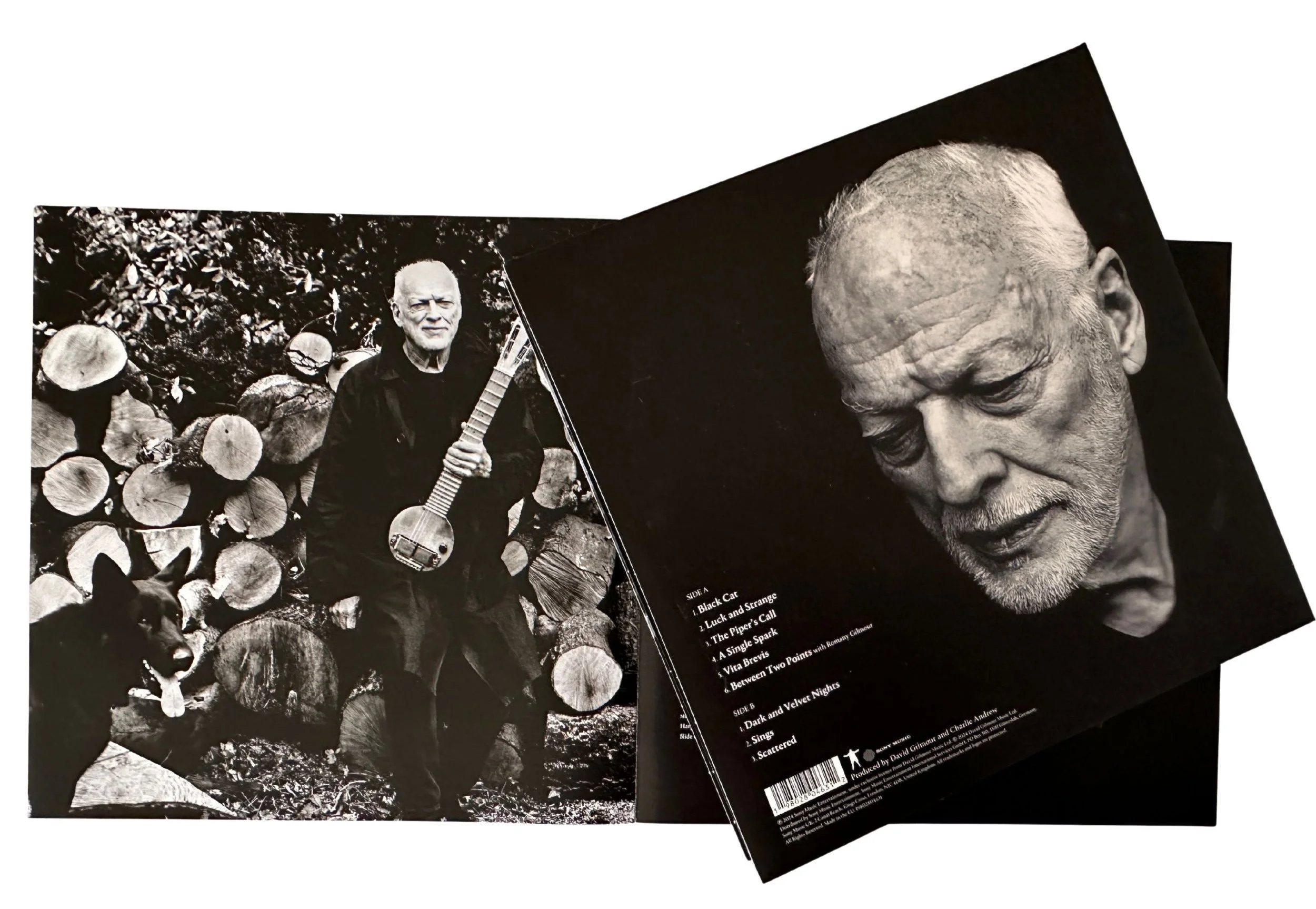
The Luck and Strange gatefold sleeve pairs an intimate Anton Corbijn portrait with stark black and white inner artwork, reinforcing the album’s reflective mood.
That sense carries through into the images inside the sleeve. The black and white photographs feel relaxed rather than staged, and they reinforce the mood of the album itself: reflective, intimate and quietly self-aware. Some, taken by Polly Samson, add to that feeling of closeness. Together, the visuals do not present Gilmour as a figure trapped by his past, but as an older artist willing to be seen plainly, with all the weight and calm that now brings.
Pink Floyd echoes in the background
It is just over thirty years since Gilmour actively recorded a Pink Floyd album, but as such a strong creative presence within the band, especially on the later records, it is impossible not to hear occasional reminders of that history. There are moments where certain textures, melodic shapes or pulses seem to glance back towards earlier work.
You can hear little traces here and there. A phrase, a mood, a heartbeat, a chord movement. The tail end of one era still flickers in the background of another. There are hints of The Division Bell, a touch of ‘Take It Back’, perhaps even something further behind that. These are not acts of self-imitation. They are the natural residue of a musical language Gilmour helped form decades ago.
Luck and Strange carries those echoes lightly. It acknowledges the past without leaning on it. The album’s best moments do not come from reminding you of Pink Floyd. They come from the confidence of a record content to stand on its own.
The meaning of Luck and Strange
The title track sits near the centre of the album’s argument. Lyrically, it feels reflective and autobiographical, the work of an artist looking back over a life shaped by talent, chance, decisions and accidents. What does ‘Luck and Strange’ mean? Is it serendipity, fate, a recognition that a career can be shaped by forces beyond planning or control? The phrase itself suggests both fortune and dislocation, the sense that a life can be blessed and bewildering in equal measure.
That tension runs through the album. Luck, good and bad. Strange, the places life can take you. Samson’s lyrics often invite listeners to read them through the lens of Pink Floyd or through Gilmour’s long and damaged relationship with Roger Waters, but that can be too narrow a reading. David Gilmour has lived a long life since those years, and these songs feel wider than any single old fracture. They are full of age, memory, ghosts, family and perspective.
The autobiographical feel is strongest in lines that look back on youth, fame and possibility from a much later vantage point. There is a sense of somebody taking stock, not with melodrama, but with calm unease. That tone gives the album much of its staying power.
‘Scattered’ and the closing stretch
If one song draws the album’s themes together most completely, it may be ‘Scattered’. Charlie’s contribution to the lyric gives it an added layer of intimacy, and the result feels like one of the most moving late-career performances Gilmour has put on record. The song carries thoughts of ageing, loss and dusk without turning heavy-handed. It feels lived-in.
The closing lines are especially affecting:
“Take my arm and walk with me
Once more down this dusty old path
The sunset cuts the hill in half
Our shadows stretch back to touch the night
The light’s fading, you say
But these darkening days
Flow like honey
These days slowing down
A whole life in a glance”