Oh by the way… Who were the original Pink Floyd band members and who’s still here today?
The story of Pink Floyd is not merely a chronicle of shifting musical boundaries; it is a masterclass in internal chemistry, friction, and structural evolution. Across four decades, the group transformed from a whimsical, London-underground psychedelic outfit into a global stadium powerhouse. Driving that evolution was a fluid roster of musicians whose personal and creative relationships defined the very parameters of the vinyl era.
To truly understand Pink Floyd, one must trace how the songwriting credits, the studio environments, and the microphone itself shifted across distinct chapters of the band's history.
The Original Pink Floyd Line-Up & The Cambridge Connection (1965–1968)
The first functional version of Pink Floyd was forged in London, built upon schoolboy friendships and artistic connections established in Cambridge.
The original four-piece line-up comprised:
Syd Barrett (Roger Keith Barrett) – Lead guitar, lead vocals, chief songwriter
Roger Waters – Bass guitar, backing vocals
Rick Wright – Keyboards, synthesisers, backing vocals
Nick Mason – Drums, percussion
Here is a breakdown of the original line-up's ages alongside their official birthdays:
Today:
- Syd Barrett would be years old today.
- Roger Waters is years old.
- Rick Wright would be years old today.
- Nick Mason is years old.
Pink Floyd Birthdays:
- Syd Barrett:
- Roger Waters:
- Rick Wright:
- Nick Mason:
David Gilmour was born on . He is years old today.
This tight-knit Cambridge circle also included close friends Storm Thorgerson and Aubrey Powell—who would later establish the legendary design partnership Hipgnosis that created the visual presentation of the band that would conquer the world.
In this first chapter of the band, Syd Barrett was the undisputed creative nucleus. He was a figure of singular, eccentric charisma, projecting a strange, playful, and faintly unsettling energy. It was Barrett who coined the band's name in 1965, hurriedly combining the first names of two Carolina bluesmen in his record collection—Pink Anderson and Floyd Council—to avoid a name clash with another London group called the Tea Set.
This original quartet recorded the band’s landmark debut, The Piper at the Gates of Dawn (1967) at EMI’s Abbey Road studios with early recordings were captured across London at Sound Techniques on Chelsea’s King’s Road.
The Five-Man Transition & A Saucerful of Secrets (1968)
By early 1968, Barrett’s mental state had deteriorated, rendering him increasingly erratic on stage and unproductive in the studio. To preserve the live act, the band recruited fellow Cambridge guitarist David Gilmour (formerly of Jokers Wild) in January 1968.
For a brief, fraught window of several months, Pink Floyd existed as a five-piece. This transitional phase is frozen in time on their second album, A Saucerful of Secrets (1968)—the only record in the catalogue to feature contributions from all five key figures: Barrett, Gilmour, Waters, Wright, and Mason.
Barrett’s final creative offering to the band was the closing track, "Jugband Blues", a hauntingly prophetic lyric that laid bare his own mental fracture and imminent detachment from the group:
"It's awfully considerate of you to think of me hereAnd I'm most obliged to you for making it clearThat I'm not here."
Shortly after its recording, Barrett was officially let go from the group. While there were fears that the band would collapse without their main songwriter, Gilmour’s arrival provided the structural and sonic foundation that allowed Pink Floyd to transition from a transient psychedelic novelty into a serious progressive force.
The Classic Era & The Shared Microphone (1968–1979)
With Barrett's exit, Roger Waters gradually emerged as the band's primary conceptualist and lyricist, but the musical direction remained a remarkably democratic collective effort between Waters, Gilmour, Wright, and Mason.
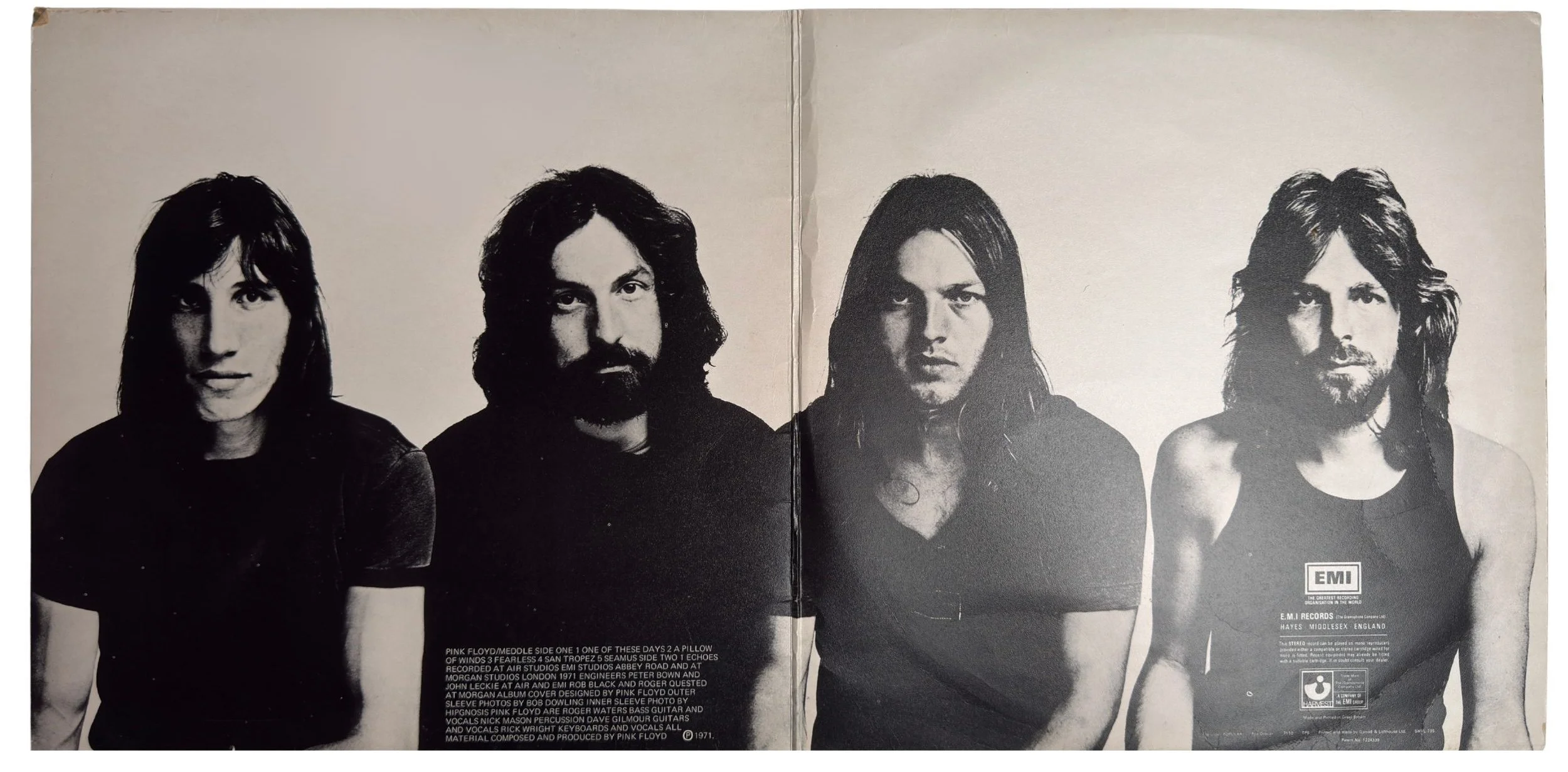
Pink Floyd - left to Right - Roger Waters, Nick Mason, David Gilmour, Rick Wright. Taken from the Meddle album cover.
Throughout this golden era, Pink Floyd famously rejected the conventional "frontman" dynamic. Instead, vocal duties were distributed with deliberate care, matching the emotional weight and tonal colour of each track to the vocalist:
David Gilmour provided the soaring, rich, and melodic lead vocals that anchored the band's most accessible moments. His voice carried the weight of "Time", "Money", "Breathe", and "Wish You Were Here".
Roger Waters delivered a sharper, more theatrical, and spoken-delivery vocal style. It was a voice designed for cynicism and dramatic narrative tension, perfectly utilised on "Brain Damage", "Dogs", and "Pigs (Three Different Ones)".
Rick Wright was the band’s secret vocal weapon, offering a delicate, melancholic lead vocal on early tracks like "Echoes" and "Us and Them", whilst providing the indispensable, cushion-like backing harmonies that defined their signature studio sound.
Nick Mason rarely stepped up to the microphone, but delivered one of the band's most iconic and menacing vocal performances on the instrumental-heavy opener of Meddle (1971), "One of These Days". His heavily distorted, ring-modulated declaration—"One of these days I'm going to cut you into little pieces"—stands as his sole credited vocal contribution on a Pink Floyd studio track.
As they refined their sound through Ummagumma (1969) and Meddle (1971), the band occasionally sought isolation outside of London, recording Obscured by Clouds (1972) at the residential Château d’Hérouville studio near Paris.
However, it was their return to Abbey Road with staff engineer Alan Parsons that crystallised their efforts. Released on EMI's progressive imprint, Harvest Records, The Dark Side of the Moon (1973) became an instant monument of the vinyl era, selling over 50 million copies and forever shifting the scale of the band's existence.
The Fracturing Wall: Sacking and Studio Exile (1979–1983)
The monumental success of Dark Side inevitably disrupted the group's delicate democratic balance. By the late 1970s, Waters began taking absolute control of the conceptual narrative, a shift that hardened during the sessions for Animals (1977) and culminated in The Wall (1979).
To escape the crushing tax rates of late-seventies Britain and the growing tension within London, the band decamped to Super Bear Studios in the South of France. Tucked away in the Alpes-Maritimes, this residential facility became both a technical haven and a symbol of their growing estrangement.
The physical layout of Super Bear allowed the members to live and work in near-complete isolation from one another. Waters, Gilmour, and Wright tracked their parts during different shifts, with co-producer Bob Ezrin brought in to act as an intermediary and musical arbiter between the warring factions.
It was during these fractured French sessions that Waters forced keyboardist Rick Wright out of the band. Wright was stripped of his partnership, but in a bizarre twist of corporate irony, he was retained as a salaried session musician for The Wall’s subsequent live tour. Because the touring costs were astronomically high, the actual band members lost money on the road, while Wright emerged as the only person to make a profit from those legendary shows.
By the time they recorded The Final Cut (1983), Pink Floyd was operating as a trio of Waters, Gilmour, and Mason. Wright was entirely absent, and the album was widely regarded as a Roger Waters solo record in everything but name.
The Gilmour-Led Reboot (1987–1994)
When Roger Waters officially left the group in 1985, he declared Pink Floyd a "spent force" and attempted to legally block the remaining members from using the name. David Gilmour and Nick Mason chose to fight, initiating a bitter high-court battle over the trademark that ultimately fell in their favour.
With Gilmour at the helm, the band was reborn:
A Momentary Lapse of Reason (1987): A heavily studio-assisted transition album that saw Rick Wright return to the fold, initially paid as a session musician due to ongoing legal entanglements with Waters.
The Division Bell (1994): A true return to form that saw Wright reinstated as a full partner. The album benefited from the lyrical input of journalist Polly Samson (soon to become Gilmour’s wife), whose reflective, poetic lines brought a mature, pastoral tone to the record.
The Division Bell’s visual campaign was handled by their long-time graphic designer, Storm Thorgerson, formerly of Hipgnosis. The sleeve—featuring two monolithic metal heads constructed and photographed in a Cambridgeshire field with Ely Cathedral standing on the distant horizon—became one of the twilight era's most iconic images. It served as a fitting, atmospheric bookend to the active recording life of the band.
A Timeline of Legacy & Mortality
For collectors and historians of the progressive rock era, the story of Pink Floyd is a closed book, punctuated by moments of deep reconciliation and the inevitable passage of time.
The final curtain for the classic four-piece came on 2 July 2005 at the Live 8 benefit concert in London's Hyde Park. Gilmour, Waters, Wright, and Mason walked onto the stage together for the first time in 24 years, delivering a brief, emotional four-song set that served as a moving tribute to their shared history. It remains the final time they would ever perform together.
The passing of Syd Barrett on 7 July 2006 (aged 60) in Cambridge, followed by the death of keyboardist Rick Wright on 15 September 2008 (aged 65), permanently closed the door on any future reunion.
Today, the remaining three members continue to steward their legacies from very different corners of the musical world:
Roger Waters (now 82) continues to stay relevant globally, presenting stark, politically charged live shows (like This is not a drill) and challenging the band's legacy with solo projects like The Dark Side of the Moon Redux. In late 2026 Roger has announced his ‘Legacy’ tour with his son Harry Waters with vision and production from Rog.
David Gilmour (now 80) maintains a highly respected solo career, recently releasing the critically acclaimed Luck and Strange, an album deeply concerned with themes of aging, family, and mortality.
Nick Mason (now 82) stands as the only member to play on every single Pink Floyd studio album. In recent years, he has come full circle, touring the globe with his outfit Nick Mason's Saucerful of Secrets to keep the adventurous, experimental spirit of the pre-1973 catalog alive.