
Eagles – On the Border (1974): Recording History, Songs and Review
Released on March 22, 1974, On the Border was the Eagles’ third studio album and the record that marked their transition from country rock toward a harder, more radio-focused sound. Produced initially by Glyn Johns in London before being completed in Los Angeles with Bill Szymczyk, the album introduced Don Felder and set the band on the path toward One of These Nights and eventually Hotel California.
Commercially successful and home to the Eagles’ first US number one single, the album remains a pivotal moment in their evolution. Artistically, it is one of their more debated releases.
Recording On the Border: From London to Los Angeles
Once again, the album was to be recorded in London with Glyn Johns in the producer’s chair. His work with The Rolling Stones and The Who had established him as a producer known for clarity and restraint, and his approach had defined the spacious country-rock sound of the Eagles’ first two albums. Johns favoured balance, air and natural instrumentation, but by 1974 the band were beginning to move in a different direction.
Dissatisfied with the early sessions, the Eagles halted recording and returned to Los Angeles. At the Record Plant they brought in Bill Szymczyk, whose approach was firmer and more radio-conscious. The shift was immediate. The guitars became more assertive and the production tightened.
Don Felder was added to the line-up during these sessions, and his arrival marked the beginning of the more aggressive twin-guitar sound that would define the Eagles through the mid-1970s. Szymczyk would remain with the band through One of These Nights and Hotel California, becoming central to their commercial peak.
On the Border Album Details
Artist: Eagles
Released: March 22, 1974
Label: Asylum Records
Producers: Glyn Johns and Bill Szymczyk
Studios: Olympic Studios, London and Record Plant, Los Angeles
Billboard 200 peak: No. 17
UK Chart Park: No. 28
The album later produced the Eagles’ first US number one single, The Best of My Love, in March 1975.
Contemporary Reception in 1974
When On the Border was released, critics noted the change in direction. Writing in Rolling Stone on May 23, 1974, Janet Maslin described the album as
“...a tight and likable collection, with nine potential singles working in its favor and only one dud.”
The comment captured both the record’s accessibility and its unevenness. The shift toward a more radio-ready sound was clear, and commercially it proved effective. The album reached No. 17 on the Billboard 200, and the band’s breakthrough chart success soon followed.
Album Cover and Visual Identity
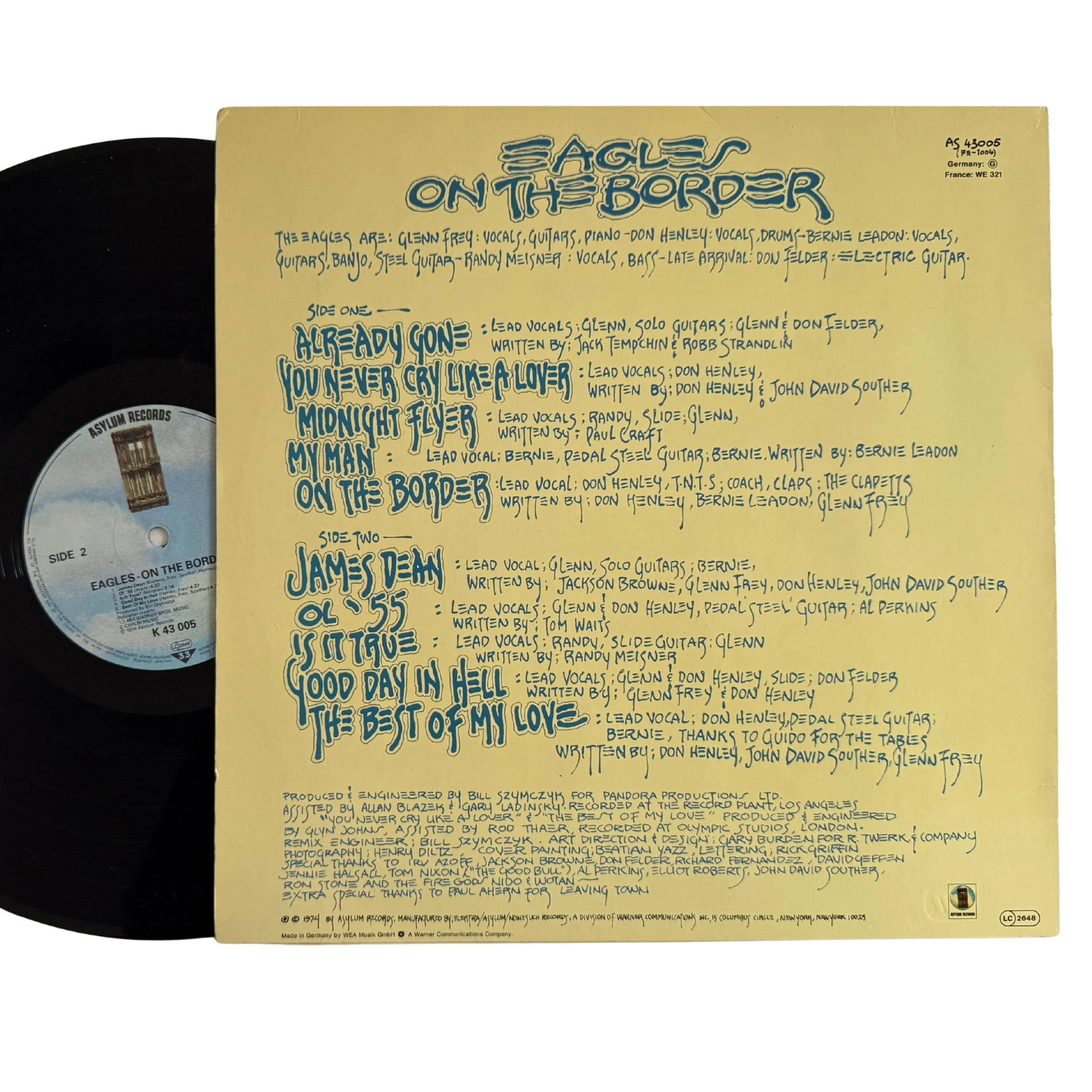
The cover of On the Border moves away from the character-driven outlaw imagery of Desperado and towards a more stripped-back desert aesthetic. The flowing “Eagles” script, first introduced on their 1972 debut, remains in place but is presented more prominently and with greater clarity. As the music tightened and moved toward mainstream rock radio, the visual identity became less theatrical and more direct.
On the Border Key Album Tracks
Already Gone
The closest thing here to a straight-ahead rocker. Confident and built for radio. It remains one of the few tracks from this album that I happily return to.
The Best of My Love
Written by Henley, Frey and J.D. Souther, this became the Eagles’ first Billboard number one in March 1975. It is easily the strongest track on the record. Controlled, melodic and emotionally measured, it hinted at the band’s ability to balance intimacy with mass appeal.
James Dean
Originally left over from the Desperado sessions. Some fans admire its energy. I have never fully warmed to it. It did not chart significantly, though it became a staple of their early live shows.
On the Border
The title track revisits outlaw imagery, but the thematic cohesion of Desperado is absent. What remains is looser and less focused.
You Never Cry Like a Lover
Polished and co-written with J.D. Souther, but not especially memorable within the wider Eagles catalogue.
Is On the Border the Eagles’ Weakest Album?
For me, yes.
Can I call myself an Eagles fan if I do not love all of their albums? I think so. They have been part of my listening life for decades. Hotel California and Desperado still spend time on the turntable. But On the Border is the one I return to least.
It lacks the cohesion of Desperado and the consistency of what followed with One of These Nights. Beyond The Best of My Love and Already Gone, the record feels uneven. It is also the only Eagles album that contains a song I actively dislike, and that inevitably colours my overall view.
Yet it was a necessary transitional record. Without the friction of the London sessions, without the move to Los Angeles, and without the arrival of Don Felder and Bill Szymczyk’s firmer production, the band might never have reached the creative and commercial peak of Hotel California.
On the Border may not be their finest hour, but it is the album that set the stage for what came next. In that sense, its importance outweighs my reservations.