
The Eagles Desperado Album: The Outlaw Concept That Built a Legend
Inside Eagles’ Desperado: who wrote the key songs, how the album was made in London, and why its outlaw myth still defines its legacy.
The Eagles were in a hurry. By the time they came to make their second LP, commercial success had arrived before the band had fully worked out what it wanted to be.
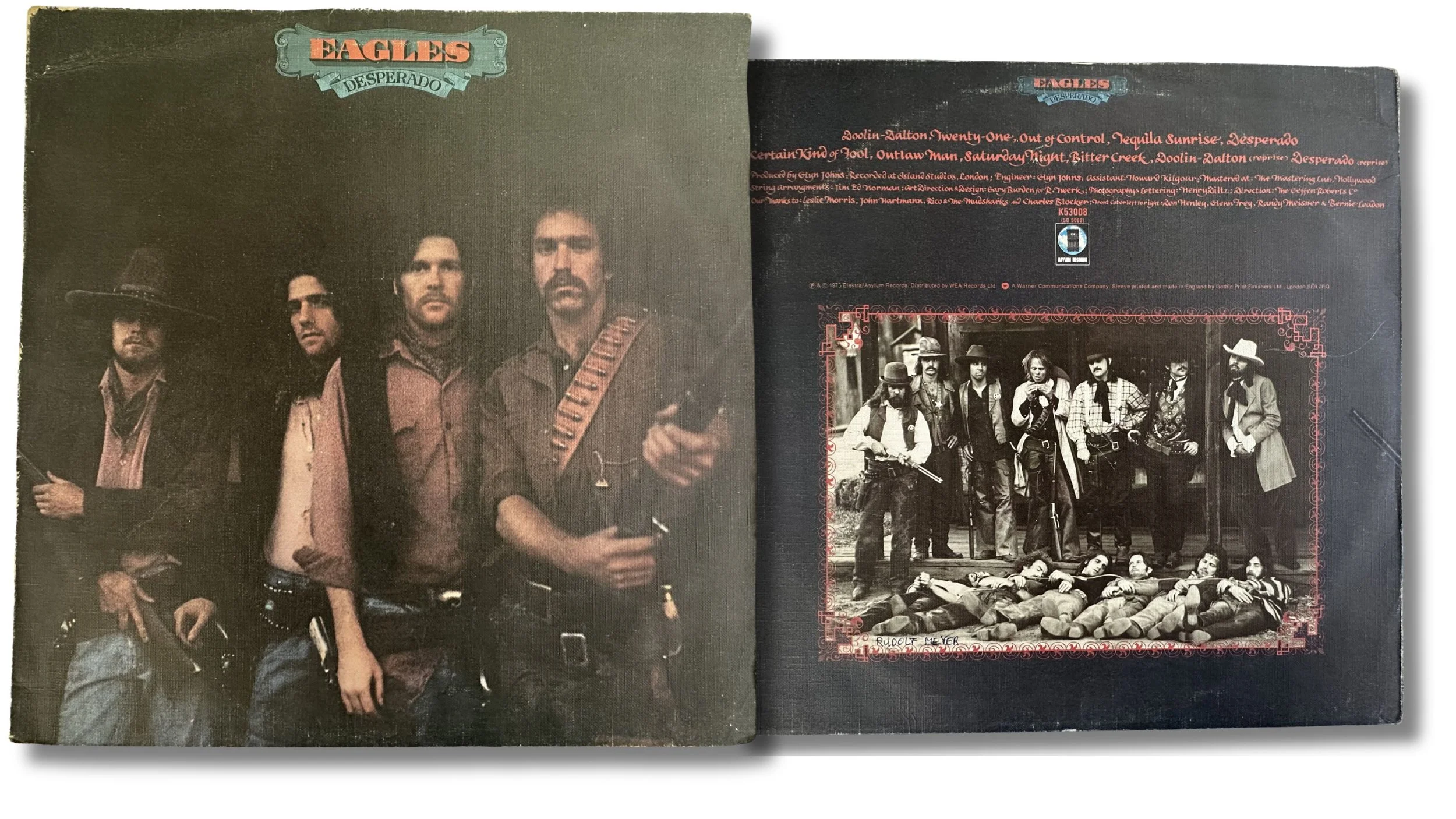
Released in 1973, the eagles desperado album was their answer. Framed around outlaws, drifters and Old West mythology, this landmark desperado album gave the group a larger identity than the clean-lined country rock of their debut had suggested. The songs, the cover, and the whole presentation pushed the Eagles towards something more theatrical and more self-aware—a band not just writing hits, but building a legend around itself. It was the kind of vinyl-era release that aimed to work as a complete statement, where the songs, the sleeve and the sequencing all carried the same idea.
That larger sense of design is a big part of why Desperado still holds such a firm place in the Eagles story. It was not the record that made them the biggest band in America, and it did not resolve every part of their sound. But it was the moment the Eagles began turning image, theme and songwriting into something more unified and more ambitious.
What followed was a record full of striking contrasts: an American outlaw fantasy recorded in London, a highly controlled studio production built around drifters and fugitives, and a concept record whose most enduring songs often reach beyond the concept itself.
Why the Eagles Turned to Outlaws
After the success of their debut, the Eagles could easily have made a safer follow-up. Instead, they reached for a concept. Don Henley described Desperado as a broad commentary on the dangers of fame and success, filtered through a cowboy metaphor. It was an ambitious idea for such a young band, and one that now looks like an early sketch for themes Henley and Glenn Frey would sharpen years later on Hotel California.
The outlaw frame gave the band more than a run of Western references. It gave them a language for independence, risk, self-invention and isolation. Rather than simply presenting themselves as laid-back California songwriters, the Eagles began casting themselves in a more mythic light, somewhere between frontier drifters and modern rock stars.
The album’s inspiration drew in people around them too. Jackson Browne, part of the band’s wider circle, shared cowboy stories that helped shape the mood. Real outlaw names such as Bill Doolin and the Dalton gang entered the imagination of the record. The theme also ran deeper than the title track and the famous sleeve. Randy Meisner’s ‘Certain Kind of Fool’, for example, follows a young man leaving home to chase music before drifting towards a fugitive sort of life, showing how fully the band had absorbed the album’s wider world.
That is the key to Desperado. It is not a strict narrative album in the rock opera sense. It works more as a shared landscape, a record held together by recurring characters, images and moods.
Who Wrote Desperado? The Songwriters Behind the Eagles' Classic
Written by Don Henley and Glenn Frey, the title track of the eagles desperado album remains one of the defining songs in classic rock history. As the principal writers whose partnership was rapidly becoming the creative centre of the band, Henley and Frey crafted both ‘Desperado’ and ‘Tequila Sunrise’ to give the record much of its emotional weight. At the heart of an album full of gunslingers, drifters and outlaw imagery sits a song that is strikingly intimate.
The song is less a Western scene-setter than a character portrait, full of regret, pride and the weariness of someone who cannot quite let their guard down. For all the album’s styling, one of its most lasting songs is powerful because it sounds human, not theatrical.
The song’s afterlife helped confirm its stature. Linda Ronstadt recorded ‘Desperado’ for her 1973 album Don’t Cry Now, and her version helped carry the song further after its initial release. That wider exposure added to the growing sense that the Eagles were producing songs built to last, not just songs suited to a concept album. In time, ‘Desperado’ became one of the band’s signature compositions.
‘Tequila Sunrise’ has lasted just as well for different reasons. It is one of the least overtly outlaw-themed songs on the record, and perhaps one of the most natural. Loose, melancholy and beautifully turned, it feels less like part of a concept and more like a glimpse of the Eagles’ deeper songwriting instincts breaking through.
Doolin, Dalton and the Outlaw World
The Old West imagery of Desperado was not invented from thin air. The album drew on real outlaw lore, especially the figures linked to the Doolin-Dalton Gang, whose story fed directly into the record’s atmosphere of escape, danger and self-created legend.
Who Was the Doolin-Dalton Gang?
The Doolin-Dalton Gang was a late 19th-century outlaw group linked to the American Old West. It emerged after the failed 1892 Coffeyville raid associated with the Dalton Gang, with Bill Doolin becoming one of the main figures in the splinter group that followed. Their robberies, gunfights and evasions helped turn them into frontier folklore, exactly the kind of mythology the Eagles drew on for Desperado.
That reference point gave the album some historical texture, but the Eagles were never trying to make a history lesson. They were borrowing from the West as myth, using outlaws as a way to talk about ambition, distance, image and the cost of living by your own rules. In that sense, the cowboy setting was less about authenticity than symbolism.
The Desperado Album Cover That Built the Myth
If Desperado has remained so vivid in rock memory, the cover is a large part of the reason.
Designed by Gary Burden and photographed by Henry Diltz, it remains one of the most iconic images in the Eagles catalogue. The shoot took place on 18 December 1972 at Paramount Ranch in Agoura Hills, a location long associated with Hollywood’s version of the American West. That setting gave the album an instant cinematic authority. The band did not merely look dressed up. They looked as if they had stepped into a fully formed legend.
The back cover deepened the illusion, pulling in figures including Jackson Browne and Glyn Johns as part of the wider outlaw tableau. It was a clever move. Before listeners had spent much time deciding whether Desperado completely worked as an album, they had already absorbed its imagery. The sleeve sold the mythology with total confidence.
For a band still defining itself, that mattered in the best possible sense. The cover did not simply package the record. It enlarged it.
An Old West Myth: Making the Desperado Album in West London
One of the most intriguing things about Desperado is the distance between its imagery and its making. This was an album full of outlaws, drifters and frontier mythology, yet it was recorded not in California, Texas or Tennessee, but in London.
The sessions took place at Island Studios in Notting Hill, with Glyn Johns producing. That contrast is part of what gives the album its peculiar tension. Desperado presents itself as a vision of the American West, but the record itself was shaped through a swift, highly professional studio process in West London, under one of British rock’s most accomplished producers.
Johns brought discipline, clarity and experience to a band still working out how large it wanted to become. The whole album was completed in under three weeks. So while the songs and sleeve artwork projected myth, the recording process itself was brisk and practical. That gap between image and reality suits Desperado. It is an album fascinated by self-invention, and part of its own story lies in the difference between the legend it projected and the way it was actually made.
Seen from a wider Eagles perspective, the album also sits at an important midpoint. On the Border would push the band towards a tougher, more rock-oriented sound. One of These Nights would bring a darker, sleeker confidence and turn that ambition into a major commercial leap. Desperado sits between those records as the moment where the mythology arrived first, before the full sound of the imperial Eagles had quite caught up.
The Desperado Album Songs That Outlasted the Concept
That is why the strongest songs on the eagles desperado album still carry the record. These key desperado album songs do not depend entirely on the cowboy frame; they survive because they stand outside it.
The title track has become a standard because it reaches beyond the album’s imagery, while ‘Tequila Sunrise’ endures for its enduring mood and craft. Even some of the more thematic material is easier to appreciate when heard not as part of a rigid concept, but as pieces of a band trying to create a shared world. The outlaw idea gave the Eagles a dramatic frame, but the tracks that have lasted best are the ones where the group sounds most emotionally direct.
That tension makes the album more interesting than a simple success or failure. Desperado may not always play like a flawless front-to-back statement, but it reveals a band learning how image, songwriting and theme can reinforce one another. In that sense, it is one of the key records in the Eagles story, even if later albums delivered the idea with greater confidence and consistency.
Where Desperado Sits in the Eagles Story
Without Desperado, the path to the later Eagles is harder to imagine.
Eagles Album Timeline
This was the album where the band first tried to become larger than life. It gave them a mythology, one of the great sleeves of the 1970s, and two songs that have long outlasted the concept that first contained them. It also showed Henley and Frey reaching towards the larger themes that would come into sharper focus later: fame, illusion, identity and the cost of success.
It was also the last Eagles album to feature the full original band members of Don Henley, Glenn Frey, Bernie Leadon and Randy Meisner before the shifts that followed began to change the band’s character.
That is why Desperado remains essential. Not because it settled the Eagles into their final form, but because it caught them in the act of inventing it.
Eagles – On the Border (1974): Recording History, Songs and Review
Released in 1974, On the Border was the Eagles’ third studio album and a turning point in their sound. From the failed London sessions with Glyn Johns to the move to Los Angeles with Bill Szymczyk, this was the record that set the stage for Hotel California.
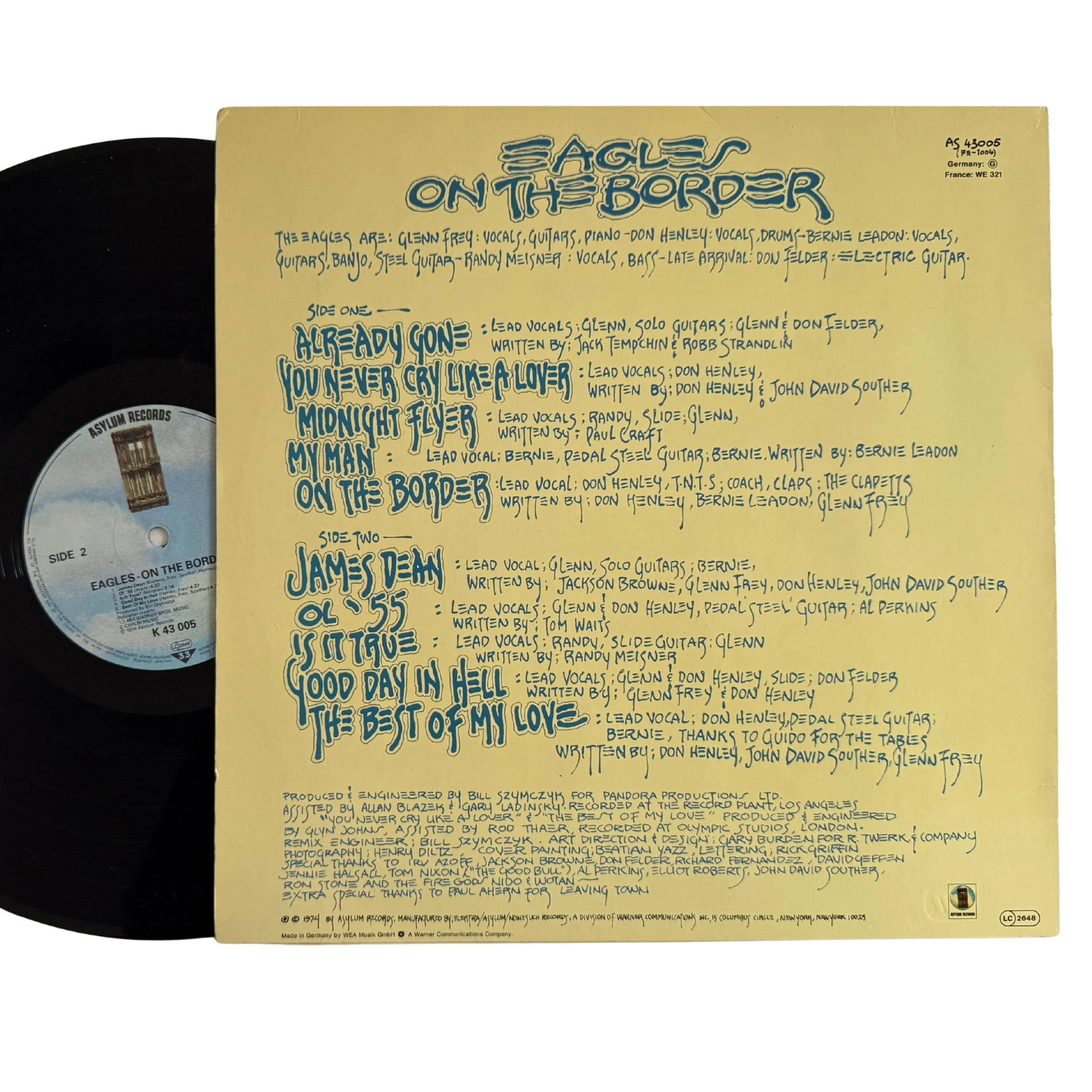
Released on March 22, 1974, On the Border was the Eagles’ third studio album and the record that marked their transition from country rock toward a harder, more radio-focused sound. Produced initially by Glyn Johns in London before being completed in Los Angeles with Bill Szymczyk, the album introduced Don Felder and set the band on the path toward One of These Nights and eventually Hotel California.
Commercially successful and home to the Eagles’ first US number one single, the album remains a pivotal moment in their evolution. Artistically, it is one of their more debated releases.
Recording On the Border: From London to Los Angeles
Once again, the album was to be recorded in London with Glyn Johns in the producer’s chair. His work with The Rolling Stones and The Who had established him as a producer known for clarity and restraint, and his approach had defined the spacious country-rock sound of the Eagles’ first two albums. Johns favoured balance, air and natural instrumentation, but by 1974 the band were beginning to move in a different direction.
Dissatisfied with the early sessions, the Eagles halted recording and returned to Los Angeles. At the Record Plant they brought in Bill Szymczyk, whose approach was firmer and more radio-conscious. The shift was immediate. The guitars became more assertive and the production tightened.
Don Felder was added to the line-up during these sessions, and his arrival marked the beginning of the more aggressive twin-guitar sound that would define the Eagles through the mid-1970s. Szymczyk would remain with the band through One of These Nights and Hotel California, becoming central to their commercial peak.
On the Border Album Details
Artist: Eagles
Released: March 22, 1974
Label: Asylum Records
Producers: Glyn Johns and Bill Szymczyk
Studios: Olympic Studios, London and Record Plant, Los Angeles
Billboard 200 peak: No. 17
UK Chart Park: No. 28
The album later produced the Eagles’ first US number one single, The Best of My Love, in March 1975.
Contemporary Reception in 1974
When On the Border was released, critics noted the change in direction. Writing in Rolling Stone on May 23, 1974, Janet Maslin described the album as
“...a tight and likable collection, with nine potential singles working in its favor and only one dud.”
The comment captured both the record’s accessibility and its unevenness. The shift toward a more radio-ready sound was clear, and commercially it proved effective. The album reached No. 17 on the Billboard 200, and the band’s breakthrough chart success soon followed.
Album Cover and Visual Identity
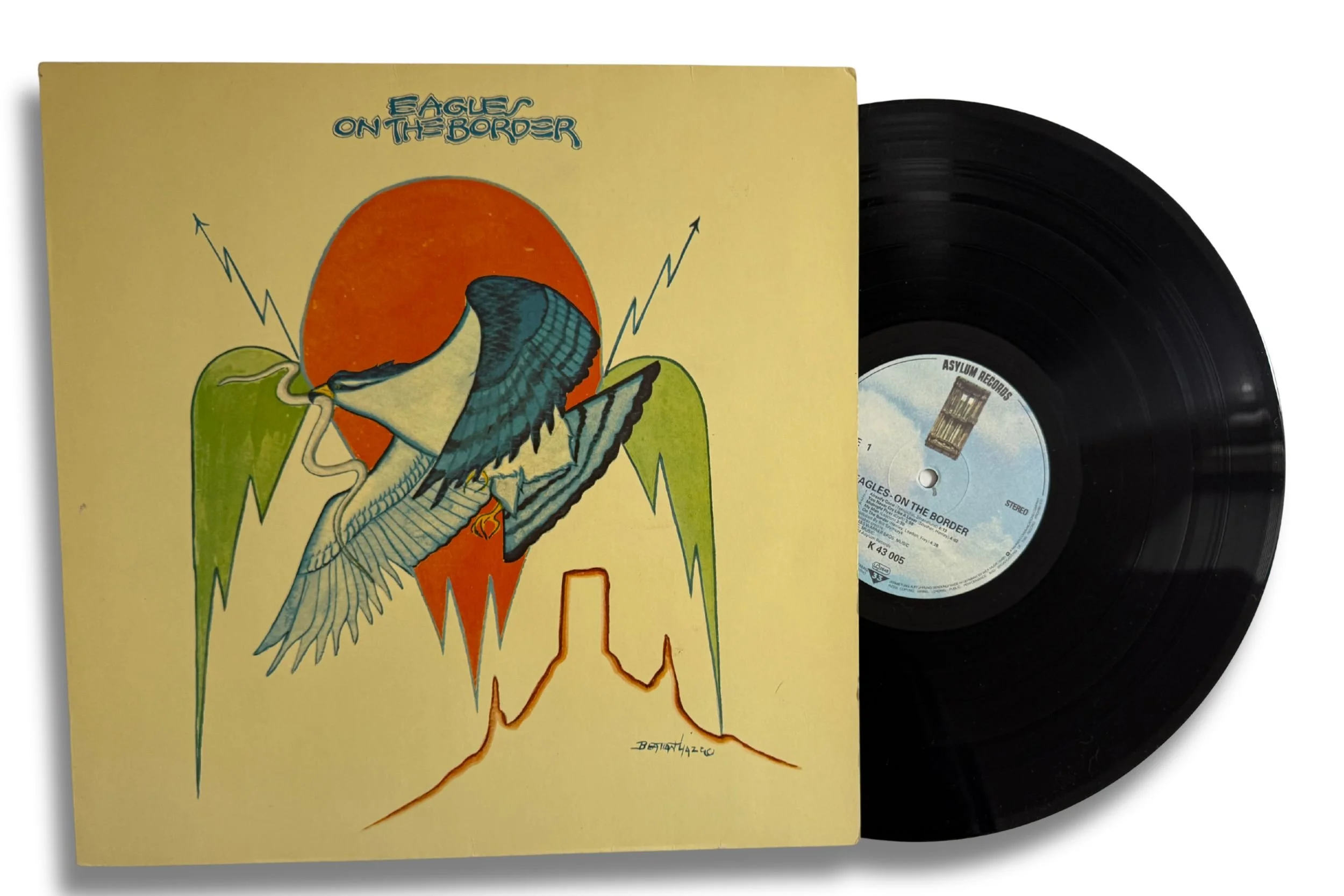
The cover of On the Border moves away from the character-driven outlaw imagery of Desperado and towards a more stripped-back desert aesthetic. The flowing “Eagles” script, first introduced on their 1972 debut, remains in place but is presented more prominently and with greater clarity. As the music tightened and moved toward mainstream rock radio, the visual identity became less theatrical and more direct.
On the Border Key Album Tracks
Already Gone
The closest thing here to a straight-ahead rocker. Confident and built for radio. It remains one of the few tracks from this album that I happily return to.
The Best of My Love
Written by Henley, Frey and J.D. Souther, this became the Eagles’ first Billboard number one in March 1975. It is easily the strongest track on the record. Controlled, melodic and emotionally measured, it hinted at the band’s ability to balance intimacy with mass appeal.
James Dean
Originally left over from the Desperado sessions. Some fans admire its energy. I have never fully warmed to it. It did not chart significantly, though it became a staple of their early live shows.
On the Border
The title track revisits outlaw imagery, but the thematic cohesion of Desperado is absent. What remains is looser and less focused.
You Never Cry Like a Lover
Polished and co-written with J.D. Souther, but not especially memorable within the wider Eagles catalogue.
Is On the Border the Eagles’ Weakest Album?
For me, yes.
Can I call myself an Eagles fan if I do not love all of their albums? I think so. They have been part of my listening life for decades. Hotel California and Desperado still spend time on the turntable. But On the Border is the one I return to least.
It lacks the cohesion of Desperado and the consistency of what followed with One of These Nights. Beyond The Best of My Love and Already Gone, the record feels uneven. It is also the only Eagles album that contains a song I actively dislike, and that inevitably colours my overall view.
Yet it was a necessary transitional record. Without the friction of the London sessions, without the move to Los Angeles, and without the arrival of Don Felder and Bill Szymczyk’s firmer production, the band might never have reached the creative and commercial peak of Hotel California.
On the Border may not be their finest hour, but it is the album that set the stage for what came next. In that sense, its importance outweighs my reservations.
One of These Nights (1975): The Eagles’ Turning Point Album
Released in June 1975, One of These Nights marked the moment the Eagles sharpened both their sound and their identity. Recorded with producer Bill Szymczyk, the album bridged the gap between their early country-rock roots and the darker, more controlled direction that would soon lead to Hotel California.
Released in June 1975 on Asylum Records, the eagles one of these nights album arrived at a moment when the band was moving beyond their country-rock roots and defining the polished California sound that would soon make them one of the biggest acts in the world.
Arriving a year before Hotel California, this landmark album one of these nights became their first No.1 on the US Billboard 200 and confirmed a group reaching full confidence in the studio. Produced by Bill Szymczyk, it brought together tighter songwriting, darker subject matter, and a growing sense of ambition.
Listening from England, it felt like another dispatch from a distant America. Stories of Hollywood, the Sunset Strip, and nocturnal Los Angeles seemed far removed from overcast skies at home, yet the record’s success made those places feel strangely familiar.
Artist: Eagles
Album: One of These Nights
Released: June 1975
Producer: Bill Szymczyk
Studios: Criteria Studios (Miami), Record Plant (Los Angeles)
Label: Asylum Records
Key Songs and Cultural Impact
The album opens with its title track, a moody, slow-burn groove built on Don Felder’s distinctive chord progression. Sung by Don Henley and co-written with Glenn Frey, it captures the dark glamour of mid-70s Los Angeles — desire, danger, and a sense of restless nights that might lead anywhere.
Searchers still ask “who sang One of These Nights?” and “what does it mean?” At its heart it’s a song about chasing passion and release in the neon-lit California night. It remains one of their defining singles, still racking up millions of streams.
The Songs That Shaped One of These Nights
One of These Nights
Written by Don Henley and Glenn Frey, the title track of the one of these nights album captures the dark glamour of mid-Seventies Los Angeles—desire, danger, and a restless sense of nocturnal tension. Built on Don Felder’s distinctive chord progression and driven by Henley’s soaring lead vocal, the song explores the pursuit of passion and escape in the neon-lit California night. Henley described it as a song about an elusive object of desire, "part angel, part devil," while Frey often pointed to the simple procrastination of everyday ambition: promising yourself you will finally chase what you want "one of these nights." With its lush harmonies and brooding groove, it remains one of their defining singles and a masterclass in atmospheric songwriting.Lyin’ Eyes
Perhaps the most enduring song on the album, Lyin’ Eyes tells the story of a young woman who trades freedom for security, only to slip back to the Strip at night in search of escape. Don Henley later linked the song to evenings spent observing the quiet dramas unfolding at Dan Tana’s, just along the street from The Troubadour, where the band watched relationships play out across candlelit tables. That sense of lived-in detail gives the song its credibility, with rich harmonies carrying a narrative that feels grounded rather than theatrical.
Lyin’ Eyes As one of the standout tracks on the one of these nights album, "Lyin’ Eyes" is perhaps the most enduring song in the Eagles' catalogue. It tells the story of a young woman who trades freedom for security, only to slip back to the Sunset Strip at night in search of escape. Don Henley later linked the song to evenings spent observing quiet dramas at Dan Tana’s, just along the street from The Troubadour, where the band watched relationships play out across candlelit tables. That lived-in detail grounds this essential album track with a narrative credibility that elevates it far beyond standard pop storytelling.
Take It to the Limit Serving as a major vocal showcase for bassist Randy Meisner on the one of these nights album, this sweeping ballad quickly became a live concert highlight and one of the Eagles' signature songs. Its yearning for “one more night” of love or freedom captures the soaring ambition of the record, standing as one of the group's most polished studio achievements during their mid-Seventies peak.
journey of the Sorcerer As a banjo-led instrumental, Bernie Leadon’s composition stands distinctly apart from the rest of the one of these nights album. While the wider record signalled the Eagles’ shift toward a tougher, more refined rock sound, this track pulls from their earlier country-rock roots, recalling the looser production style of On the Border. In hindsight, it marks the definitive end of an era for the band. Beyond its role on the album, it holds a special place for British listeners as the iconic theme music for Douglas Adams’ The Hitchhiker’s Guide to the Galaxy on BBC Radio, transforming what once felt out of step into an enduring cult favourite.
I Wish You Peace ends out the album. This gentle acoustic ballad was written by Bernie Leadon alongside his then-girlfriend Patti Davis, daughter of Ronald Reagan. Often overlooked in retrospective reviews, its wistful lyrics and stripped-back arrangement reveal a softer side of the Eagles. With Leadon departing shortly after release, the track functions as an intimate parting gift within the broader arc of the album.
One of These Nights Meaning
The meaning of One of These Nights is two fold. On the surface there is an alluring feeling of attraction. Don Henley suggests there is an object of desire, "part angel and part devil," which captures the tension between attraction, danger, and complexity in a relationship. Co-writer Glenn Frey offers another meaning, “one of these nights” as that feeling of putting something off. “One of these nights I’m gonna do that thing ; one of these nights I am gonna get that girl.”
There is a potential third meaning, almost an in-joke with the band. The recording sessions were long and sometimes arduous as the band sought perfection, “one of these nights we’re gonna finish this record!”
Release and Commercial Impact
One of These Nights was both a critical and commercial success. It sold over four million copies in the US and was nominated for Album of the Year at the 1976 Grammys (losing to Paul Simon’s Still Crazy After All These Years). The single Lyin’ Eyes did win a Grammy for Best Pop Vocal Performance by a Duo, Group or Chorus.
The album’s consistency stood out. Where Desperado and On the Border felt patchy, this was a cohesive, confident work — a band finally arriving at their classic sound.
Album Artwork and Visual Identity
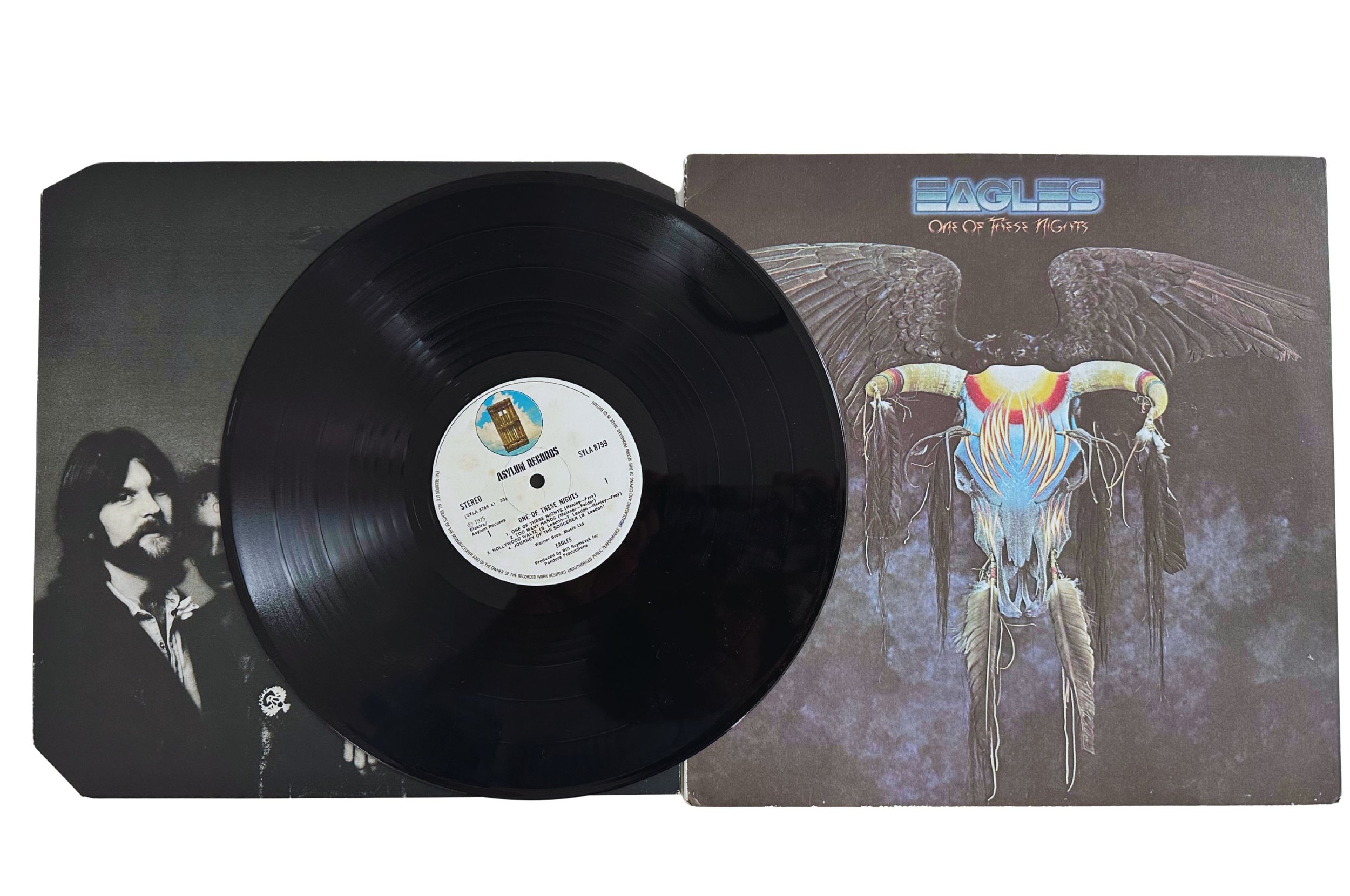
After the Western imagery of Desperado and the looser symbolism of On the Border, One of These Nights established the eagle as the defining visual emblem of the band.
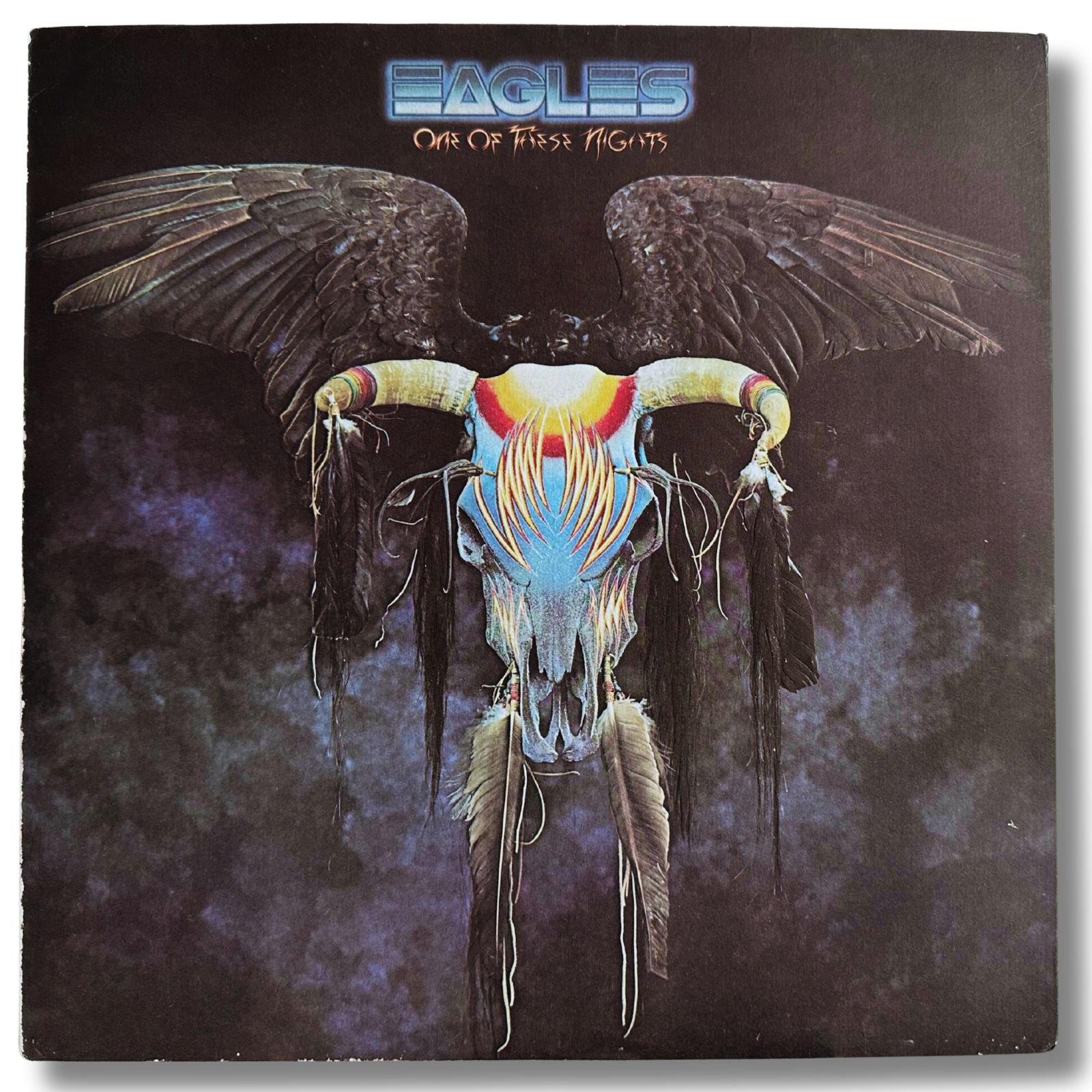
One of These Nights album cover, designed by Boyd Elder, released in 1975
As The Eagles album with the skull on the cover One of These Nights has become one of the Eagles’ most recognisable images. It presents a stylised eagle skull set against a dark, cosmic backdrop, stark and confrontational in tone, and very different from the imagery that had come before.
Designed by Boyd Elder, an artist whose work with painted animal skulls had already begun to attract attention in the American Southwest. His imagery fixed the eagle as a permanent part of the band’s visual identity, one that is still reflected in how the Eagles present themselves today.
One of These Nights marks the point where the Eagles’ direction became clear. Its controlled production, narrative songwriting, and visual identity set the framework for what would follow on Hotel California.
Nearly fifty years later, the album still stands as a precise record of a band arriving at full definition.