
Who Were the Original ELO Members?
Few bands defined the sonic ambition of the 1970s vinyl era quite like the Electric Light Orchestra. With global sales exceeding 50 million records, ELO fused Beatles-inspired pop hooks with sweeping classical arrangements.
What started as an equal partnership between two Birmingham musicians would evolve through artistic differences, soaring success and lawsuits to become the Electric Light Orchestra we know today.
The Founding Trio and the Shared Vision
The idea for the Electric Light Orchestra originated within the late-period line-up of psych-pop group The Move. Multi-instrumentalist Roy Wood wanted to steer rock music into classical terrain, incorporating cellos, violins, and woodwinds. To realise this, Wood invited singer, songwriter, and guitarist Jeff Lynne (then fronting The Idle Race) to join The Move in 1970, on the condition that they would establish a brand-new orchestral-rock outfit alongside drummer Bev Bevan.
The original line-up that formed in late 1970 and recorded their 1971 debut album consisted of:
Roy Wood – Vocals, guitars, cello, oboe, bassoon, recorder, bass
Jeff Lynne – Vocals, guitars, piano, bass
Bev Bevan – Drums, percussion, backing vocals
Bill Hunt – French horn, hunting horn
Steve Woolam – Violin
On that 1971 debut, artistic control was shared right down the middle. Songwriting was divided across the tracklist (Lynne penned tracks like "10538 Overture", while Wood contributed pieces like "Look at Me Now"), and the album sleeve credited production equally: "Produced by Roy Wood and Jeff Lynne."
However, translating this experimental studio project to the stage proved disastrous. In 1972, live sound technology was crude; microphones could not amplify delicate acoustic string instruments over Bevan’s drumming without generating severe feedback. At the same time, the British music press persistently stoked an ego rivalry, debating whether Wood or Lynne was the genuine mastermind.
Tensions came to a head during the early sessions for ELO 2 in July 1972. Realising the band was not large enough for two uncompromising visionaries, Roy Wood walked out, taking Bill Hunt and cellist Hugh McDowell with him to form Wizzard.
The Evolution: Lynne as Songwriter, Producer, and Captain
Wood’s exit changed the structural DNA of the group. While ELO remained an active band, it ceased being an artistic democracy.
From ELO 2 (1973) onwards, Jeff Lynne assumed sole production credit, wrote almost all of the original material, and sang lead vocals. His complete control of the studio console was not merely an ego trip but a practical necessity. Because Lynne heard entire multi-layered arrangements in his head before stepping into the studio, having a single architect write the melodies, map out the harmonies, and run the recording desk became the only way to turn massed classical strings and rock rhythms into coherent records.
Lynne took full charge of the studio process on 1973's On the Third Day and perfected it on 1974's Eldorado. Rather than endlessly overdubbing a handful of live cellos, Lynne hired a full 30-piece orchestra and choir, brought in conductor Louis Clark, and partnered with keyboardist Richard Tandy to arrange the parts.
By 1974, Lynne was the primary songwriter, sole producer, lead singer, and rhythm guitarist. ELO had become an expression of one man's singular studio vision, executed by a crack unit of musicians.
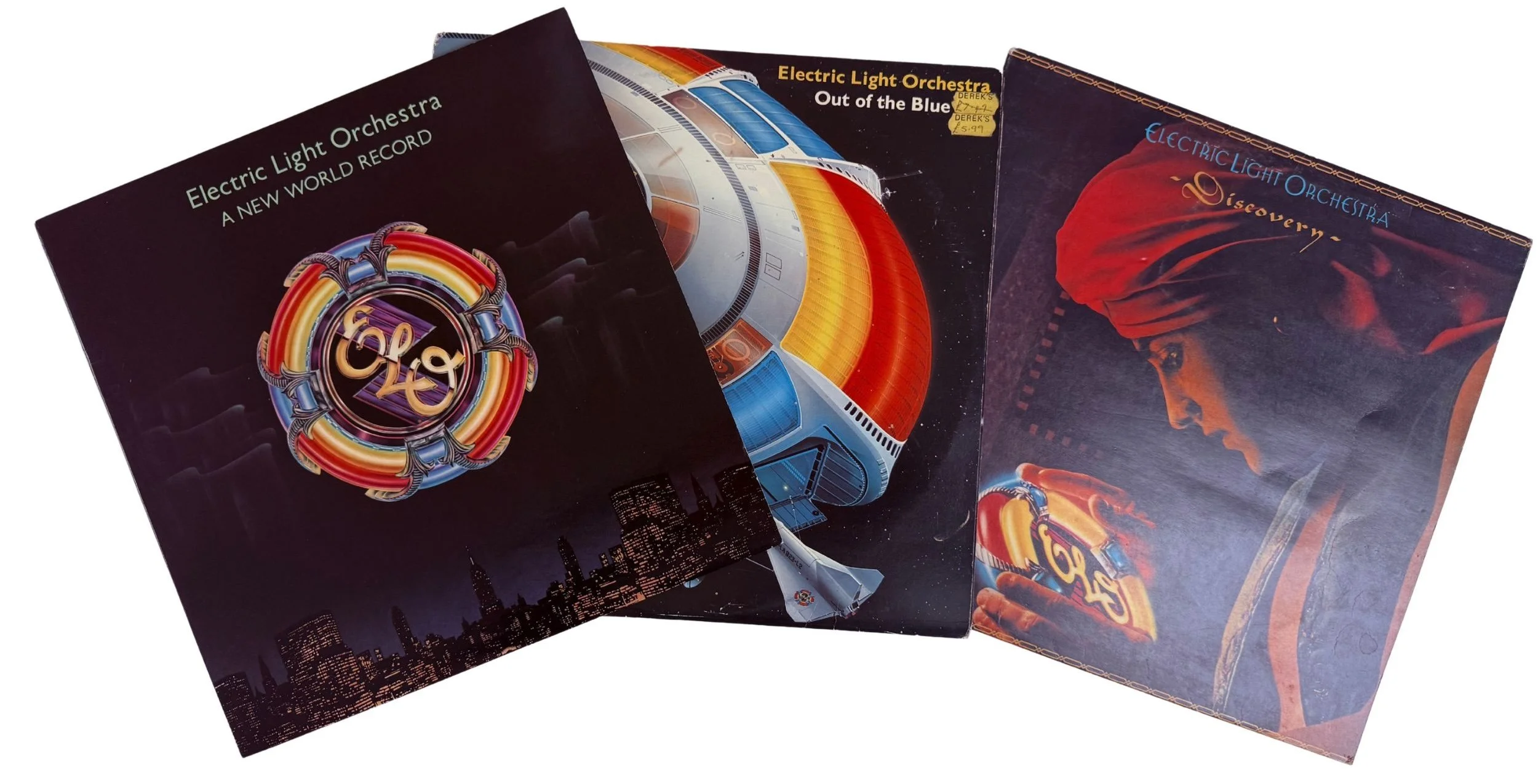
Three Classic ELO albums from my collection
The Classic ELO Line-Up (1974–1979)
With Lynne firmly at the helm, the definitive seven-piece line-up clicked into place in late 1974:
Jeff Lynne – Lead vocals, guitar, sole producer, principal songwriter
Bev Bevan – Drums, percussion, backing vocals
Richard Tandy – Keyboards, synthesisers, vocoder, musical arranger
Kelly Groucutt – Bass guitar, backing vocals, occasional co-lead vocals
Mik Kaminski – Violin
Hugh McDowell – Cello (rejoining after his stint in Wizzard)
Melvyn Gale – Cello
This unit drove ELO’s commercial golden era, releasing a peerless sequence of multi-platinum records: Face the Music (1975), A New World Record (1976), the 1977 double-LP blockbuster Out of the Blue, and the chart-topping Discovery (1979).
While Lynne was the undisputed architect, the band dynamic remained crucial. Kelly Groucutt provided the soaring operatic falsettos and backing harmonies that defined the group's wall-of-sound vocals, while Richard Tandy became Lynne's trusted musical sounding board, translating complex melodic ideas onto synthesisers and keyboards.
Even as Lynne began streamlining studio arrangements during the Munich sessions for Discovery by relying on session players and synthesisers, the classic seven-piece image remained the public face of the band, featuring on the album artwork and performing across the groundbreaking music video album that accompanied the release.
How Old Are the ELO Members Today?
Decades on from their landmark arena tours and giant flying-saucer stage sets, the members of ELO's classic era and founding circle span several generations:
Today:
- Bev Bevan is years old.
- Roy Wood is years old.
- Jeff Lynne is years old.
- Mik Kaminski is years old.
- Melvyn Gale is years old.
- Richard Tandy would be years old today.
- Kelly Groucutt would be years old today.
- Hugh McDowell would be years old today.
Electric Light Orchestra Birthdays:
- Bev Bevan:
- Kelly Groucutt:
- Roy Wood:
- Jeff Lynne:
- Richard Tandy:
- Mik Kaminski:
- Melvyn Gale:
- Hugh McDowell:
The Turning Point: Streamlining the Band and Xanadu
By 1980, the transition from an orchestral collective to a streamlined studio engine was complete. Lynne officially parted ways with the classical string section of Kaminski, McDowell, and Gale, reducing ELO to a four-piece rock unit of Lynne, Bevan, Tandy, and Groucutt.
The ultimate demonstration of this shift came with the 1980 film soundtrack Xanadu. Tracks like "I'm Alive", "All Over the World", and the UK Number 1 title track with Olivia Newton-John were essentially Jeff Lynne solo projects backed by his trusted studio unit, confirming that ELO had become an engine for his singular vision.
Internal Friction, Royalties, and the ELO Name
Operating as a streamlined unit did not insulate the band from internal disputes over money and identity. The 1980s saw two major legal battles that permanently fractured member relationships.
The first came in 1983 when bassist Kelly Groucutt discovered his contract paid him as an employee rather than an equal legal partner. Following Secret Messages, Groucutt sued Jeff Lynne and Jet Records for £300,000 in unpaid royalties. Settled out of court, the lawsuit severed his relationship with Lynne permanently and ended his tenure in the group.
A larger battle followed when Lynne paused the band after 1986's Balance of Power. Co-founding drummer Bev Bevan, who held a 50% legal stake in the group's name, wanted to keep touring and formed Electric Light Orchestra Part II in 1989 alongside former members Mik Kaminski, Kelly Groucutt, and Hugh McDowell. Lynne opposed the venture, eventually agreeing to a settlement allowing Bevan to tour only as long as Bevan personally performed. When Bevan retired in late 1999, he sold his 50% ownership share of the trademark back to Lynne, ending ELO Part II (who rebranded as The Orchestra) and returning undivided ownership of the ELO name to Jeff Lynne.
Where ELO Members Went Next
Away from the ‘light, the group's classic and founding members forged distinctive paths of their own across rock history. Co-founder Roy Wood found immediate commercial glory with Wizzard, scoring consecutive UK Number 1 singles alongside his perennial festive staple "I Wish It Could Be Christmas Everyday". Drummer Bev Bevan took a heavier musical turn in the mid-1980s, stepping behind the kit for Black Sabbath on their 1983–1984 Born Again album and tour before launching ELO Part II, while keyboardist Richard Tandy remained Lynne's most enduring collaborator, playing on Lynne's solo projects and returning for the 2014 emergence of Jeff Lynne's ELO.
For Jeff Lynne a focus on production would come to define late-eighties classic rock. Lynne co-produced George Harrison's hit 1987 comeback album Cloud Nine, an alliance that directly led to co-founding the multi-platinum supergroup The Traveling Wilburys. This friendship with Harrison when the remaining Beatles recruited Lynne to produce "Free as a Bird" and "Real Love" for The Beatles Anthology. For Lynne, helming those landmark sessions brought his career entirely full circle: from co-founding ELO to pick up where “I am the Walrus” left off, to taking up producing the Beatles in the 1990’s.
"Faded like the Beatles on 'Hey Jude'.