Pink Floyd’s Animals: Meaning, Music, and the 2018 Remix
An analysis of the album, its socio-political themes, and the history behind that unforgettable Battersea Power Station artwork.
Wedged between the massive success of Wish You Were Here and the global dominance of The Wall, Pink Floyd’s Animals can sometimes feel like the overlooked sibling. Yet this 1977 record remains one of the most direct, fierce and socially pointed albums in their catalogue. For listeners asking what Animals by Pink Floyd is about, the answer lies in its biting socio-political allegory. Drawing inspiration from George Orwell’s Animal Farm, the record recasts society into dogs, pigs and sheep through sprawling progressive rock arrangements. Driven by David Gilmour’s biting guitar work and Roger Waters' dystopian song structures, the result is a sharp look at ambition, manipulation and the danger of simply drifting with the crowd. While the record is often remembered for its striking visual presentation, the music establishes a powerful thematic foundation beside Wish You Were Here and foreshadows the darker, angrier writing that would take full form on The Wall and The Final Cut.
This was also a pivotal moment in the band’s own trajectory. Recorded at Britannia Row Studios in North London (one of London’s Lost Recording Studios), their newly built space gave them total control. The dreamy textures of Dark Side and the introspective warmth of Wish You Were Here were replaced by harder guitars, sharper lyrics and some of Nick Mason’s most powerful drumming.
What Is the Meaning of Animals by Pink Floyd?
To fully grasp the Pink Floyd Animals meaning, one must look at how the record divides society into three distinct groups. Rather than a simple collection of songs, the Animals album meaning functions as a harsh critique of modern capitalism, manipulation, and blind obedience. Each movement examines a specific slice of societal corruption in detail:
'Dogs': The Corporate Predators
These are the cutthroat operators of the world—people who climb through charm, calculation and self-interest until they eventually collapse under the weight of their own choices. The composition is long, bleak and brilliantly constructed. David Gilmour’s vocals and guitar work drive the piece, but it is the middle instrumental section that always stood out for me. Nick Mason’s kick drum becomes a steady, thumping heartbeat while distant canine effects echo around it. It creates a tense and unsettling atmosphere, exactly as intended.
“You gotta sleep on your toes, and when you’re on the street / You gotta be able to pick out the easy meat with your eyes closed” — Dogs
'Pigs': The Moral Hypocrites
Here are the figures who try to control, influence or moralise. Waters went after censors, politicians and the sanctimonious voices of the day, including Mary Whitehouse. Musically, this socio-political anger translates into classic mid-seventies rock aggression; Gilmour’s talkbox guitar gives the track an aggressive snarl, matching Waters’ frustration with those who preach one thing while doing another.
“Big man, pig man / Ha, ha, charade you are” — Pigs
'Sheep': The Blind Followers
If the first two movements represent active forces, Sheep focuses on the passive followers who drift along without question. It begins more gently, almost pastoral, before building into something far more forceful. The narrative turns from resignation to revolt as the sheep finally push back against those who have controlled them. It remains one of the most surprising transitions on the album.
“Only dimly aware of a certain unease in the air” — Sheep
Despite the heavy subject matter, the album is not depressing. It feels alive. Animals is muscular, intense and purposeful, carrying a conceptual weight that rewards deep, repeated listening.
Is Animals Still Relevant Today?
Completely. In many ways it feels even more current. The themes of manipulation, media influence and blind obedience remain familiar. The names have changed, the platforms have changed, but the underlying behaviours have not. Waters has continued to highlight this in his live shows. At Desert Trip in 2016, Pigs was performed against a giant caricature of Donald Trump. On the more recent This Is Not a Drill tour, the sheep were singled out for accepting the status quo before finally turning against their tormentors. The anger driving the album is not stuck in 1977.
Animals and Battersea Power Station
The album’s imagery is inseparable from its music and meaning. The concept for the cover was to fly an inflatable pig over Battersea Power Station. Roger Waters could see the power station from his home and thought the active, stark industrial backdrop perfectly suited the capitalist powerhouse themes of the record.
The shoot was booked, the airspace was closed, and the concert pig was launched. On the second day of shooting, it broke free of its chains and drifted toward Heathrow, causing genuine concern for air traffic and leaving the designers at Hipgnosis without the shot they wanted. That is why the final iconic artwork features a painted composite.
That image has since become one of the most recognisable in rock history. The connection between the power station and the album has never faded. For many music fans, including me, it remains a key London rock landmark. Today there is even a small plaque at the redeveloped Power Station complex commemorating the connection.
The 2018 Remix of Animals
The long-delayed 2018 remix was finally released in 2022, and it genuinely improves the listening experience of this classic album. The contrast between instruments is stronger, the overall sound is sharper and clearer, and you notice far more subtlety in Nick Mason’s incredible drumming. I often struggle to hear meaningful differences in modern remixes, but this version stands out. It sharpens the edges of the original without losing its atmosphere. To celebrate the release, the chimneys of Battersea Power Station were lit up one clear September evening, creating a visual echo of the album’s legacy.
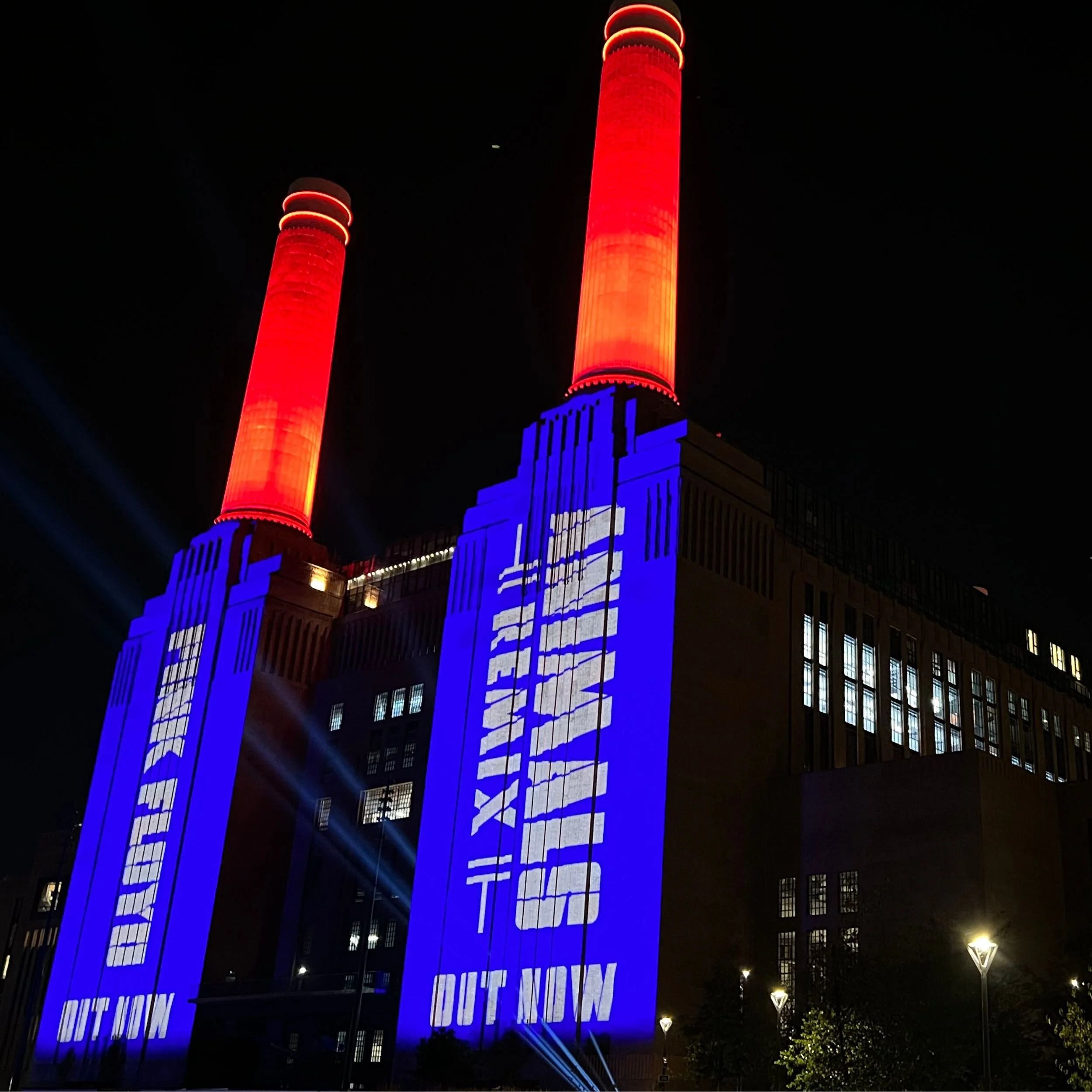
A close-up view of the iconic London landmark glowing in red and blue, celebrating the arrival of Pink Floyd’s Animals remix.

Battersea Power Station lit up against the London night sky, featuring the striking blue projections and illuminated red chimneys that marked the release of the long-awaited Animals remix.
Where Was the 2018 Animals Redux Cover Photo Taken?
We all recognise the original cover, with Battersea Power Station viewed from a distance beneath a heavy London sky. The remix introduces a new image, taken from a different angle, showing the building beneath a pile of cranes during its redevelopment. I set out to discover where it was photographed to capture my own version. It adds another layer to the ongoing story of an album deeply connected to one of London's most striking structures.
Forty-five years after its release, Pink Floyd's Animals still sounds as fresh, clear, and relevant as ever before. It is a vinyl record I return to regularly, finding inspiration from every track.